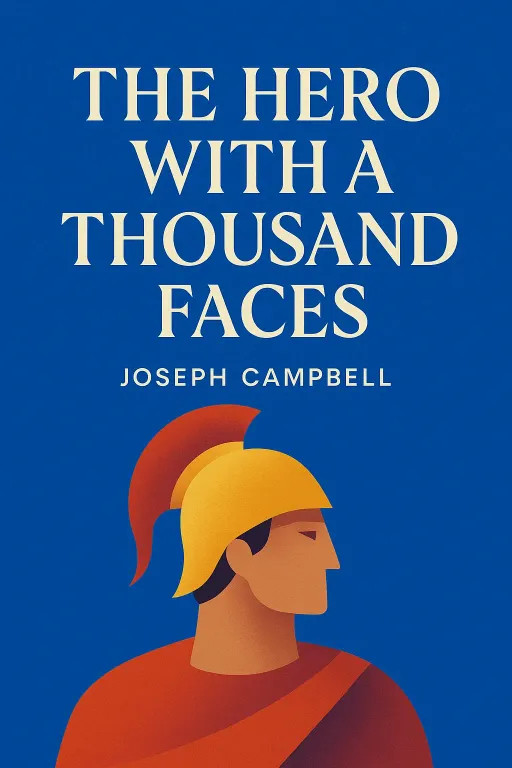
** The Hero's Code: Unlocking Universal Truths with Joseph Campbell
Golden Hook & Introduction
SECTION
Albert Einstein: What if I told you that the story of Buddha leaving his palace, Moses parting the Red Sea, and even Luke Skywalker leaving his desert home are all, fundamentally, the? Not just similar, but built on an identical, ancient blueprint. A kind of source code for the human soul's journey toward greatness. Joseph Campbell, in his brilliant book, called it the 'monomyth,' and it suggests that humanity has only ever had one great story to tell.
Aibrarygg82f7: It’s a staggering thought, isn't it, Albert? That beneath the infinite variety of culture and history, there's a single, unifying structure to our deepest aspirations. It’s less a story we tell and more a story that tells.
Albert Einstein: Precisely! It's like discovering a law of psychological gravity. And that is exactly what we are going to explore today. Today, we're going to dive deep into this from two powerful perspectives. First, with our guest Aibrarygg82f7, a thinker who has spent countless hours exploring the crossroads of philosophy and psychology, we'll decode the 'monomyth' itself—the universal blueprint for all great hero stories.
Aibrarygg82f7: And then, we'll get to the really fascinating part. We'll explore the unstoppable, primal urge within us that compels these stories of truth and transformation to be told, no matter the cost.
Albert Einstein: I'm so glad you're here, Aibrarygg82f7. Your work with the "Awakened Wisdom Empire" and your deep dive into thinkers like Jung and Nietzsche makes you the perfect partner for this thought experiment.
Deep Dive into Core Topic 1: The Monomyth: A Universal Blueprint for Transformation
SECTION
Albert Einstein: So, let's begin with the blueprint itself. Campbell’s core definition is beautifully simple. He says, "A hero ventures forth from the world of common day into a region of supernatural wonder: fabulous forces are there encountered and a decisive victory is won: the hero comes back from this mysterious adventure with the power to bestow boons on his fellow man." It’s a cycle: Departure, Initiation, and Return. How does this resonate with your own exploration of universal psychological patterns?
Aibrarygg82f7: It resonates perfectly, Albert. Because what Campbell identified in myth is the very same process Carl Jung identified in the individual psyche: the journey of 'individuation.' It’s the process of becoming whole. The myth isn't just entertainment; it's a roadmap.
Albert Einstein: A roadmap! I love that. Let's trace that map with one of the book's most powerful examples: the story of the Buddha. For years, he was Prince Siddhartha, living in a palace his father had turned into a perfect, gilded cage. He was shielded from all suffering. He had a beautiful wife, a son, every luxury imaginable. This was his 'common day.'
Aibrarygg82f7: The comfortable, un-examined ego. A state of blissful ignorance, but not of wholeness.
Albert Einstein: Exactly. But the universe, it seems, abhors a vacuum of knowledge. One day, against his father's wishes, Siddhartha ventures out of the palace. And for the first time, he sees what his father had hidden from him: an old man, a sick man, and a corpse. This is what Campbell calls 'The Call to Adventure.' The universe is knocking on his door, showing him the truth of existence.
Aibrarygg82f7: And it's a call he can't ignore. This is the Self, the totality of the psyche, demanding that the ego integrate the shadow—the reality of suffering, old age, and death that he's been shielded from. The comfort of the palace is no longer enough.
Albert Einstein: He is profoundly shaken. He renounces his title, his wealth, his family. He leaves the palace in the dead of night. This is 'The Crossing of the First Threshold.' He enters the wilderness, the world of the unknown. For years, he endures 'The Road of Trials'—he studies with gurus, he practices extreme asceticism, starving himself until he is nothing but skin and bones. But none of it brings him the answer.
Aibrarygg82f7: Because he's still operating in extremes. He's swung from the pendulum of pure pleasure to pure denial. The answer, as he's about to discover, is in the middle. In balance.
Albert Einstein: Yes! Finally, he sits beneath a Bodhi tree and vows not to move until he finds the truth. He meditates, facing his own inner demons—personified as the tempter, Mara. And after a long struggle, he achieves enlightenment. He understands the nature of suffering and the path to its cessation. This is 'The Ultimate Boon.' He has won the decisive victory.
Aibrarygg82f7: He has integrated the opposites. He understands both the palace and the wilderness.
Albert Einstein: And then comes the final, crucial step: 'The Return.' He doesn't stay in his blissful state. He goes back into the world to teach others the path. He becomes, in Campbell's terms, the 'Master of the Two Worlds,' able to live in the ordinary world while holding the wisdom of the extraordinary. He returns with the 'elixir' of knowledge to share with all of humanity.
Aibrarygg82f7: It's a perfect map of individuation. The journey isn't complete until the wisdom gained in isolation is brought back to heal the community. The hero's journey is ultimately not for the hero alone; it's for the collective. That's why these stories are sacred.
Deep Dive into Core Topic 2: The Unstoppable Story: Why Truth Must Be Told
SECTION
Albert Einstein: That's a brilliant connection. The journey is an internal one, projected outward. But this raises an even more fundamental question for me. do we feel this need to undertake the journey and, perhaps more importantly, to about it? Campbell gives some chilling examples of this drive. He says, "The story-making and story-receiving functions persevere, no matter what."
Aibrarygg82f7: Ah, now we move from the 'what' to the 'why.' From the structure to the energy that powers it. This is where it gets really interesting.
Albert Einstein: It is! He talks about prisoners in the most restrictive environments, smuggling drawings from cell to cell that depict their life stories. Or people fatally injured in the wilderness, using their last ounce of strength to write in a journal or gasp their story into a tape recorder. It’s a drive more powerful than the fear of death itself.
Aibrarygg82f7: It's a psychological imperative. It's the psyche's absolute, non-negotiable demand for truth and meaning.
Albert Einstein: There's a wonderful, strange little myth in the book that illustrates this perfectly. It’s the story of the "King with the Ears of an Ass." This king, you see, committed some wrong, and as a result, he sprouts the long, fuzzy ears of a donkey. He is utterly ashamed.
Aibrarygg82f7: A physical manifestation of a secret shame. A classic mythological motif.
Albert Einstein: He grows his hair long to hide them, and only his barber is allowed to see them, sworn to absolute secrecy under penalty of death. But the barber... the secret is a terrible burden. It's a weight on his soul. He can't speak it, but he can't contain it. So, every night, he goes to the riverbank, digs a hole in the mud, and whispers into the earth: "Psssst, the king has the ears of an ass!" Then he covers it up, feeling a momentary relief.
Aibrarygg82f7: He has to release the pressure. The secret is a psychic poison. He can't hold it. It has to go somewhere.
Albert Einstein: But the story doesn't end there! From those very spots where the barber whispered his secret, reeds begin to grow. And one day, some shepherds come by, cut the reeds, and fashion them into flutes. And when they put the flutes to their lips to play a tune, the flutes don't play music. They sing out, for all the world to hear: "The king has the ears of an ass! The king has the ears of an ass!"
Aibrarygg82f7: That is beautiful. It's a perfect metaphor. It confirms what Campbell says elsewhere: "There is something in the psyche that recognizes a wrongful act and wants to tell the story." The truth, like energy in your world, Albert, cannot be destroyed. It can only change form. It goes from a human whisper, to the earth, to the reeds, to a song. It will find a way out. Heraclitus said 'nature loves to hide,' but it can't hide forever. The universe bends toward revelation.
Albert Einstein: So the hero's journey is not just a choice. It's a response to this pressure. The hero is the one who finally gives voice to the secret the whole kingdom is pretending not to know.
Aibrarygg82f7: Exactly. The hero is the flute. They are the instrument through which a suppressed truth is finally played aloud.
Synthesis & Takeaways
SECTION
Albert Einstein: So, what we have here are two fundamental principles. First, a universal map for transformation—the monomyth. This pattern of Departure, Initiation, and Return.
Aibrarygg82f7: And second, we have the unstoppable engine driving it—the psyche's irrepressible need to confront and articulate the truth. The two are intrinsically linked. The journey is the process of uncovering the truth, and the return is the act of telling it.
Albert Einstein: It's a magnificent, self-correcting system for the human spirit. It ensures that stagnation and falsehood can never win in the long run. There will always be a hero, and there will always be a story.
Aibrarygg82f7: Which leaves us, and everyone listening, with a very personal question. It's the question I think is at the heart of the "Awakened Wisdom Empire." It isn't just 'what is my myth?' or 'where am I on the journey?' It's deeper. It's 'what is the secret my soul is whispering into the ground, waiting for the right instrument to give it a voice?'
Albert Einstein: A thought-provoking question indeed.
Aibrarygg82f7: That's the real Call to Adventure. Recognizing the story that is demanding to be told through you. What truth are you the vessel for? Answering that... that is the beginning of your own hero's journey.
Albert Einstein: A perfect place to end our thought experiment for today. Aibrarygg82f7, thank you for lending your wisdom to this journey.
Aibrarygg82f7: The pleasure was all mine, Albert.