Personalized Podcast
Golden Hook & Introduction
SECTION
Nova: Have you ever wondered why humans are so obsessed with stories? Even in the most desperate situations—prisoners in solitary, or explorers dying alone in the wilderness—people will use their last ounce of strength to draw a picture, write a note, or whisper into a recorder. It’s a drive that seems almost more fundamental than survival itself. What if that impulse isn't just a quirk, but a key to understanding how we, as a species, navigate our greatest challenges?
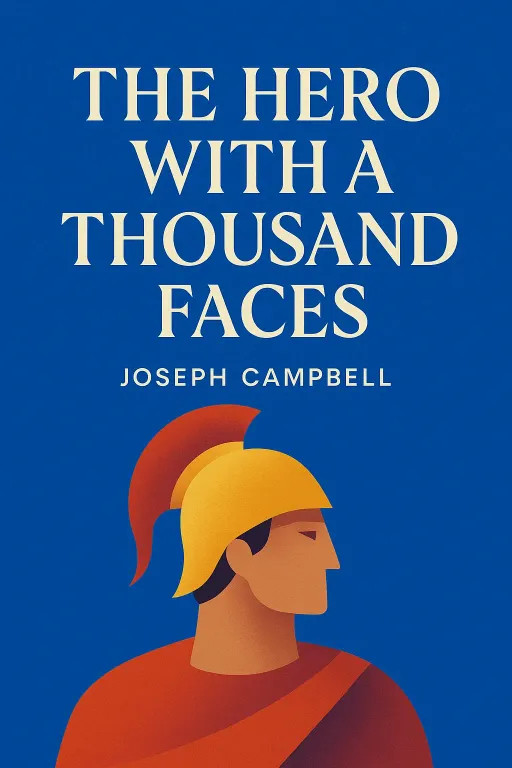
Nova: Welcome to the podcast. In his masterwork, "The Hero With a Thousand Faces," the great mythologist Joseph Campbell argues that this storytelling drive reveals a universal pattern for transformation. Today, we're going to explore this from two angles. First, we'll look at the primal, unstoppable human need to tell stories, especially stories of truth and injustice. Then, we'll decode the universal pattern hidden within these stories—the Hero's Journey—and see how it can serve as a map for anyone trying to change the world. And I'm thrilled to have the perfect person here to explore this with me. OSTRICH is an aspiring economist and a climate action enthusiast, a true visionary thinker. OSTRICH, welcome.
OSTRICH: Thanks for having me, Nova. I'm excited. It's a fascinating intersection of ideas.
Nova: It really is. Your work involves looking at huge, complex systems, and I think Campbell gives us this incredible, almost psychological, lens to understand the dynamics of change within those systems.
Deep Dive into Core Topic 1: The Unstoppable Story
SECTION
Nova: So let's start with that first idea, OSTRICH. This almost biological need to tell a story. Campbell brings this to life with some incredible, and frankly, haunting examples. He talks about how, in prisons, inmates will create these little paintings, almost like religious offerings, called ex-votos. They use whatever materials they can find, and these artworks depict crucial moments from their lives—successes, failures, brushes with death. They then smuggle these paintings from cell to cell. It's a visual language, a way of telling their story when no other means are available. The drive to share their experience, to be heard, just perseveres.
OSTRICH: That’s amazing. It’s not for profit, not for fame. It’s a fundamental need to communicate one's existence and experience. It’s a form of data transfer, in a way, but deeply human.
Nova: Exactly. It’s data with a soul. And it gets even more interesting when the story involves a secret, especially a secret about a wrongdoing. Campbell tells this brilliant old folktale about a king who, after committing some terrible wrong, grows the ears of a donkey.
OSTRICH: Okay, I'm listening.
Nova: So, the king is obviously horrified and deeply ashamed. He grows his hair long to hide the ears from everyone. But he has one problem: he needs a haircut. So he brings in his royal barber, swears him to absolute secrecy on pain of death, and lets him do the job. The barber sees the ears, is terrified, and promises never to tell a soul. But the secret… it eats away at him. It’s this heavy, psychological burden. He can't hold it in.
OSTRICH: The pressure of knowing the truth.
Nova: Precisely. So, to relieve the pressure without breaking his oath directly, the barber goes down to the riverbank every night, digs a hole in the mud, and whispers into it, "Psssst, the king has the ears of an ass!" Then he covers it up and feels a little better. But then, reeds begin to grow in that exact spot. A little while later, some shepherds come by, cut the reeds to make flutes, and when they start to play them… the music that comes out is the whisper itself. The flutes sing, for all the kingdom to hear, "The king has the ears of an ass!"
OSTRICH: Wow. That's such a powerful metaphor. The secret of the 'wrongful act' has to come out. It's like the earth itself won't keep the secret. It reminds me of the pressure on whistleblowers in corporations or government agencies that are hiding environmental damage.
Nova: Tell me more about that connection.
OSTRICH: Well, the barber is the insider who knows the truth. The burden is immense. The 'reeds' in the story are like the anonymous leaks to journalists or posts on social media. They are the channels that truth will inevitably find, even when the official channels are blocked. The system itself, in a way, wants the truth to be told to correct the injustice.
Nova: That’s a perfect modern parallel. Campbell says, and I'm quoting here, "There is something in the psyche that recognizes a wrongful act and wants to tell the story of how it came about and what action ought be undertaken to correct it." It's a drive for correction.
OSTRICH: And in climate action, that's the whole battle, isn't it? It's a narrative war. For decades, the 'wrongful act' of pollution and its consequences was a secret whispered into the 'ground' of scientific journals. Now, the 'reeds' are singing everywhere—through activists, through extreme weather events, through public consciousness—and the king, the old system, can't hide his ears anymore. The story is out.
Deep Dive into Core Topic 2: The Monomyth as a Blueprint for Change
SECTION
Nova: And that idea of a story forcing a correction is the perfect bridge to our second topic. Because Campbell discovered that these stories of change aren't random. They follow a map. He analyzed myths from every corner of the world and found a single, underlying pattern. He called it the 'Monomyth,' or what we now often call the Hero's Journey.
OSTRICH: The classic structure we see in movies like Star Wars.
Nova: Exactly! And George Lucas was a direct student of Campbell's work. The core definition Campbell gives is this: "A hero ventures forth from the world of common day into a region of supernatural wonder: fabulous forces are there encountered and a decisive victory is won: the hero comes back from this mysterious adventure with the power to bestow boons on his fellow man." It's a cycle: Departure, Initiation, and Return.
Nova: To make this real, let's look at one of his prime examples: the story of the Buddha. Prince Siddhartha Gautama lives a perfectly sheltered life in a palace. His father, the king, ensures he never sees sickness, old age, or death. That's the 'common day,' the ordinary world.
OSTRICH: A comfortable, but incomplete, reality. A system that is stable but based on ignorance. That feels very relevant to our current economic models.
Nova: That's a fantastic connection. So, one day, Siddhartha ventures outside the palace walls and for the first time, he sees an old man, a sick man, and a corpse. This is his 'Call to Adventure.' The reality of suffering shatters his known world. He can't stay in the palace any longer. He renounces his title, his wealth, his family, and crosses the threshold into the unknown world to seek an answer to suffering.
OSTRICH: He leaves the system. He rejects the status quo because he's seen a truth it was designed to hide.
Nova: Precisely. Then comes the 'Initiation.' He faces years of trials—extreme asceticism, starvation, temptation. This is the 'Road of Trials.' Finally, he sits under the Bodhi tree, defeats the demon Mara, and achieves enlightenment. That's the 'Ultimate Boon,' the decisive victory. He has found the answer. But the journey isn't over.
OSTRICH: Right, he has to return.
Nova: Yes, the 'Return.' He goes back into the world to teach the Dharma, the path to liberation from suffering. He brings the 'elixir' of his knowledge back to bestow it on his fellow man. That completes the cycle.
OSTRICH: So, if we apply that framework, what's the 'Call to Adventure' for an economist or a climate activist today?
Nova: That’s the question! What do you think?
OSTRICH: I think it's the data. It's the IPCC report. It's the undeniable scientific consensus that the 'palace' of our fossil-fuel-based economy is unsustainable. The 'call' is the piercing realization that we can't stay here. It's a moral and an analytical imperative.
Nova: And the 'Refusal of the Call'? That's a key stage too. The hero often hesitates.
OSTRICH: Oh, the 'Refusal of the Call' is what we see every day. It's political inertia, it's corporate lobbying, it's public apathy. It's the deep, powerful desire to stay in the comfortable, known world, even when we know it's flawed or even doomed. It’s easier to pretend the call never came.
Nova: So what does the 'Return with the Elixir' look like in this context? What's the boon the hero brings back?
OSTRICH: It would be a new system. A working model for a circular economy, a policy for a just transition, a technology for clean energy that is scalable and affordable. It's not a magic potion; it's a new, functioning paradigm. But Campbell's framework is so powerful because it reminds us that bringing the solution back and getting society to accept it is often the hardest, most perilous part of the entire journey. The hero is often misunderstood or rejected upon their return.
Nova: Because they are trying to change the very world they left, and the world resists change.
OSTRICH: Exactly. The elixir can taste like poison to those who are still comfortable in the old palace.
Synthesis & Takeaways
SECTION
Nova: This is all so illuminating. So, to bring it all together, Campbell gives us these two incredible ideas. First, we have this deep, psychological need to tell stories of truth, a force that can expose the 'donkey ears' of a flawed system. And second, the stories of true, transformative change often follow a universal map—a journey out of a flawed 'known' and into a difficult 'unknown' to bring back a solution.
OSTRICH: You know, what I'm really taking from this is a sense of perspective. For anyone trying to innovate, to push for change, whether in finance or climate or any field... that feeling of being lost, or facing immense resistance, or being misunderstood—it isn't a sign of failure. It's a documented, predictable stage of the journey.
Nova: It's a feature, not a bug.
OSTRICH: It's a feature, not a bug, of transformative work! Knowing you're on 'The Road of Trials' or in the 'Belly of the Whale,' as Campbell calls it, can be incredibly empowering. It reframes struggle as progress. It means you've actually left the palace.
Nova: That is a perfect way to put it. It’s a roadmap that gives you courage because you know where you are on the path, even if it's a dark part of the forest. OSTRICH, this has been an absolutely fantastic conversation. Thank you so much for bringing your perspective.
OSTRICH: Thank you, Nova. It's given me a whole new framework to think about the challenges ahead.
Nova: So for everyone listening, we'll leave you with that question to ponder, inspired by OSTRICH's insight: What 'call to adventure' are you hearing in your own world? And are you ready to cross the threshold?