

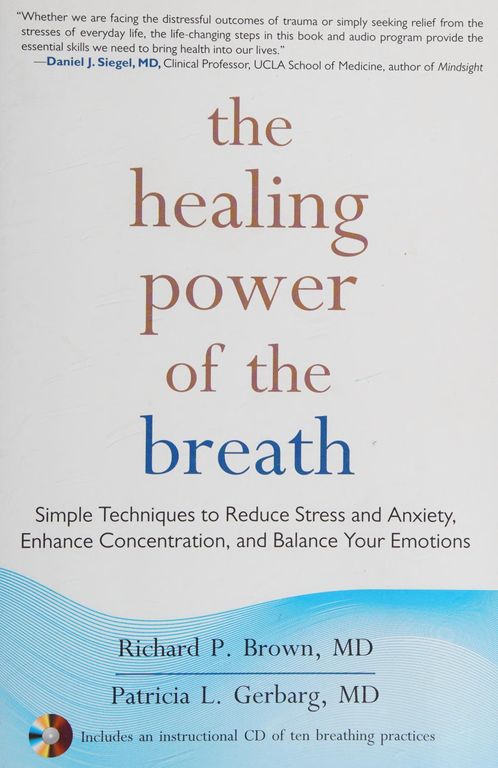
The healing power of the breath
Introduction
Nova: Think about the last time you were really stressed. Maybe your heart was racing, your palms were sweaty, and your mind was just spinning in circles. What was the first thing someone told you to do?
Nova: It sounds too simple, right? But today we are diving into a book that argues breathing is actually the most powerful manual override we have for our entire nervous system. We are talking about The Healing Power of the Breath by Dr. Richard P. Brown and Dr. Patricia Gerbarg.
Nova: Exactly. They have spent decades researching how specific breathing patterns can treat everything from everyday anxiety to severe PTSD in survivors of 9/11 and natural disasters. They have found that by changing how you breathe, you can literally change the signals your body sends to your brain.
Nova: Precisely. And today, we are going to break down the science of why this works, the specific techniques they recommend, and how you can start using them today to find a sense of calm you might not have felt in years.
Key Insight 1
The Science of the Vagus Nerve
Nova: To understand why breathing is so powerful, we have to talk about the Vagus nerve. Dr. Brown and Dr. Gerbarg call it the information superhighway of the body.
Nova: It really is! But for good reason. It is the longest nerve in your autonomic nervous system, stretching from your brainstem all the way down to your abdomen. It touches almost every major organ along the way.
Nova: Think of your nervous system as having two modes: the sympathetic, which is your gas pedal or fight-or-flight, and the parasympathetic, which is your brake or rest-and-digest. The Vagus nerve is the primary component of that braking system.
Nova: Exactly. But here is the catch: you cannot just tell your heart to slow down or your digestion to start working again through sheer willpower. You cannot think your way into a lower heart rate.
Nova: That is because those functions are involuntary. However, breathing is the only part of the autonomic nervous system that is also under our voluntary control. We do it automatically, but we can also choose to change it.
Nova: That is a perfect analogy. When you breathe in a specific way, you send a signal through the Vagus nerve directly to the brain's emotion-processing centers. You are essentially telling your brain, hey, the body is breathing slowly and rhythmically, so we must be safe. The brain then responds by lowering stress hormones like cortisol.
Nova: And that is what Dr. Brown and Dr. Gerbarg are trying to fix. They found that most of us are chest-breathing, which is shallow and rapid. That actually keeps us in a state of low-grade fight-or-flight all day long. We are essentially telling our brains there is a tiger nearby twenty-four hours a day.
Key Insight 2
The Gold Standard: Coherent Breathing
Nova: If there is one thing you take away from this book, it is the concept of Coherent Breathing. This is the cornerstone of their entire program.
Nova: It is all about the rhythm and the rate. Through their research, they discovered that for most adults, there is a sweet spot where the heart, lungs, and brain all enter a state of resonance. That spot is usually between four and a half and six breaths per minute.
Nova: Most people do! But when you slow it down to that five-to-six range, something magical happens. Your Heart Rate Variability, or HRV, increases. HRV is basically the measure of how flexible your nervous system is. A high HRV means you can bounce back from stress easily.
Nova: Exactly. The standard practice they recommend is a five-second inhale and a five-second exhale. No holding the breath, no pausing. Just a smooth, continuous circle of air. In for five, out for five.
Nova: That is a common reaction! Dr. Brown emphasizes that you should never strain. If five seconds feels too long, start with three or four and work your way up. The goal is to make it feel like a gentle wave, not a workout. They even suggest using a chime or a track to keep the pace so you do not have to count in your head.
Nova: It is based on the physics of the body. At that rate, the natural fluctuations in your heart rate align perfectly with your breathing. It creates a state called coherence, where your systems are working in total harmony. It is like tuning a radio to the exact right frequency to get a clear signal.
Nova: They recommend starting with twenty minutes a day for maximum benefit, but they also say even five minutes can shift your state. The best part is you can do it anywhere. You can do it in a meeting, while driving, or while standing in line. No one even has to know you are doing it.
Key Insight 3
Resistance and Movement
Nova: Now, Coherent Breathing is the foundation, but the book introduces a few other tools for when you need an extra boost. One of them is called Resistance Breathing, or what yogis call Ujjayi breath.
Nova: Sort of! You slightly constrict the back of your throat, making a soft ocean sound as you breathe. It sounds a bit like Darth Vader.
Nova: The resistance actually stimulates the laryngeal nerves, which are branches of that Vagus nerve we talked about. It is like giving the Vagus nerve a direct massage. It amplifies the calming signal even more than regular slow breathing.
Nova: Exactly. It is great for when you are feeling particularly agitated or if your mind is racing too fast to focus on the count. The sound gives your mind something to anchor onto.
Nova: They have an answer for that too! It is called the Ha Breath. This one is more active. You stand up, take a quick breath in, and then forcefully exhale with a loud Ha sound while dropping your arms.
Nova: It is very similar! It is designed to clear out stagnant energy and give you a quick burst of alertness without the caffeine crash. It is the opposite of Coherent Breathing—it is a quick hit of the sympathetic system to wake you up, but in a controlled way.
Nova: Precisely. And there is one more technique they mention called Breath Moving. This is more of a visualization. As you breathe, you imagine the breath moving up and down your spine or to specific parts of your body that feel tense.
Nova: It is actually about neuroplasticity and attention. By focusing your attention on specific body parts while in a coherent state, you are training your brain to release chronic tension in those areas. It is using the breath as a vehicle for your awareness.
Case Study
Healing Trauma and Global Impact
Nova: What really sets this book apart for me is the real-world application. Dr. Brown and Dr. Gerbarg did not just test this on college students in a lab. They took these techniques to some of the most traumatized populations on earth.
Nova: After the attacks, they worked with survivors and first responders who were struggling with severe PTSD. Many of these people found that traditional talk therapy was too overwhelming because talking about the trauma just re-triggered them.
Nova: Exactly. But breathing is bottom-up. You fix the body's alarm system first, and then the mind can follow. They found that after just a few days of intensive breathwork training, survivors reported significant drops in depression and anxiety. Some even said it was the first time they felt safe in their own skin since the attacks.
Nova: They have done the same thing with veterans, survivors of the Rwandan genocide, and people affected by the Gulf oil spill. In every case, the results were consistent. When people learn to regulate their breath, they regain a sense of agency over their own emotions.
Nova: And that is why they started the Breath-Body-Mind foundation. They want to scale this so that it is taught in schools, hospitals, and disaster zones. They even have studies showing it helps medical students manage the intense stress of their training.
Nova: That is the beauty of it. It scales from the mundane to the monumental. The physiology is the same. Whether it is a small stressor or a huge trauma, the Vagus nerve is the key to coming back to center.
Conclusion
Nova: We have covered a lot today, from the science of the Vagus nerve to the specific rhythm of Coherent Breathing. The core message of Dr. Brown and Dr. Gerbarg is that you are not a victim of your nervous system. You have a manual override.
Nova: If you want to try it yourself, start small. Try five minutes of Coherent Breathing tomorrow morning before you check your phone. See how it changes the tone of your day. The Healing Power of the Breath is a fantastic guide if you want to dive deeper into the specific protocols for different conditions.
Nova: It definitely is. Remember, your breath is always with you. It is the most portable, effective, and free health tool you will ever own. Use it.
Nova: That is the power of the breath! Thank you for listening. This is Aibrary. Congratulations on your growth!