The Mechanics of Joy: Deconstructing the Science of a Happy Mind
Golden Hook & Introduction
SECTION
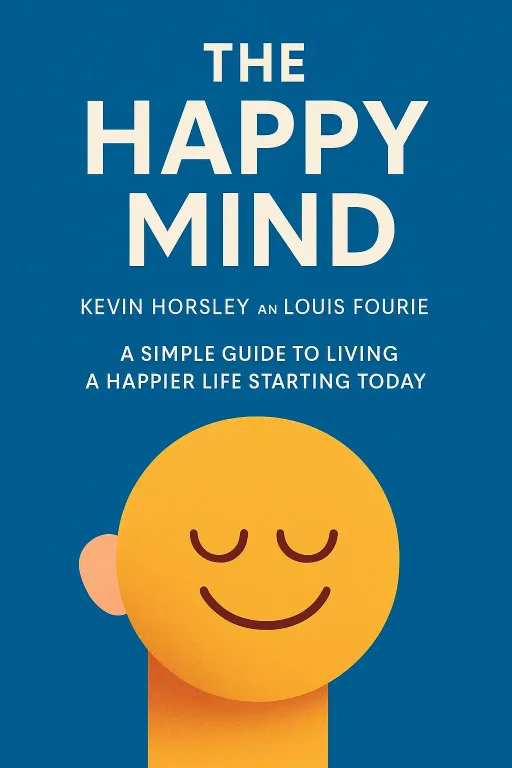
Nova: Imagine waking up tomorrow with everything you have ever wanted. The perfect bank account, the dream house, the ideal partner, and absolute freedom. You would be permanently happy, right? Well, psychological science and history suggest otherwise. Today, we are diving into Kevin Horsley and Louis Fourie's profound book, The Happy Mind, to unpack why our brains are practically wired to look for joy in all the wrong places. We are going to tackle this from three fascinating angles. First, we will dismantle the illusion of external happiness and the traps of looking for peace in the world, in another time, or in other people. Second, we will explore how happiness is actually a highly trainable, now-and-here cognitive skill. And finally, we will look at the practical daily habits that shift us from passive survival to active, joyful living. Joining me today is Kem, an incredibly analytical thinker who loves looking at the systems behind how we think and behave. Kem, it is so wonderful to have you here.
Kem: It is great to be here, Nova. You know, when I was reading through the core concepts of this book, what struck me most was how much of our unhappiness comes from a fundamental system error. We treat happiness as an output of our circumstances, like a mathematical equation where external inputs equal internal joy. But the authors argue, and I think the data backs this up, that happiness is actually the operating system itself. It is the framework through which we process those inputs, not the result of them.
Nova: Oh, I love that analogy. Happiness as the operating system, not the output. That is such a great way to frame it because so many of us spend our entire lives trying to upgrade the hardware, the jobs, the cars, the relationships, while running a totally buggy, outdated software system inside our minds.
Kem: Exactly. We are trying to run high-definition software on a system that is still reacting to primitive survival threats. It is a classic mismatch, and it is exactly why so many highly successful people end up feeling completely empty.
Deep Dive into Core Topic 1
SECTION
Nova: That brings us right to our first major theme, the illusion of external happiness. The authors talk about how we constantly seek happiness out there, in what they call the world, another time, or other people. Let us start with the world, specifically the chase for wealth and status. There is a really powerful story in the book about a man named John in New York during the early two thousands. John was a middle-class guy, but he was absolutely consumed by the idea that wealth was the ultimate key to joy. He looked at the wealthy lifestyles around him and thought, if I just get that affluence, all my problems vanish. So, what did John do? He started working sixty, seventy hours a week. He sacrificed his family time, ignored his friends, and even started taking massive, highly stressful financial risks to fast-track his way to wealth.
Kem: And let me guess, the classic hedonic treadmill kicked in.
Nova: Oh, completely. He actually managed to accumulate a significant amount of money, but his stress and anxiety skyrocketed. He was richer on paper, but his life felt completely hollow. He had neglected his health and his relationships, and when he finally stood at the top of his financial mountain, he realized the view did not make him happy. He had to completely re-evaluate his priorities and realize that money alone could not buy internal peace.
Kem: It is a classic case study in what psychologists call hedonic adaptation. As humans, we have this incredible ability to adapt to new levels of stimulus, including wealth. When John got more money, his baseline expectation simply shifted upward. From a systems perspective, he was chasing a moving target. He was treating a variable, wealth, as a constant source of fulfillment. But the real danger, as Eckhart Tolle pointed out in a quote the authors highlight, is that while trying to find yourself in things, you may end up losing yourself in things.
Nova: That quote is so hauntingly accurate. Losing yourself in things. And it is not just material things, is it? We also do this with time. We displace our happiness to another time, either romanticizing the past or obsessing over the future.
Kem: Yes, the temporal displacement of happiness. It is a fascinating cognitive bias. The book illustrates this beautifully with the story of Mary, an elderly woman living in the late twenty-tens. Mary spent almost all her mental energy reminiscing about her youth, longing for what she called the good old days. She would spend hours looking at old photos, listening to old music, and telling the same stories over and over, completely idealizing her past while ignoring the actual challenges she faced back then.
Nova: Right, and the tragedy was that she became totally isolated from her present life. She was physically in the present, but mentally living in a museum.
Kem: Exactly. She was treating her memories as a sanctuary, but it became a prison. When we dwell on the past like Mary did, or when we constantly look to the future, saying, I will be happy when I get that promotion, or when I retire, we are practicing a form of mental time travel that robs us of the only moment we actually have control over, which is right now. Colley Cibber wrote a beautiful poem that the authors quote: The happy have whole days and those they choose. The unhappy have but hours and those they lose. When you are temporally displaced, you are literally losing your hours to a time that does not exist anymore.
Nova: That is so true. And then there is the third external trap, other people. We see this so often in relationships, where we expect another person to be the sole source of our joy. The book shares the story of Sarah, a young woman in Los Angeles who believed with absolute certainty that finding the perfect romantic partner was the key to her life. She went on endless dates, constantly searching for the one, putting these massive, unrealistic expectations on every single person she met.
Kem: Which is a recipe for immediate disappointment.
Nova: Oh, absolutely. She would idealize them at first, then get incredibly let down when they turned out to be, you know, human. She was looking for someone else to complete her, rather than doing the work to feel complete on her own. It was only when she stepped back, focused on her own passions, and learned to appreciate her own company that she was able to build a healthy, balanced relationship.
Kem: This is what we might call the relational dependency trap. From an analytical standpoint, expecting another person to make you happy is a high-risk dependency. You are giving away your emotional agency. The authors use a wonderful quote from Douglas Jerrold to counter this: Happiness grows at our own firesides, and is not to be picked in strangers' gardens. If you do not cultivate that inner landscape, you are constantly begging for scraps of joy from others, which inevitably leads to resentment and instability.
Nova: It really does. It is like trying to build a house on someone else's land. The foundation is completely out of your control.
Deep Dive into Core Topic 2
SECTION
Nova: So, if happiness is not in the world, not in another time, and not in other people, where is it? That brings us to our second major theme: happiness as an active, now-and-here cognitive skill. The authors argue that happy people do not just have better circumstances; they actually think differently. They run a different cognitive program.
Kem: This is where the book gets incredibly practical. They outline several qualities of happy people, and the thread connecting all of them is personal accountability. Happy people do not view themselves as passive victims of life. There is this great observation in the book about the different questions happy and unhappy people ask when something bad happens. When an undesirable event occurs, an unhappy person immediately asks, why does this always happen to me? Or, who is to blame for this? They look outward to assign fault, which keeps them stuck in a victim mindset.
Nova: Right, whereas a happy person asks, what am I going to do about this? And, how can I prevent this from happening again?
Kem: Exactly. Those are solution-oriented questions. They shift the brain from the reactive, threat-focused amygdala to the problem-solving prefrontal cortex. It is a simple linguistic shift, but it completely changes your neurological state. You go from feeling helpless to feeling empowered. The data actually shows that while extreme circumstances certainly impact us, everyday, non-extreme situations only account for about ten percent of the variance in our happiness levels. The other ninety percent is determined by our cognitive processing, our attitude, and our response.
Nova: Ten percent. That is a wild statistic when you think about how much time we spend stressing over that ten percent. We obsess over traffic, weather, minor delays, or a rude comment from a coworker, completely ignoring the ninety percent we actually control.
Kem: It is a massive misallocation of cognitive resources. And happy people seem to intuitively understand this. They also have this incredible ability to appreciate the simple things. The authors quote Albert Einstein's famous line: There are two ways to live your life. One is as though nothing is a miracle. The other is as if everything is a miracle. That is not just a poetic sentiment; it is a cognitive strategy. When you train your brain to look for the small wonders, a good cup of coffee, a beautiful sunset, a warm conversation, you are actively strengthening your neural pathways for gratitude.
Nova: Yes, and the science on gratitude is so clear. The book references a famous study from two thousand three by Emmons and McCullough, where participants who kept a simple gratitude journal for just a few weeks reported a twenty-five percent increase in overall happiness compared to the control group. They were more optimistic, had better sleep, and felt less stressed. A twenty-five percent increase just from writing down a few things you are grateful for. That is a massive return on investment.
Kem: It really is. And it works because it counteracts our evolutionary negativity bias. Our brains are naturally wired to scan the environment for threats and deficits because that kept our ancestors alive. But in the modern world, that bias often manifests as chronic dissatisfaction. Gratitude is the conscious override of that primitive programming. It is telling your brain, look at what we have, not just what we lack.
Nova: It is like doing reps at the gym, but for your perspective. And speaking of perspective, there is a beautiful story in the book that perfectly illustrates this. It is about a ninety-two-year-old lady named Mrs. Jones who was moving into a nursing home. She was this incredibly elegant woman, fully dressed by eight in the morning, hair perfectly done, moving into a tiny, unfamiliar room. As she was walking down the hall with her walker, the staff member assisting her started describing the room, trying to prepare her because it was quite small and basic. But before she even stepped foot inside, Mrs. Jones enthusiastically said, I love it.
Kem: That is amazing. She had not even seen it yet.
Nova: Exactly. The staff member was taken aback and said, Mrs. Jones, wait until you see the room first. But Mrs. Jones replied with something so profound. She said, whether I like my room or not does not depend on how the furniture is arranged. It depends on how I arrange my mind. I have already decided to love it. She explained that happiness is a decision she makes every morning when she wakes up. She can either spend the day in bed focusing on the parts of her body that do not work, or she can get up and be grateful for the parts that do.
Kem: That story gives me chills, Nova. It is the ultimate demonstration of an internal locus of control. Mrs. Jones understood that her physical environment was a variable, but her mental state was a choice. She did not wait for the room to please her; she brought her own joy to the room. It reminds me of that powerful quote on thinking that the authors share: Guard over your thinking, for it becomes actions. Your actions slowly turn into habits. Over time, your habits shape your character. And in the end, your character becomes your destiny. If you want to change your destiny, change your thinking. Mrs. Jones had built a destiny of joy because she had spent decades guarding her thoughts.
Nova: She really had. And it shows that happiness is not this elusive, magical thing that strikes like lightning. It is a daily, disciplined practice. It is a habit of mind.
Synthesis & Takeaways
SECTION
Kem: You know, as we synthesize all of this, it becomes clear that the origin of our unhappiness often lies in our inability to control our primitive instincts. Our old brain is constantly screaming about scarcity and rejection, telling us we do not have enough or we are not enough. But we have this incredible, sophisticated prefrontal cortex that allows us to make conscious decisions. We can choose to override those outdated survival fears with willpower, self-discipline, and intentional focus.
Nova: Absolutely. And the beauty of The Happy Mind is that it does not give us some complex, impossible formula. It points us back to the simple, daily choices. It is about taking full ownership of our lives, managing our expectations, nurturing our closest relationships, and practicing gratitude. As the authors remind us in the final chapter, we do not have to be happy for the rest of our lives, only now. Just be.
Kem: That is such a liberating thought. It removes the pressure of trying to achieve some permanent state of enlightenment. You do not have to solve the next forty years today. You just have to manage this present moment. You have to choose how you arrange your mind right now, in this room, in this conversation.
Nova: What a perfect place to leave our listeners. So, here is our challenge for you today: take a page out of Mrs. Jones's book. Before you face your next challenge, whether it is a difficult meeting, a long commute, or a messy house, make the decision ahead of time to find something to love about it. Arrange your mind for gratitude, and see how the world shifts around you. Kem, thank you so much for sharing your brilliant, analytical insights with us today. This was an absolute joy.
Kem: Thank you, Nova. It was a pleasure. I think we all walked away with a slightly better operating system today.
Nova: We certainly did. And to our listeners, thank you for tuning in. Remember, your happiness is in your hands. Guard your thoughts, cherish your days, and we will see you next time on The Mechanics of Joy.