

Mastering Emotional Resilience and Mental Clarity
Golden Hook & Introduction
SECTION
Nova: We spend an enormous amount of energy trying to avoid feeling bad. We curate our lives, we distract ourselves, we chase milestones, all to keep discomfort at bay. But the data suggests that the more we fight our negative emotions, the more they actually dominate our day.
Atlas: That sounds like a losing battle. It’s like trying to hold a beach ball underwater. You might keep it submerged for a second, but the second you get tired, it rockets back up and hits you in the face.
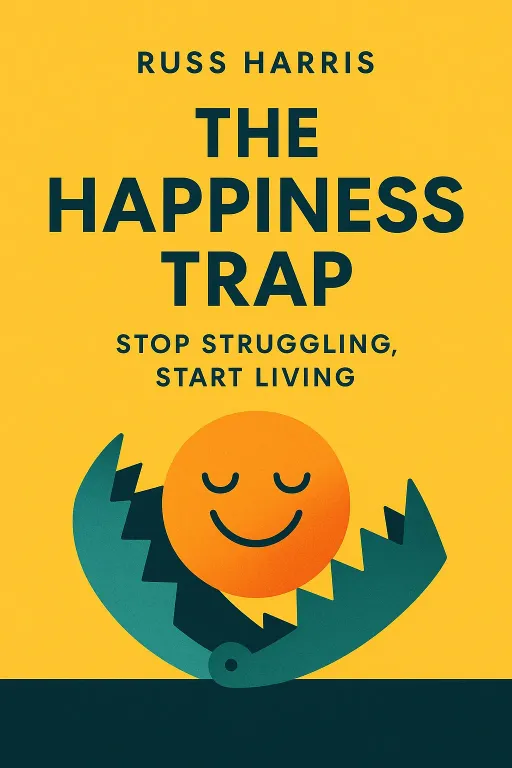
Nova: Exactly. And that is the central tension we are diving into today. We are looking at two powerful frameworks for handling this. First, there is The Happiness Trap by Russ Harris, which introduces the principles of Acceptance and Commitment Therapy. It is a fascinating look at why the standard advice to just think positive is actually setting us up for failure.
Atlas: And that is a bold claim, considering how much of the self-help industry is built entirely on the idea of thinking positive.
Nova: It is. And to balance that out, we are also pulling from Thibaut Meurisse and his book Master Your Emotions. While Harris gives us the philosophical shift, Meurisse provides a very practical, almost mechanical system to deconstruct those negative feelings and reprogram the way we respond to them.
Atlas: So we have the strategy and the tactics. We have the mindset shift and the workbook. For anyone listening who feels like they are constantly at the mercy of their own internal weather patterns, this is going to be a crucial conversation.
Nova: Precisely. Let us start by dismantling the biggest myth about happiness, which is that it is a permanent destination we are supposed to reach and then stay at.
The Trap of Fighting Emotions
SECTION
Atlas: Okay, but hold on. Most people would argue that being happy is the goal. If I am not happy, I am doing something wrong. Is that not the baseline assumption for almost everyone?
Nova: It is the baseline, and that is exactly the problem. Russ Harris makes a compelling case that this pursuit is actually a trap. The more you chase happiness as a feeling, the more you notice when you do not have it. And the moment you notice the absence of happiness, you feel unhappy about being unhappy.
Atlas: That is a vicious feedback loop. It is like being anxious about being anxious.
Nova: It is exactly that. Harris, who comes from a background in Acceptance and Commitment Therapy, or ACT, points out that we have this internal struggle switch. When a difficult emotion shows up—say, frustration at work or fear about a project—our first instinct is to flip the switch to on. We engage in a wrestling match with the feeling. We tell ourselves, I should not be feeling this, I need to get rid of this, I need to fix this.
Atlas: And I imagine that wrestling match is exhausting.
Nova: It is draining. And here is the key insight: the wrestling match is actually more painful than the emotion itself. Harris uses a brilliant analogy here. Imagine you are stuck in quicksand. The natural, instinctive reaction is to thrash, to fight, to struggle to get out. But what happens in quicksand when you struggle?
Atlas: You sink faster. The more movement you make, the more you displace the sand and pull yourself down.
Nova: Precisely. You have to stop struggling. You have to spread your weight out. You have to accept that you are in the sand so that you can float. It is the same with our emotions. Acceptance, in this context, is not passivity. It is not saying, I like this feeling. It is saying, I am willing to experience this feeling without letting it dictate my actions.
Atlas: That is a tough pill to swallow for someone who wants to be in control. I am an architect of my own life. I want to build a system where I do not feel fear or doubt. You are telling me that I have to invite those feelings to the party?
Nova: Not invite them, but stop trying to throw them out the window. When you stop struggling, you reclaim the energy you were spending on the fight. That energy is what you need to focus on value-driven action. The question is not, how do I stop feeling afraid? The question is, what would I do today if I were willing to feel afraid and take action anyway?
Atlas: That shifts the focus from the internal state to the external output. It is the difference between waiting for the right mood to work and deciding to work regardless of the mood.
Nova: Exactly. And that is where we see the limitation of the traditional positive thinking approach. It tries to change the internal state first. ACT suggests you change the action first, and the internal state often takes care of itself, or at least loses its power to paralyze you.
Atlas: It sounds counterintuitive, but it makes sense from a productivity standpoint. If I spend two hours trying to talk myself out of being anxious, I have lost two hours of work. If I just accept the anxiety and start the work, I have gained two hours.
Nova: You have hit the nail on the head. You are trading the illusion of control for the reality of progress.
Deconstructing the Emotional Mechanism
SECTION
Atlas: So, we have accepted the feeling. We are not fighting the quicksand. But acceptance can feel a bit abstract. Once I have accepted that I am feeling anxious, what do I actually do? This is where I am curious about what Meurisse brings to the table. He seems to have a more systematic approach.
Nova: He does. Thibaut Meurisse takes a much more analytical, almost engineering-based approach to the mind. He suggests that emotions are not just random storms; they are signals. They are data points. The problem is that most of us are terrible at reading the data because we are too busy reacting to the intensity of the signal.
Atlas: Right. The fire alarm goes off, and instead of checking where the fire is, we just scream because the noise is annoying.
Nova: That is the perfect analogy. Meurisse argues that we need to deconstruct the emotion. He suggests that an emotion is usually comprised of three things: the event, the interpretation, and the physiological response. The event is neutral. The interpretation is what we add to it. And the physiological response is the body’s reaction.
Atlas: So, if I get a harsh email from a client, the event is just text on a screen. My interpretation is, they hate me, I am going to lose this contract, I am a failure. And the physiological response is my heart racing and my stomach tightening.
Nova: Exactly. Meurisse’s system is about putting a gap between the event and the interpretation. You have to become a scientist of your own mind. When that spike of negative emotion hits, you pause and ask, what is the story I am telling myself about this event?
Atlas: That requires a level of self-awareness that is really hard to summon in the heat of the moment. How do you actually train that?
Nova: It starts with labeling. Neuroscience tells us that when you put a name to an emotion, you engage the prefrontal cortex, which is the rational part of your brain. It actually dampens the activity in the amygdala, which is the emotional, reactive center. So, instead of saying, I am angry, which identifies you with the emotion, you say, I am experiencing a feeling of anger.
Atlas: It sounds like a semantic trick, but I have seen this work. It creates distance. It turns you from the victim of the emotion into the observer of the emotion.
Nova: Yes, and Meurisse takes it further. He suggests you look for the narrative. He asks, what is the self-limiting narrative you are telling yourself today? That is the core of his work. We have these ingrained scripts. For many of us, the script is, if I fail, it means I am not good enough. If someone criticizes me, it means I am a fraud.
Atlas: And that script is what triggers the emotion. The event is just the catalyst. The script is the fuel.
Nova: Precisely. If you want to reprogram your emotional response, you do not just try to calm down. You have to rewrite the script. You have to look at that event and find a more empowering, or at least a more neutral, interpretation.
Atlas: So, if the client sends a harsh email, the old script says, I am a failure. The new script says, this client is frustrated with a specific deliverable, and I can address that. It is a problem to solve, not a judgment on my character.
Nova: You have just performed the exact reprogramming Meurisse is talking about. You have taken the emotional weight out of the situation and replaced it with a tactical response.
Atlas: It sounds simple, but I know how hard it is to do when you are in the middle of a high-stakes project. It is like trying to fix a plane engine while you are mid-flight.
Nova: It is. But that is why it is a skill, not a switch. You practice it in the low-stakes moments so you can perform it in the high-stakes moments. You start by analyzing your reactions to minor annoyances—traffic, a rude waiter, a slow internet connection. You practice deconstructing those so that when the big crisis hits, the habit is already formed.
Synthesis & Takeaways
SECTION
Atlas: This brings us back to the idea of the architect mindset we talked about at the start. You are not just reacting to your life; you are designing the architecture of your response.
Nova: I love that framing. You are not the victim of your brain's default settings. You are the architect who can choose to renovate.
Atlas: So, if we synthesize these two approaches, we have a very clear roadmap. First, we use Harris’s ACT principles to stop the internal war. We accept the discomfort, we stop the struggle, and we reclaim our energy. We stop sinking in the quicksand.
Nova: And then, once we have that space, we use Meurisse’s analytical tools to deconstruct the emotional signal. We stop reacting to the story we are telling ourselves and start responding to the reality of the situation.
Atlas: It is a powerful combination. It moves us from a state of being emotionally reactive to being intentionally responsive.
Nova: And the ultimate takeaway for our listeners is this: the next time you feel that surge of negativity, that wave of anxiety or frustration, do not try to suppress it. Instead, pause. Label it. Ask yourself what narrative you are attaching to it. And then, most importantly, ask yourself: what is the one value-driven action I can take right now that moves me toward the future I want, regardless of how I feel?
Atlas: That is the anchor. Regardless of how I feel. That is the key to mastery. It is not about feeling good all the time; it is about being effective all the time.
Nova: Exactly. Because when you stop waiting to feel ready, or to feel happy, or to feel confident, you start doing the work that actually builds the life you are aiming for. The emotions will still be there. They are part of the human experience. But they no longer have to be in the driver’s seat.
Atlas: It is a shift from being a passenger in your own emotional vehicle to being the driver who knows how to handle the road, even when the weather turns bad.
Nova: I think that is the perfect note to end on. Remember, you have more agency than you think. The story you tell yourself is the blueprint for your reality. Make sure it is a story that serves your growth.
Atlas: I am definitely going to be more conscious of my own internal scripts this week. This was a great breakdown.
Nova: I am glad to hear that. For everyone listening, take that 15 minutes today, apply this, and see what changes. This is Aibrary. Congratulations on your growth!









