Personalized Podcast
Golden Hook & Introduction
SECTION
Socrates: Imagine walking through an infinite library. Every book ever written is on the shelves, containing the absolute truth of human existence, the secrets to happiness, the cure for suffering. But as you wander the endless corridors, you realize something terrifying. The sheer abundance of books makes it impossible to find the one volume you actually need. You are drowning in information, yet starving for wisdom. My friend, does this modern paradox sound familiar to you?
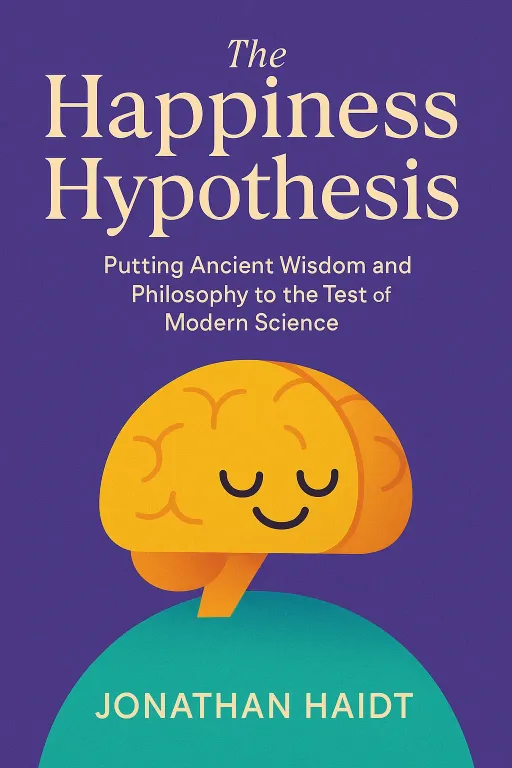
Aibrarygg82f7: It sounds like the very definition of our current cultural landscape, Socrates. We have the entire history of human thought at our fingertips, yet we are more anxious, distracted, and divided than ever. Jonathan Haidt captures this beautifully in. He suggests that wisdom isn't about discovering brand-new secrets; it's about pressure-testing the great ancient ideas under the rigorous lens of modern cognitive science.
Socrates: A fascinating premise. If the answers have always been right in front of us, why do we struggle so mightily to live them? Today, we are going to tackle this disconnect from two profound angles. First, we will look inward at the civil war raging inside our own minds, what Haidt calls the division between the Rider and the Elephant. Then, we will look outward, examining how suffering and adversity, far from being mere obstacles, are actually the essential raw materials required to forge a coherent, meaningful life. Shall we begin our descent into the self?
Aibrarygg82f7: Let us descend. To understand the world, we must first map the fractured geography of our own minds.
Deep Dive into Core Topic 1
SECTION
Socrates: Let us start with this internal division. Haidt uses a brilliant metaphor: a human rider sitting atop a giant elephant. The rider represents our conscious, verbal, reasoning mind. The elephant is everything else, our automatic processes, gut feelings, instincts, and emotions. When you look at your own life, who do you think is really in charge? Is it the logical rider, or the powerful elephant?
Aibrarygg82f7: We like to tell ourselves a comforting lie, Socrates. We like to believe the rider is a king, ruling over the beast with absolute authority. But cognitive science reveals a much more humbling truth. The rider is actually more like a press secretary or a defense attorney. Its job isn't to command the elephant, but to observe what the elephant does and then construct a highly sophisticated, post-hoc rationalization to justify the elephant's behavior to the outside world.
Socrates: A press secretary. That is a striking image. It suggests that our rational mind is constantly spinning narratives to cover up our instinctual impulses. But tell me, what happens when the rider and the elephant disagree? What does the scientific evidence show us about this internal conflict?
Aibrarygg82f7: The evidence is stark, and it often shows up in our daily failures of self-control. Think of Walter Mischel's famous marshmallow experiments from the 1970s. Four-year-old children were placed in a room with a single marshmallow. They were told that if they could wait for the researcher to return without eating it, they would get two. The children who struggled most were the ones who stared directly at the marshmallow, trying to use sheer, conscious willpower to resist. The rider was trying to hold back a hungry elephant by pulling on the reins. But the children who succeeded were the ones who managed to distract the elephant. They covered their eyes, sang songs, or turned their chairs around. They changed the elephant's focus.
Socrates: So, the rider cannot simply overpower the elephant through brute force. It must use strategy, redirection, and understanding. But where does this division come from? Is it merely a psychological metaphor, or is it hardwired into our physical biology?
Aibrarygg82f7: It is deeply biological, Socrates. Look at the split-brain studies of the 1960s. When surgeons severed the corpus callosum, the bridge connecting the left and right hemispheres of patients with severe epilepsy, they discovered something extraordinary. The left hemisphere, which houses our language centers, would actively invent stories to explain actions initiated by the right hemisphere. If researchers flashed a command to the right brain telling the patient to walk, the patient would stand up and start moving. When asked why they were walking, the left brain didn't say, "I don't know." Instead, the rider immediately confabulated an explanation, saying, "Oh, I was just going to get a soda." The mind is a master of self-delusion.
Socrates: It seems we are strangers to ourselves, living in a house divided. If our conscious reasoning is so weak, and our automatic processes are so dominant, how can we ever hope to change our minds? How do we retrain the elephant when it has a mind of its own?
Aibrarygg82f7: This is where ancient practices and modern therapy converge. You cannot change the elephant by arguing with it. If you tell yourself, "I must stop worrying," the elephant hears the word "worry" and becomes even more anxious. This is what Edgar Allan Poe called the Imp of the Perverse, and what modern psychologists call ironic processing. The harder you try to suppress a thought, the more your brain automatically monitors for its presence, which ironically keeps the thought alive. To retrain the elephant, you have to use somatic, repetitive practices. Meditation, for instance, tames the wild mind by slowly changing our automatic, default cognitive habits. Cognitive behavioral therapy does the same by training the rider to catch the elephant's distorted, catastrophic thoughts and gently reframe them over time. It is a slow, daily process of training, not a sudden intellectual epiphany.
Socrates: It sounds like a patient, loving relationship between a trainer and a wild beast. But let us take this a step further. If we are so blind to our own internal divisions, how does this affect how we view other people? Why are we so quick to see the speck in our neighbor's eye, yet completely ignore the log in our own?
Aibrarygg82f7: Because the elephant is designed for survival, not objective truth. We are evolutionary descendants of creatures who had to navigate complex social hierarchies. We developed what psychologists call naive realism, the deep, unconscious belief that we see the world exactly as it is, objectively and without bias. Therefore, anyone who disagrees with us must be biased, uninformed, or malicious. This creates a rose-colored mirror. We judge ourselves by our noble intentions, which our inner lawyer is happy to draft for us, but we judge others strictly by their worst actions. We are naturally hypocritical because hypocrisy is a highly effective tool for social navigation.
Deep Dive into Core Topic 2
SECTION
Socrates: If we are trapped in this cycle of self-delusion, naive realism, and internal division, it seems almost miraculous that we can grow at all. This brings us to our second major theme: the role of struggle. Many ancient philosophies, particularly the Stoics, suggest that happiness comes entirely from within, by withdrawing from the chaotic external world and mastering our reactions. Yet, Haidt challenges this. He introduces the Adversity Hypothesis, the idea that we actually need trauma, loss, and struggle to reach our highest potential. How do you reconcile these two views?
Aibrarygg82f7: This is one of the most critical turning points in the book. The ancient Stoics like Seneca and Epictetus, and even the Buddha, argued that because the external world is fragile and unpredictable, we should detach ourselves from it to avoid suffering. They said, "Nothing is miserable unless you think it so." But modern psychological data suggests they went too far. While internal mental training is necessary, we are fundamentally social, active creatures. We cannot thrive in a vacuum of complete detachment. True human flourishing requires us to engage deeply with the world, and that engagement inevitably brings us into contact with suffering. The key is not to avoid the fire, but to understand how the fire refines us.
Socrates: To be refined by the fire. That is a powerful image of transformation. But surely, suffering does not automatically make people better. We have all seen adversity crush people, leaving them bitter, broken, and defeated. What is the difference between adversity that destroys and adversity that transforms?
Aibrarygg82f7: The difference lies in the process of sense-making. Haidt points to the profound research of James Pennebaker on the power of disclosure. Pennebaker found that when people write or talk about their most traumatic experiences, not just venting their raw emotions, but actively trying to construct a coherent narrative around it happened and they learned, their physical and mental health improves dramatically. They show stronger immune systems and lower rates of depression. The trauma itself is not the teacher; the act of integrating that trauma into your life story is what facilitates posttraumatic growth. It forces a radical reevaluation of your priorities.
Socrates: So, the mind must act as an alchemist, turning the lead of tragedy into the gold of wisdom. Can you share a concrete example of this alchemy in action? How does a devastating event actually lead to psychological growth?
Aibrarygg82f7: Consider the story of Greg, a young professor whose life was completely shattered when his wife suddenly abandoned him, took their two young children, and ran off with a manipulative con artist. In an instant, Greg lost his family, his financial stability, and his sense of reality. He was plunged into a living nightmare. Yet, years later, looking back on that devastating period, Greg realized he had experienced profound posttraumatic growth. The crisis forced him to stop taking his children for granted. It stripped away his academic self-absorption and deepened his capacity for empathy, love, and forgiveness. He described it as his "moment to sing the aria." He didn't want the tragedy, but when it came, it forced him to rise to an intellectual and emotional height he never would have reached in a comfortable, uninterrupted life.
Socrates: "His moment to sing the aria." What a beautiful way to describe rising to meet one's fate. It reminds me of the Nietzschean idea that what does not kill us makes us stronger. But is there a specific window in our lives when this kind of growth is most effective? Can adversity strike too early, or too late?
Aibrarygg82f7: Yes, timing is incredibly important. The research suggests there is a developmental sweet spot for adversity, typically during our late teens and twenties. This is the period when we are actively constructing our identity, our characteristic adaptations, and our life story. If severe trauma occurs in early childhood, before the brain has developed robust coping mechanisms, it can be deeply damaging and lead to lifelong vulnerability. If it occurs too late in life, our cognitive frameworks are often too rigid to adapt. But during young adulthood, a moderate amount of struggle acts as a powerful catalyst. It shakes up our mental structures just enough to allow us to rebuild them into something far more resilient and coherent.
Socrates: It seems, then, that wisdom is not something that can be taught in a classroom or read in a book. It must be earned through the lived experience of navigating obstacles.
Aibrarygg82f7: Exactly. Wisdom is tacit knowledge. It is procedural, not declarative. You cannot simply hand someone a set of moral rules and expect them to be wise. It is like trying to teach someone how to ride a bicycle by reading them a manual. The rider can memorize the rules, but the elephant only learns by falling down, feeling the balance shift, and trying again. Adversity is the ground upon which the elephant learns how to walk.
Synthesis & Takeaways
SECTION
Socrates: We have journeyed from the deep, divided recesses of the individual mind to the external trials of human suffering. If we are to synthesize these insights, where does happiness ultimately come from? Is it found entirely within us, as the ancients claimed, or is it found in the external world of achievements and relationships?
Aibrarygg82f7: Jonathan Haidt's ultimate conclusion is beautiful in its simplicity: happiness comes from. It is not something you can find, achieve, or directly pursue. Instead, happiness is an emergent property. It emerges when you get the relationships right between different levels of your existence. You must get the relationship right between your conscious rider and your instinctive elephant. You must get the relationship right between yourself and your community, through love and shared moral values. And finally, you must get the relationship right between yourself and your work, finding what Kahlil Gibran called "love made visible." When these physical, psychological, and spiritual levels are in perfect alignment, coherence emerges, and happiness simply flows.
Socrates: A profound synthesis. It suggests that we are not isolated islands, but nodes in a vast, interconnected web of meaning. As we bring our conversation to a close, what is one practical, actionable step our listeners can take today to begin aligning their own rider and elephant?
Aibrarygg82f7: I would challenge everyone to stop trying to fix their weaknesses through sheer willpower. The rider will only exhaust itself. Instead, identify your signature strengths, whether that is curiosity, gratitude, or zest, and find a way to use those strengths to navigate your current struggles. If you are facing adversity right now, do not run from it. Write about it. Try to find the narrative thread that connects your pain to a deeper purpose. Remember, the crucible of struggle is not there to break you, but to melt away the superficial, leaving behind the pure, unshakeable core of who you are truly meant to become.
Socrates: Let us leave our listeners with that powerful thought to ponder. My friend, thank you for walking this path of inquiry with me today.
Aibrarygg82f7: Thank you, Socrates. The journey toward wisdom is endless, but there is no better way to travel than together.