

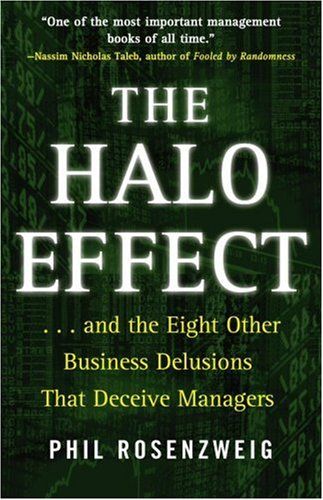
The Halo Effect
Introduction
Nova: Imagine this. It's 2005. Fortune magazine just named Dell Computer the number one most admired company in the world. Fast forward two years. Dell's stock is slumping, the CEO has been fired, and the press is publishing articles with titles like "Dell's hubris" and "How complacency killed a giant." Same company. Same business model. Same people. So what changed?
Nova: : Let me guess — nothing? Or at least, nothing fundamental?
Nova: Exactly. And that right there is the central provocation of the book we're diving into today: The Halo Effect by Phil Rosenzweig. It's a book that systematically dismantles almost everything you think you know about why companies succeed or fail.
Nova: : I love a good intellectual demolition job. But what makes this one different from all the other skeptics out there?
Nova: Here's what's remarkable. Rosenzweig isn't some armchair critic. He earned his PhD at Wharton, taught at Harvard Business School, spent seven years at Hewlett-Packard, and now teaches at IMD in Switzerland. He's an insider taking aim at the entire industry of business books — and he names names. In Search of Excellence, Good to Great, Built to Last — these are multi-million copy bestsellers. And Rosenzweig argues they're built on fundamentally flawed reasoning.
Nova: : That's a bold claim. What's the core idea?
Nova: The core idea is deceptively simple. When a company is performing well — rising sales, soaring stock price — we automatically assume it must have a brilliant strategy, a visionary leader, a vibrant culture, and superb customer focus. When that same company falters, we suddenly decide its strategy was flawed, its leader was arrogant, its culture was complacent. But the company itself may not have changed at all. The financial performance creates a glow — a halo — that colors everything we think we see.
Nova: : So we're basically writing stories backwards. We see the ending and then construct a narrative that makes it seem inevitable.
Nova: That's it. And here's why this matters: we're not just talking about lazy journalism. Rosenzweig argues this delusion infects some of the most celebrated business research of the past forty years. Books that CEOs swear by. Books that shape strategy at the highest levels. And the implications are enormous. Today we're going to walk through the nine delusions Rosenzweig identifies, the famous books he takes apart, and what he says we should actually do instead.
Nova: : Let's get into it.
How the Halo Effect Distorts Everything
The Golden Glow
Nova: Let's start with the big one. The halo effect was first identified by the psychologist Edward Thorndike back in 1920. His original finding was about people: if someone is good-looking, we tend to rate them as more intelligent, more trustworthy, more competent. A general impression contaminates specific judgments.
Nova: : So the business version is basically: profitable company equals brilliant at everything?
Nova: Exactly. And Rosenzweig's favorite example is Cisco Systems. In the late 1990s, Cisco was on fire. Growing rapidly, riding the internet wave. What did the press say? Fortune called it a company with a quote "brilliant strategy" and "masterful acquisition management" and "laser-like customer focus." BusinessWeek praised CEO John Chambers for his "seemingly flawless management." An article in Wired even described Cisco employees as "shiny, happy people" who had never had so much fun going to work.
Nova: : Shiny, happy people. That's a direct quote?
Nova: Direct quote. Now fast forward to the year 2000. The tech bubble bursts. Cisco's stock crashes from eighty dollars a share to fourteen dollars. More than four hundred billion dollars in market value vanishes in twelve months. And suddenly? Those same publications that had gushed over Cisco now ran scathing takedowns. Fortune declared Cisco made its own mess, citing "flawed strategy, haphazard acquisition management, and poor customer relations."
Nova: : Wait. Did Cisco actually change that dramatically in a year?
Nova: No. And that's Rosenzweig's point. The company's core practices hadn't fundamentally changed. What changed was the financial performance, which then cast a dark halo over everything else. The journalists weren't lying — they genuinely believed what they were writing. But their perceptions of things like "strategy" and "culture" and "leadership" were entirely contaminated by the stock price.
Nova: : What about ABB, the Swiss-Swedish engineering company? I've heard that story too.
Nova: Same pattern. In the 1990s, ABB was the darling of the business world. Its elegant matrix organizational structure was studied in every business school. CEO Percy Barnevik was celebrated as a visionary genius. The culture was described as innovative and risk-taking. Then performance declined. And overnight? The matrix structure was "dysfunctional." The culture was "chaotic." Barnevik was "arrogant." Same company. Same people. Different stock price.
Nova: : So the halo effect means we can never trust any description of a company's intangible qualities if we already know how well it's performing financially.
Nova: That's the devastating implication. Leadership quality, corporate culture, customer focus, innovation capability — these are all genuinely important. But they're also frustratingly vague. We can't measure them directly. So what do we do? We use the one thing we can measure — financial performance — as a proxy. And then we congratulate ourselves for discovering that profitable companies have great cultures.
Nova: : It's completely circular.
Nova: Exactly. Rosenzweig cites research by Berkeley professor Barry Staw, who ran experiments where he told groups they had either performed well or poorly. The groups told they did well described themselves as cohesive, communicative, open to change. The groups told they did poorly described the opposite. In reality, all groups performed about the same. The only difference was what Staw told them.
Nova: : That's disturbing. So even we ourselves can't accurately assess our own team's qualities independent of knowing the outcome.
Nova: Right. And this is where Rosenzweig really sharpens his knife. Because if the halo effect is this powerful, what happens when you build entire best-selling books on data contaminated by it?
In Search of Excellence, Good to Great, and Built to Last Under Fire
Taking Down the Titans
Nova: Let's talk about the books Rosenzweig takes direct aim at. First up: In Search of Excellence, the 1982 mega-bestseller by Tom Peters and Robert Waterman. It identified forty-three "excellent" American companies and distilled eight practices they supposedly had in common: things like "stick to the knitting," "stay close to the customer," and "a bias for action."
Nova: : I've definitely heard those phrases. They've become part of the business vocabulary.
Nova: They have. And the book was enormously influential. But Rosenzweig points out two fatal flaws. First, Peters and Waterman only studied successful companies. They never compared them to unsuccessful ones. That's like trying to understand what causes high blood pressure by only studying people who already have it.
Nova: : You'd never find the real causes that way.
Nova: Exactly. And second, their data came from sources like press articles and interviews — precisely the kinds of sources most contaminated by the halo effect. Of course successful companies were described as having great cultures and visionary leaders. That's what the halo effect does.
Nova: : But here's the kicker, right? How did those forty-three excellent companies actually perform afterwards?
Nova: This is where it gets awkward. In the five years after the book came out, only about one-third of the excellent companies managed to outperform the overall stock market. Two-thirds fell behind. When Rosenzweig checked profitability, it was even worse: of the thirty-five companies where data was available, only five improved their profitability. Thirty declined. Most of them weren't even average, let alone excellent.
Nova: : So the book basically identified companies that had recently done well, attributed their success to a set of traits, and then those companies promptly stopped doing well.
Nova: Which makes perfect sense if the traits were never actually causing the success in the first place. They were just descriptions of what success looked like from the outside.
Nova: : What about Good to Great by Jim Collins? That might be even more famous.
Nova: Good to Great, published in 2001, is probably the most influential business book of the past twenty-five years. Collins and his team studied companies that had made the leap from good performance to great performance, and they identified factors like "Level 5 Leadership" and the "Hedgehog Concept" that supposedly explained the transformation.
Nova: : And Rosenzweig's critique?
Nova: He points out that Collins and his team selected companies based on outcome — they started by knowing which companies became great. Then they gathered data through retrospective interviews and press articles. But if you already know a company succeeded, and you ask people to look back and explain why, and you read press coverage written after the success was known — all of that is drenched in the halo effect. You're not discovering causes. You're collecting the glow.
Nova: : There's a great line from Rosenzweig about this. Something about hedgehogs and foxes?
Nova: Yes. Collins uses the famous Isaiah Berlin metaphor — hedgehogs know one big thing, foxes know many things. Good to Great argues great companies are like hedgehogs: narrow focus, incredible discipline. Foxes scatter their attention and fail. Rosenzweig basically says this might be "plain hogwash" because if you only study companies you already know succeeded, you're not doing science — you're doing storytelling dressed up as research.
Nova: : And Built to Last? That was Collins and Porras together.
Nova: Built to Last tried to be more rigorous. It compared eighteen "visionary" companies to eighteen comparison companies from the same industries. Rosenzweig acknowledges this was an improvement over In Search of Excellence. But the core problem remains: the data about culture, values, and leadership came from sources thoroughly contaminated by the halo effect. When you already know which companies are the winners, all the descriptions of their intangible qualities are automatically rosier.
Nova: : So the central methodological crime across all these books is the same: they never achieve what Rosenzweig calls data independence. The thing they're trying to explain — success — is already baked into the data they're using to explain it.
Nova: That's exactly it. And Rosenzweig invokes Richard Feynman's famous phrase: cargo cult science. It has all the superficial trappings of rigorous research — big datasets, sophisticated frameworks, confident conclusions. But it operates at the level of storytelling. We find these stories comforting and satisfying, but they're built on sand.
Correlation, Lasting Success, and the Myth of Certainty
The Remaining Delusions
Nova: Let's run through the rest of Rosenzweig's nine delusions, because each one adds an important layer. The second is the delusion of correlation and causality. Just because two things move together doesn't mean one causes the other.
Nova: : Classic stats 101. But how does it play out in business?
Nova: Take employee satisfaction. Many studies claim that high employee satisfaction drives high performance. Sounds plausible, right? But Rosenzweig points out the evidence actually suggests the reverse: high performance leads to employee satisfaction. When a company is winning, people feel proud, they get bonuses, they have opportunities for advancement. It's more likely that success causes satisfaction than satisfaction causes success.
Nova: : So companies spending millions on ping-pong tables and free lunches might be getting the causality backwards.
Nova: Potentially. Then there's the delusion of single explanations. Many studies claim that factor X — say, corporate culture — improves performance by forty percent, and factor Y — customer focus — adds another thirty percent. But these factors are deeply correlated with each other. Companies with strong cultures also tend to be customer-focused. You can't just add the percentages.
Nova: : And the delusion of connecting the winning dots we've already touched on — only looking at winners.
Nova: Right, that's number four. Number five is the delusion of rigorous research. Authors boast about the vast quantities of data they've gathered, as if volume alone guarantees validity. But if the underlying data is contaminated by the halo effect, it doesn't matter if you analyzed ten thousand pages or ten million. Garbage in, garbage out.
Nova: : The delusion of lasting success — that one seems almost cruel.
Nova: It's a hard truth. Rosenzweig argues that truly lasting success — consistently outperforming the market generation after generation — basically doesn't happen in a competitive economy. Companies that look like enduring success stories are usually identified after the fact. Regression to the mean is powerful. Competitors imitate, advantages erode, technologies shift. As McKinsey's Richard Foster showed, the long-term outperformance most people imagine simply isn't there in the data.
Nova: : Which leads to the delusion of absolute performance.
Nova: Yes. Performance isn't absolute — it's relative. A company can be getting objectively better in every way and still lose to competitors who are improving faster. Rosenzweig uses General Motors as his example: GM's cars in 2005 were dramatically better than GM's cars in the 1980s — better quality, more features, improved safety. And yet in those same years, GM's market share kept falling from thirty-five percent to twenty-five percent. It improved and fell behind simultaneously.
Nova: : That's a brutal reality for any manager to face.
Nova: It gets at why there can never be a simple formula for success. If success were absolute — if you just had to do X, Y, and Z — then anyone could do it. But in a competitive market, success means doing things better than rivals, and rivals are trying to do the same things better than you. It's a moving target.
Nova: : What about delusion eight — the wrong end of the stick?
Nova: This is about getting cause and effect backwards. Successful companies often have corporate social responsibility programs. So does CSR cause success? Or is it that profitable companies have money to spend on CSR? Rosenzweig argues it's mostly the latter. Similarly, successful companies are often focused. But does focus lead to success, or does success give you the luxury of focus?
Nova: : And the ninth delusion?
Nova: Organizational physics — the idea that business follows discoverable, immutable laws, like physics. That somewhere out there are rules for success, and if only we can find them, everything becomes predictable. Rosenzweig says this is deeply seductive but fundamentally wrong. Business involves strategy, execution, and chance. There's inherent uncertainty that no amount of research can eliminate.
Nova: : I think that's the one that really stings. We want the world to make sense. We want to believe that if we just find the right formula, everything will work out.
Nova: And that desire is exactly what makes books like Good to Great so appealing. They scratch a deep psychological itch — the need for order and predictability in a chaotic world. Rosenzweig quotes the social psychologist Eliot Aronson: "People are rationalizing beings, not rational beings."
Rosenzweig's Practical Wisdom
So What Should We Do Instead
Nova: At this point you might be thinking: okay, Rosenzweig has burned down the entire business book genre. But does he offer anything to replace it?
Nova: : That was exactly my next question. Criticism is easy. What does he actually recommend?
Nova: He does offer guidance, though it's notably less catchy than "seven habits" or "eight principles." And that's by design. He's not selling false certainty. But he lays out five things that clear-thinking managers should embrace.
Nova: : Let's hear them.
Nova: First, good strategies involve risk. No strategy is foolproof. If it were, everyone would copy it immediately and the advantage would disappear. The very nature of competitive advantage is that it requires making bets under uncertainty.
Nova: : So if a business book promises a risk-free path to greatness, that's a red flag.
Nova: Absolutely. Second, execution is also uncertain. What works brilliantly at one company may flop at another. Context matters enormously — the specific people, culture, industry dynamics, and timing all shape outcomes in ways that can't be reduced to universal rules.
Nova: : Third?
Nova: Chance plays a greater role than most managers want to admit. This is uncomfortable. We love stories of visionary geniuses who saw the future. But Rosenzweig, like Nassim Taleb — who wrote the foreword, by the way — insists that randomness is a real factor in business outcomes. Good decisions sometimes fail. Bad decisions sometimes succeed.
Nova: : Taleb endorsing this makes so much sense. Fooled by Randomness is basically the same argument from a different angle.
Nova: Exactly. Fourth: bad outcomes don't always mean bad decisions. And favorable outcomes don't always mean brilliant decisions. This is the antidote to the hindsight bias we see in all the Cisco and ABB stories. Just because something didn't work out, that doesn't mean it was a mistake at the time, given what was known.
Nova: : And the fifth?
Nova: This one is almost paradoxical given everything we've just discussed. Rosenzweig says that when the die is cast, the best managers act as if chance is irrelevant. Persistence and tenacity are everything. You can't control outcomes, but you can control effort and commitment.
Nova: : So the message is: acknowledge uncertainty when you're planning, but once you commit, go all in.
Nova: That's the balance he's going for. And beyond those five points, his broader message is about critical thinking. He wants managers to ask hard questions when they read business books or case studies. Would I describe this company's culture the same way if I didn't know its stock price? Are these data truly independent of performance? Is this author comparing winners to losers, or just describing winners?
Nova: : It's like a consumer protection guide for business thinking.
Nova: That's a great way to put it. The book was named Business Book of the Year at the 2007 Frankfurt Book Fair. The Financial Times called it "brave and provocative." Forbes put it at the top of its "Five Must-Read Books for the Chastened CEO" list. The Wall Street Journal praised its "trenchant view." Even the critics who wished Rosenzweig offered more practical tools acknowledged that his diagnosis was devastatingly accurate.
Nova: : Has the book held up since 2007?
Nova: If anything, it's become more relevant. The 2014 second edition added chapters on the 2008 financial crisis, showing how halo-effect thinking contributed to the meltdown. Banks with rising stock prices were assumed to have brilliant risk management — until the whole edifice collapsed. And in today's world of breathless tech company profiles, where a startup's valuation seems to determine whether its founder is called a "visionary" or a "fraud," the halo effect is alive and well.
Conclusion
Nova: Let's step back and put it all together. The Halo Effect by Phil Rosenzweig makes one devastating argument: most of what we think we know about business success is built on circular reasoning. We see a company doing well, we attribute its success to qualities like great leadership and strong culture, and then we pat ourselves on the back for discovering that great leadership and strong culture drive success. But we never actually measured those things independently of the success itself.
Nova: : And this isn't just an academic nitpick — it means that managers who try to copy the "secrets" of successful companies may be copying illusions. The traits they're trying to emulate might be consequences of success, not causes.
Nova: Exactly. The nine delusions Rosenzweig identifies — the halo effect itself, the confusion of correlation with causation, single explanations, connecting only winning dots, mistaking data volume for data quality, believing in lasting success, treating performance as absolute rather than relative, getting cause and effect backwards, and imagining business follows predictable laws — these are not just esoteric logical errors. They shape multi-billion dollar decisions every day.
Nova: : So what's the one thing a listener should take away from this?
Nova: I think it's the importance of critical thinking. The next time you read a business book that promises the "seven secrets of success" or a magazine profile that gushes about a CEO's "flawless vision," ask yourself: how do they know? Would they be saying the same things if the stock had dropped thirty percent last quarter? Are they comparing winners to losers, or just describing winners after the fact? The capacity for this kind of skeptical thinking is Rosenzweig's real gift to managers.
Nova: : He's not saying don't read business books or don't study successful companies. He's saying do it with your eyes open. Understand the limits of what you can actually learn from retrospective storytelling.
Nova: And perhaps most importantly, make peace with uncertainty. There is no formula for guaranteed success in a competitive economy. Strategy involves risk. Execution is uncertain. Luck plays a role. That's not a reason for despair — it's actually what makes strategic thinking valuable in the first place. If success were just a matter of following a recipe, we wouldn't need talented managers. We'd need administrators with checklists.
Nova: : The absence of easy answers is frustrating, but it's also liberating.
Nova: It is. And Rosenzweig closes with a kind of paradox that I find genuinely wise. Acknowledge that you can't control everything. Understand that good decisions sometimes lead to bad outcomes and vice versa. But once you've made your best judgment, act with total commitment. Persistence and tenacity still matter enormously. Just don't confuse effort with guarantees.
Nova: : This is Aibrary. Congratulations on your growth!