

The 'Success Trap' Fallacy: Why Past Wins Can Blind You to Future Growth.
Golden Hook & Introduction
SECTION
Nova: Success, explained, or is it?
Atlas: Luck, stories, strategic blind spots.
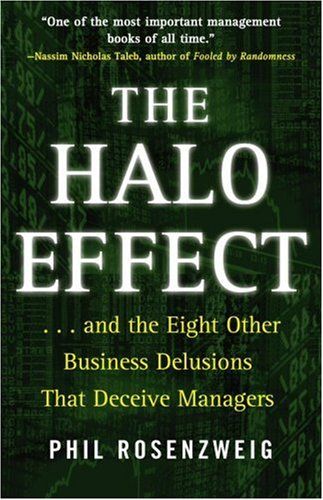
Nova: You know, Atlas, those five words actually perfectly encapsulate the fascinating, and sometimes frustrating, world we're diving into today. We're talking about something I've dubbed 'The Success Trap Fallacy,' and it’s deeply explored in books like "The Halo Effect" by Phil Rosenzweig.
Atlas: Oh, "The Halo Effect." I’ve seen that on so many business school reading lists. What makes Rosenzweig's take so compelling, beyond just the title?
Nova: What's truly compelling is Rosenzweig himself. He isn't just an academic; he's a business school professor and a former executive who grew increasingly critical of conventional business wisdom. He brings this incredible blend of academic rigor and real-world skepticism, which gives his work a unique edge. He basically looked at all these lauded business practices and said, "Wait a minute, are we sure about this?"
Atlas: That makes sense. It’s easy to get swept up in what everyone else is saying is 'the secret sauce' to success.
Nova: Exactly. And that's where the 'halo effect' comes in. It’s this insidious bias where our overall impression of something—or someone—colors our judgment of its individual qualities. If a company is doing well, we automatically assume its leaders are brilliant, its culture is innovative, and its strategy is flawless.
Atlas: I can definitely see how that creates a blind spot. If you’re already assuming everything is great, you’re not looking for potential weaknesses.
Deep Dive into Core Topic 1: The 'Halo Effect' in Success Analysis & Compelling Case Study 1
SECTION
Nova: Precisely. Rosenzweig debunks so many common business myths by showing how many management beliefs are based on attributing success to factors that often prove to be outcomes, not causes. It’s like we’re looking at a well-lit stage and saying, "Wow, those actors are amazing because the stage is so bright," rather than realizing the bright stage is just a consequence of a successful play.
Atlas: So, how does this 'halo effect' actually play out in the real world? Can you give me an example where this bias really led people astray?
Nova: Absolutely. Think about Cisco Systems in the late 1990s, during the dot-com boom. They were universally lauded. Business magazines praised their "visionary strategy," their "customer focus," their "ability to execute." Everyone wanted to emulate Cisco. They were the poster child for success.
Atlas: I remember that. They were everywhere. The stock market darling.
Nova: Right? But then, the dot-com bubble burst. And almost overnight, the narrative completely flipped. Those same traits that were celebrated as 'visionary strategy' were suddenly criticized as 'arrogance.' Their 'customer focus' became 'catering to every whim,' and their 'ability to execute' was reframed as 'lack of discipline.'
Atlas: Whoa. So, the attributes didn't change, but the of them changed entirely based on the market outcome. That's wild.
Nova: It's a perfect illustration of the halo effect. When Cisco was successful, everything they did was interpreted positively. When their performance declined, those exact same characteristics were reinterpreted negatively. It makes it incredibly difficult to truly diagnose what was driving performance or failure. You're looking through a distorted lens.
Atlas: I can see how that's dangerous for any leader trying to make strategic decisions. How do you even begin to differentiate between genuine drivers of success and just reflections of it if your perception is that clouded?
Nova: It requires a rigorous, evidence-based approach, which Rosenzweig champions. The danger is what he calls "reverse causality." We see a successful company, assume it has great traits, and then conclude those traits the success. But often, the success itself us to those traits.
Atlas: That makes me think of sports teams. It’s like saying a winning football team has 'great chemistry' and 'excellent leadership' after they win the championship. But if they lose, suddenly the same team has 'poor communication' and 'lack of direction,' even if the players and coaches are identical.
Nova: Exactly! That's a perfect analogy. The chemistry didn't magically appear or disappear; our interpretation of it was influenced by the scoreboard. And in business, that kind of biased analysis can lead to really flawed strategic decisions, because you're chasing ghosts instead of actual causes.
Deep Dive into Core Topic 2: The Role of Randomness vs. Skill in Outcomes & Illuminating Case Study 2
SECTION
Nova: And that naturally leads us to a related, but even more unsettling idea, which is how much of what we call 'skill' is actually just... luck. This is where Nassim Nicholas Taleb steps in with his groundbreaking work, "Fooled by Randomness."
Atlas: Oh, Taleb. He's the one who basically says the world is mostly chaos, and we just pretend it's orderly, right? I imagine a lot of our listeners who are driving growth and innovation might find that idea a bit unsettling.
Nova: Unsettling, yes, but incredibly insightful. Taleb illustrates how much of what we perceive as skill or strategy is actually luck. He argues that we humans are wired to create narratives, to find patterns, even in purely random events. It's how our brains make sense of the world.
Atlas: So, are you saying my strategic brilliance in landing that last big project was just a coin flip? Because I put in a lot of late nights and tough negotiations!
Nova: Not entirely, Atlas! Taleb isn't denying skill exists. But he forces us to confront its relative contribution, especially in environments with high variance, high uncertainty. He highlights that in random systems, someone is bound to get lucky. And we, being storytellers, immediately attribute that luck to profound skill, foresight, or genius.
Atlas: Give me an example. How does this play out in a way that blinds us?
Nova: Consider the "successful" day trader who made millions during a booming market. Everyone would point to his exceptional 'instinct,' his 'market timing,' his 'unique strategy.' Books would be written about him. He might even believe it himself.
Atlas: Sounds like a classic success story.
Nova: On the surface, yes. But Taleb would challenge that. He'd argue that in a highly random system like the stock market, especially during a bull run, many people will inevitably have streaks of luck. We only hear about the ones who got rich, not the equally skilled or even more skilled ones who, due to a different sequence of random events, got wiped out. The media, and our own brains, create a narrative of skill around the survivor.
Atlas: That’s a tough pill to swallow. It’s like we want to believe there’s always a clear path, a formula. But if it’s just luck, then what’s the point of strategy?
Nova: That’s the critical question. Taleb isn't saying strategy is useless. He's saying we must be brutally honest about the role of randomness. The danger is when we create these neat narratives to explain random events, because it can lead to flawed decision-making. We might try to replicate a "strategy" that was actually just a lucky break, leading to strategic missteps and a dangerous overconfidence.
Atlas: So, how do you tell the difference? How can a leader, someone who needs to anticipate the future of their field, know if their past win was skill or just a lucky break? Because for them, their vision is a powerful asset.
Nova: It's incredibly difficult, but the key is to focus on process over outcome. Did you have a robust decision-making process, even if the outcome was bad? Did you test your assumptions? Were you consistent across varied conditions? If you only celebrate the outcome, you might be reinforcing a lucky habit. If you dissect the process, you can learn, irrespective of the outcome.
Synthesis & Takeaways
SECTION
Nova: So, what we're really talking about here, Atlas, is the common thread between Rosenzweig and Taleb: the human tendency to oversimplify cause and effect. We want simple stories, clear heroes, and direct lines between effort and reward. But reality is far messier.
Atlas: It makes me wonder, for our listeners who are constantly seeking concrete skills and value direct impact, what's key takeaway here? How do they avoid these 'success traps,' especially when their strategic instincts are so vital for staying ahead?
Nova: The key is to embrace what we call epistemic humility—the awareness of how little we truly know. It’s not about doubting your every move, but about questioning the you construct around those moves.
Atlas: That’s a powerful idea. But what’s a practical step someone can take? Something they can apply tomorrow?
Nova: Here's a concrete action: actively seek out alternative explanations for both your successes and your failures. Don't just celebrate the win; dissect it. Ask, 'Could this have happened purely by chance, or only in these specific market conditions?' or 'Are we attributing success to a trait that's just a byproduct of success itself?'
Atlas: And that means being really honest about the data, even when it challenges your strategic instincts. It’s about protecting your focus from convenient narratives, and carving out that dedicated time for deep work to truly analyze.
Nova: Exactly. It's about developing a more critical and robust approach to understanding success and failure in your field. It’s the deep question we started with: Where might you be unconsciously applying a 'halo effect' to past successes or failures, and how could a more objective lens change your future strategy?
Atlas: That's a question that could fundamentally shift how you approach everything.
Nova: It truly can. And it’s the kind of critical thinking that separates good leaders from truly great, future-focused ones.
Atlas: Fascinating stuff, Nova. Always a pleasure.
Nova: You too, Atlas.
Nova: This is Aibrary. Congratulations on your growth!