

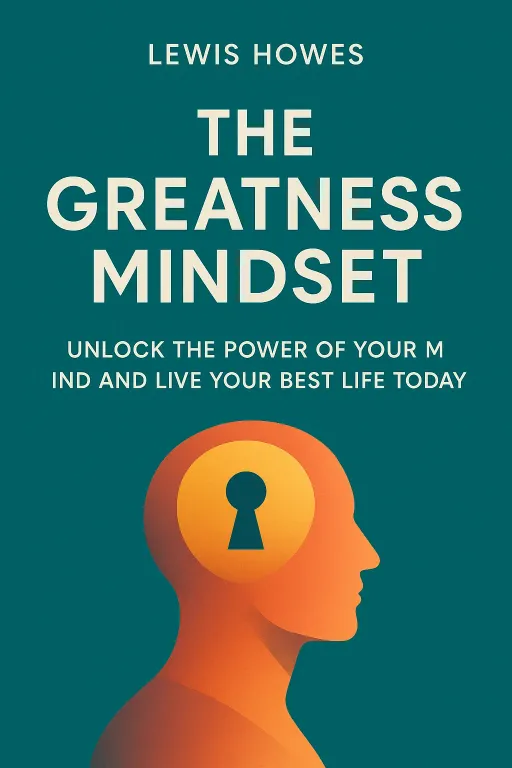
Decoding Greatness: An Analyst's Guide to Mindset Architecture
Golden Hook & Introduction
SECTION
Albert Einstein: What if I told you that your life is generating data every single second? Every decision, every hesitation, every success, every failure—it's all data. But are you analyzing it? Or are you letting a faulty, outdated program run your life on autopilot? Many of us are running on code written by our fears and our past, but today, we're going to talk about a system upgrade. We're diving into Lewis Howes's brilliant book, "The Greatness Mindset," to learn how to become the lead architect of our own success.
Albert Einstein: Today we'll dive deep into this from three perspectives. First, we'll explore how to define your 'Meaningful Mission' as the core operating system of your life. Then, we'll discuss how to debug the 'dream-killing' bugs of fear and self-doubt. And finally, we'll focus on the 'Game Plan for Greatness'—a concrete framework for turning your vision into reality.
Albert Einstein: And to help us decode this blueprint, we have Eunice Essuman, a data analyst whose entire world is about finding patterns and optimizing systems. Eunice, welcome. It feels like this book was written for someone with your mind.
Eunice Essuman: Thank you for having me, Albert. It's a fascinating premise. We spend so much time optimizing business processes and technological systems, but rarely do we apply that same rigorous, analytical lens to the most important system of all: ourselves. I'm excited to dig in.
Deep Dive into Core Topic 1: Defining Your 'Meaningful Mission'
SECTION
Albert Einstein: Wonderful. So, let's start at the foundation. Howes argues that before any action, you need a 'Meaningful Mission.' It's the 'why' that powers everything. Without it, we're just... processing tasks without a purpose, like a computer running random calculations.
Eunice Essuman: It's the core business objective. Without knowing what you're trying to achieve, any analysis is meaningless. You're just looking at numbers.
Albert Einstein: Precisely! And the book gives a powerful example of someone who had to find a new objective after his first one failed spectacularly. Let's talk about Dwayne 'The Rock' Johnson. It's hard to imagine now, but in his early twenties, his dream was to be a professional football player. He poured everything into it. But then, he was cut from the Canadian Football League. He found himself back in his parents' small apartment in Florida, completely broke. He famously had only seven dollars in his pocket. His life's entire operating system, the program that said 'I am a football player,' had just crashed.
Eunice Essuman: A critical system failure.
Albert Einstein: A total failure. He was depressed, lost, and had no idea what to do. But after weeks of this, he had a moment of clarity. He realized he was meant for something more. This wasn't the end. It was a reboot. He looked at his life, his history. His father and grandfather were professional wrestlers. He was built like a titan. He had charisma. He decided his new mission wasn't to be a football player, but to be an entertainer.
Eunice Essuman: That's a powerful story, Albert. From an analytical standpoint, what he did was a classic pivot. His initial strategy failed. So, he conducted an inventory of his core assets—his physical presence, his family's legacy in wrestling, his charisma—and identified a new market opportunity where those assets would be more valuable. He didn't just wish for a new dream; he re-allocated his resources toward a new, more viable objective.
Albert Einstein: Yes! He re-allocated his resources! I love that. He didn't just change his goal; he changed his entire operating system from 'I must be a football player' to 'I will entertain and connect with millions.' Howes calls this finding your 'sweet spot'—the intersection of your passion, your power, and a problem you can solve.
Eunice Essuman: And that's key. In business, we can't just build a product because we like it; it has to solve a customer problem. His 'problem' was that the world needed a new kind of superstar. It's a perfect mapping of personal assets to a market need. He found product-market fit for himself.
Albert Einstein: Product-market fit for a person! Isn't that a wonderful way to think about it? You have to find where your unique talents can best serve the world. That becomes your mission, your North Star.
Deep Dive into Core Topic 2: Debugging the 'Dream Killers'
SECTION
Albert Einstein: But even with a clear mission, a perfect North Star, Howes says our progress can be sabotaged by internal 'bugs.' And the biggest one, the most persistent piece of malware in the human mind, is the fear of failure. It's a 'dream killer' that stops us before we even start.
Eunice Essuman: It's a logic loop that says, 'If the probability of failure is greater than zero, do not execute.' It's paralyzing.
Albert Einstein: Exactly. And to illustrate how to debug this, Howes tells the story of Sara Blakely, the founder of the shapewear company SPANX. Before she was a billionaire, she was selling fax machines door-to-door. She had this great idea for footless pantyhose, but she had no experience, no connections. She spent two years driving around, pitching her idea to hosiery mills, and every single one of them, run by men, told her no. They rejected her.
Eunice Essuman: So she's getting a consistent 'error' message from the market.
Albert Einstein: A consistent, loud 'error' message! Most people would have given up. But Sara had a secret weapon. When she was growing up, her father would ask her and her brother at the dinner table every week, "So, what did you fail at this week?"
Eunice Essuman: Wow.
Albert Einstein: Right? If they didn't have a failure to report, her father would be disappointed. He taught them that failure wasn't the opposite of success; it was a necessary part of it. He was essentially teaching them to seek out data.
Eunice Essuman: I love that. It's a mindset shift from 'failure is a verdict' to 'failure is data.' As an analyst, if a query I write returns an error, I don't quit my job. I debug. I analyze the error message to understand it failed, and then I rewrite the code. Her father taught her to see rejection not as a personal failing, but as an error message from the market that she could use to refine her approach.
Albert Einstein: A brilliant analogy! And Howes argues this is how we should treat self-doubt too. He calls it another 'Dream Killer.' It's just a recurring bug in our code, often stemming from past experiences. The book talks about healing the past to stop these bugs from running in the background and draining our processing power.
Eunice Essuman: Right. It's about root cause analysis. The symptom might be procrastination or avoiding a challenge. But the root cause could be an event from ten years ago that installed a faulty belief, a line of code that says 'I'm not good enough' or 'People like me don't succeed at this.' You have to patch the source code, not just keep fixing the same recurring error on the surface.
Albert Einstein: You have to go deep and rewrite the code. That's the work. It's not just about positive thinking; it's about deep, structural change to your internal system.
Deep Dive into Core Topic 3: The 'Game Plan for Greatness'
SECTION
Albert Einstein: So, once we have our mission and we've started debugging our fears, we need an execution strategy. A plan. This is where Howes introduces the 'Game Plan for Greatness,' which is less of a vague idea and more of a project plan.
Eunice Essuman: This is where it gets really interesting for me. A vision without a project plan is just a hallucination.
Albert Einstein: I suppose it is! Howes offers a very practical algorithm for this, which he calls the S. A. E. C. process. It's an acronym. S is for Schedule: what gets scheduled gets done. Put your priorities on the calendar. A is for Automate: find ways to automate repetitive tasks to free up mental energy. E is for Eliminate: be ruthless about cutting out tasks and commitments that don't serve your mission. And C is for Celebrate: acknowledge your wins, big and small, to build momentum.
Eunice Essuman: This is the language of tech and project management. It's an agile framework for life. 'Schedule' is your sprint planning—defining what you'll accomplish in a set period. 'Automate' is like writing a script to handle a repetitive data-cleaning task so you can focus on higher-level analysis. 'Eliminate' is crucial—it's cutting scope creep. In any project, new 'features' or requests pop up that can derail you. You have to be disciplined and say no to focus on the Minimum Viable Product, or in this case, your most important goal.
Albert Einstein: And the celebration?
Eunice Essuman: That's the team demo or the project retrospective after a successful sprint. It's vital for morale and for reinforcing what works. It's how you build a culture of success. By applying this S. A. E. C. framework, you're not just dreaming about greatness; you're actively engineering it. You're transforming a 'dream' into a 'project' with clear deliverables, deadlines, and success metrics.
Albert Einstein: It takes the emotion and the mystery out of it and turns it into a process. A system that anyone can follow.
Synthesis & Takeaways
SECTION
Albert Einstein: So, when we zoom out and look at the whole picture, it seems the architecture of greatness is surprisingly logical. It's not some mystical gift. It's a buildable system.
Eunice Essuman: Absolutely. You need a clear objective—your Meaningful Mission. That's your system's purpose. You need to perform quality assurance by constantly debugging your internal code—your fears and self-doubt. And you need an agile execution plan, like S. A. E. C., to deploy your project and get it done.
Albert Einstein: Design, debug, deploy. A three-step process for a better life. I think our listeners can work with that. Eunice, this has been incredibly insightful. You've really helped us structure these ideas in a powerful way.
Eunice Essuman: My pleasure, Albert. It's what I do—find the structure in the chaos.
Albert Einstein: And you do it brilliantly. To leave our listeners with something to chew on, something to start their own analysis...
Eunice Essuman: Exactly. It's a system. And for anyone listening who wants to start building their own system, the book offers many 'Courageous Questions.' Let's leave our listeners with just one to ponder this week. It's a question that bypasses all the practical excuses and gets right to the core data.
Albert Einstein: What is it?
Eunice Essuman: 'If you won the lottery today, what would you do next?' The answer to that question isn't about money; it's data that points to your true, unconstrained mission. Analyze that, and you've found the starting point for your own greatness mindset.









