

The Counter-Narrative: 'Progress' is a Trap? Why You Need to See History's Cycles.
Golden Hook & Introduction
SECTION
Nova: What if I told you that the idea of constant, unstoppable progress is actually a dangerous illusion? That history isn't a straight line, but a series of predictable loops, and understanding them is your ultimate strategic advantage.
Atlas: Whoa. That's a bold claim, Nova. Most of us are taught to believe in that steady upward climb, right? Especially those of us trying to build something sustainable. My mind immediately goes to, "Where's the data for that kind of assertion?"
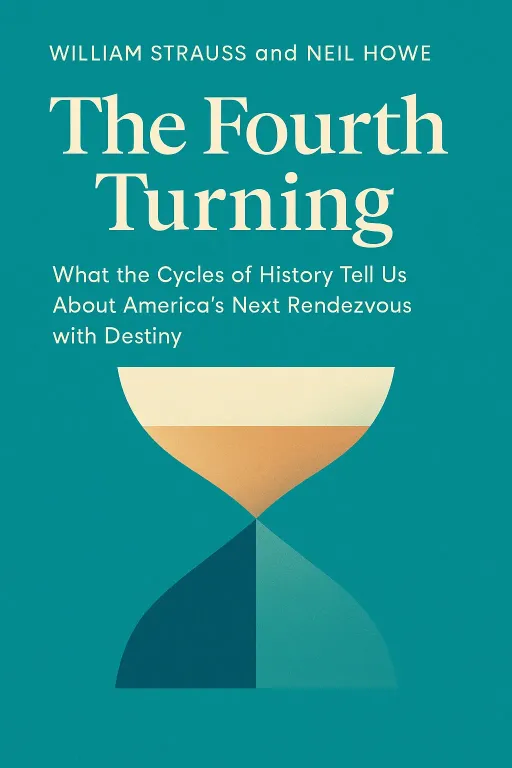
Nova: Exactly! And that's our blind spot. Today, we're diving into a fascinating counter-narrative, drawing from two incredibly insightful works: by William Strauss and Neil Howe, and by David Hackett Fischer. What's remarkable about these authors is how they each, in their own way, challenged the prevailing historical narrative. Strauss and Howe, for instance, created a framework so compelling it's become almost prophetic for many strategists, despite initial academic skepticism. Fischer, on the other hand, brought a meticulous, data-driven approach to economic history that was groundbreaking in its scope, revealing patterns few had dared to connect.
Atlas: So, when you say "predictable loops," are we talking about history repeating itself verbatim, or something more nuanced? Because for leaders, recognizing patterns is key, but blindly following them can be disastrous.
Nova: That’s the critical distinction, Atlas. It's not about exact repetition, but recurring archetypes, patterns, and mood shifts. It’s about recognizing the rhythm of eras, which brings us to our first core idea.
The Rhythm of Eras: Understanding Societal Cycles
SECTION
Nova: Strauss and Howe, in, proposed that history moves in predictable generational cycles, or 'turnings,' each lasting roughly 20-25 years, the length of a human generation. They identified four distinct phases: the High, the Awakening, the Unraveling, and the Crisis.
Atlas: Okay, so what defines a 'High' versus an 'Awakening'? Can you give us an example so we can really grasp what these turnings feel like?
Nova: Absolutely. Imagine the "High" as a period of strong institutions, collective purpose, and relative consensus. Think post-World War II America: a booming economy, shared national identity, trust in government. It’s a time of order. Then comes the "Awakening." This is where individuals start to question that order, seeking personal and spiritual autonomy. The 1960s and 70s are a perfect example: civil rights movements, counterculture, a blooming of individualism, but also a fragmentation of that previous consensus.
Atlas: I see. So the 'High' is about collective strength, and the 'Awakening' is about individual expression, often challenging that very collective. That makes sense when you look at how different generations come of age and react to the world they inherit. But then what? Does it just fall apart?
Nova: That’s where the "Unraveling" comes in. This is a period of weakening institutions, growing cynicism, and a focus on self-interest. Think late 20th and early 21st century: increasing political polarization, cultural wars, a sense of drift. Individualism can become atomization. And finally, the "Crisis." This is a period of great upheaval, where society faces existential threats, and collective action becomes necessary for survival. It's a time of major institutional destruction and rebuilding.
Atlas: That sounds a bit unnerving, Nova. For someone trying to build a resilient organization, the idea of an 'Unraveling' or a 'Crisis' turning can feel incredibly daunting. Are these cycles truly inevitable, or can leaders and communities influence their trajectory? How much agency do we actually have within these grand historical waves?
Nova: That's a crucial question. Strauss and Howe aren't suggesting a deterministic future where we're powerless. Instead, they offer a framework for. If you understand the mood and challenges of the current turning, you can anticipate the kind of leadership and innovation that will be most effective. For example, during an Unraveling, building consensus is incredibly difficult, so leaders might focus on empowering smaller, agile teams. During a Crisis, the demand for clear, decisive action and shared sacrifice becomes paramount. It’s about recognizing the landscape to better navigate it, not being swept away blindly. They argued that understanding your generational archetype and the turning you're in helps you play your part more effectively.
Atlas: That's a much more empowering perspective. It's like having a weather forecast for societal mood swings. It doesn't stop the storm, but it helps you prepare your shelter. But if societal moods shift like this, what are the underlying forces driving these massive currents? Because for anyone building a long-term strategy, the economic current is often the strongest.
The Economic Undertow: How Waves of Price & Wages Shape History
SECTION
Nova: Precisely, Atlas. And that naturally leads us to David Hackett Fischer’s monumental work,. While Strauss and Howe looked at generations and societal moods, Fischer delved into the deep, slow-moving economic forces that underpin much of this change: long-term patterns of prices and wages.
Atlas: Price and wages? That sounds incredibly granular compared to societal turnings. What kind of patterns did he uncover, and how do they connect to something as vast as social stability?
Nova: He meticulously analyzed centuries of data, from medieval times through the modern era, revealing that economies don't just grow steadily. Instead, they experience these massive "waves" of inflation and deflation, often lasting for decades or even centuries. A classic example is the great price revolution of the 16th century, driven by the influx of silver from the Americas. It led to massive inflation across Europe, enriching some while impoverishing others, fueling social unrest, and contributing to major political upheavals. He showed how these economic shifts weren't just numbers on a ledger, but powerful forces that literally reshaped societies, driving migrations, wars, and even cultural movements.
Atlas: So, are you saying that some of our current economic anxieties—like discussions around inflation or the cost of living—are just echoes of these ancient waves? For a leader trying to navigate today's markets, does this suggest a different kind of financial resilience, a focus on understanding these deep currents rather than just reacting to quarterly reports?
Nova: Absolutely. Fischer's work suggests that understanding these deep economic waves can offer profound insights into our current situation. When you see similar patterns of rising prices, wage stagnation for some, and increasing social stratification, it's not simply a contemporary problem; it’s a familiar pattern playing out again. It suggests that leaders need to think beyond short-term economic indicators and consider the much longer cycles of resource availability, population growth, and monetary policy that drive these waves. It's about building a strategy that can withstand, and even thrive within, these long-term economic shifts.
Atlas: That’s a powerful connection. So, on one hand, we have Strauss and Howe giving us a map of societal moods and generational shifts, and on the other, Fischer is showing us the underlying economic engine that can fuel or constrain those shifts. It’s a much more comprehensive view of historical change than that simple upward arrow we always draw.
Nova: Exactly. The beauty is in seeing how these two frameworks intersect. An economic wave of inflation, for instance, could exacerbate the tensions within an "Unraveling" turning, pushing it closer to a "Crisis." Conversely, a period of economic stability might help a "High" turning maintain its cohesion. They aren't isolated; they're deeply interwoven, creating the complex tapestry of history.
Synthesis & Takeaways
SECTION
Nova: What both of these perspectives ultimately challenge is our inherent 'blind spot' – the assumption that progress is linear and inevitable. By recognizing history's cyclical nature, both in societal mood and economic patterns, we gain a crucial strategic advantage. It's not about predicting the future with certainty, but about understanding the forces that drive societal collapse and renewal, equipping us to build with greater foresight.
Atlas: That's really powerful, Nova. It shifts the entire perspective from simply reacting to events to understanding the underlying currents and preparing for what's likely to come. For our listeners who are builders and leaders, especially those focused on sustainable success, this isn't just academic; it's a call to a deeper, more informed strategic mindset. It makes me ask that deep question we posed earlier: Where in today's world do you observe echoes of past cycles, and how might that inform your long-term strategies?
Nova: Precisely. It’s about building a mental model that allows you to see the familiar in the novel, to recognize that while the specific events change, the human and economic dynamics often rhyme. This perspective empowers you to make choices today that are resilient against the long arc of history, not just the next quarter.
Atlas: It’s about being a strategic storyteller with data, understanding the narrative of the past to shape a better future. I imagine many of our listeners will be thinking about how they can apply these cyclical frameworks to their own long-term planning, whether it's for their team, their organization, or even their personal growth journey. We want to hear your thoughts on this! Head over to our community and share where you observe these echoes of past cycles in today's world. Let's start a conversation about how this might inform your long-term strategies.
Nova: That’s a fantastic invitation, Atlas. We love hearing from you and seeing how these ideas resonate.
Atlas: And that's all for today's episode.
Nova: This is Aibrary. Congratulations on your growth!