

The 'Growth' Trap is a Trap: Why You Need Degrowth Principles.
Golden Hook & Introduction
SECTION
Nova: Alright, Atlas, let me hit you with a thought experiment right out of the gate. What if the very thing we’ve been relentlessly told is the key to all prosperity—this idea of endless, perpetual growth—is actually the biggest, most elaborate trap preventing us from building a truly better future?
Atlas: Whoa. That’s a bold claim, Nova. My initial gut reaction is, “But… isn’t growth good? Isn’t that how we get innovation, better living standards, more opportunities?” That’s the narrative we’re all steeped in.
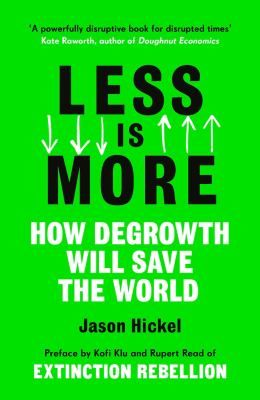
Nova: Exactly! And that’s the trap, right there. Today, we’re peeling back the layers on something we’re calling “The 'Growth' Trap is a Trap: Why You Need Degrowth Principles.” We’re diving into the brilliant, often challenging, insights from thinkers like Jason Hickel, author of "Less Is More," and Nate Hagens, who’s been illuminating the complex interplay of energy and economics with "The Great Simplification." These are voices that are really pushing us to question the foundational assumptions of our entire economic world.
Atlas: Okay, so we’re not just talking about a minor tweak to the system. You’re talking about a fundamental re-evaluation. That’s going to resonate with anyone who’s ever looked at a problem and thought, “There has to be a better way to design this.”
The Inevitable Collision: Why Endless Growth on a Finite Planet is a Trap
SECTION
Nova: Precisely. And the first big blind spot these thinkers point out is our societal obsession with endless growth. We’re often caught in this cycle of constantly needing more—more production, more consumption, more GDP. The problem is, this pursuit overlooks two absolutely undeniable truths.
Atlas: And those truths are?
Nova: First, the planet’s finite boundaries. It’s a closed system, Atlas. We have limited resources, limited capacity to absorb pollution, and limited biodiversity. You can’t have infinite growth on a finite planet. It’s like trying to infinitely expand your garden in a tiny backyard. At some point, you run out of soil, sun, and space.
Atlas: That makes sense when you put it like that. We intuitively understand it in our own lives—you can’t just keep buying bigger shoes or adding rooms to your house forever. But somehow, at a societal level, it feels like we’ve convinced ourselves we can.
Nova: We absolutely have. And the second truth it ignores is the deep human need for well-being over sheer material accumulation. We’ve equated "more stuff" with "more happiness," when countless studies and, frankly, our own lived experience, tell us that’s not entirely true. Hickel, in particular, argues that this pursuit of infinite growth isn't just ecologically destructive; it’s also profoundly socially inequitable. It concentrates wealth, exploits labor, and exacerbates inequalities.
Atlas: So, you’re saying that the very engine we believe lifts everyone up might actually be pushing some down, and pushing the planet to its breaking point? That’s… a lot to unpack. But wait, if we stop growing, don't economies collapse? Doesn't that mean job losses, poverty, a decline in living standards? That’s the fear, right?
Nova: That’s the immediate, understandable fear, and it’s why the concept of "degrowth" can sound almost heretical. But Hickel isn't advocating for deprivation or a return to the Stone Age. He’s advocating for a of prosperity. It's about reducing throughput—the amount of stuff we extract, produce, use, and discard—in wealthy nations, to allow for greater equity and ecological restoration, while simultaneously raising living standards for the global majority who need it.
Atlas: Okay, so it’s not about everyone having less, but about a more intentional, equitable distribution.
Nova: Precisely. Then we have Nate Hagens, who gives us "The Great Simplification." He explains that our entire current system—our economy, our infrastructure, our daily lives—is built on an incredibly energy-intensive foundation. Think about it: everything from your smartphone to your takeout coffee, to the roads you drive on, relies on a massive, constant input of cheap, abundant energy, primarily fossil fuels.
Atlas: I’ve been thinking about that. It’s like we're running a marathon on a treadmill that's powered by a rapidly depleting battery. We keep pushing for more, but the energy source is finite.
Nova: A perfect analogy! Hagens highlights that this isn't just an environmental issue; it's a fundamental economic and ecological one. The "simplification" he talks about isn't a choice; it's an inevitable consequence of hitting those energy and resource limits. Our current systems are not designed for this reality.
Atlas: So, the blind spot isn't just theoretical; it's built into the very architecture of our modern world. It makes sense why it's so hard to see, let alone change. Because it’s everything.
Beyond Scarcity: Designing for Degrowth, Efficiency, and Equitable Systems
SECTION
Nova: It truly is everything. And if endless growth is the trap, as we’ve discussed, then what's beyond it? This naturally leads us to the idea of degrowth not as a sacrifice, but as a design principle for something genuinely better.
Atlas: That’s the million-dollar question, isn’t it? How do we actively incorporate principles of degrowth and resource efficiency into system design, rather than just managing scarcity? Because as an architect of systems, I’m not just interested in pointing out problems; I want to build solutions.
Nova: And this is where it gets really exciting! Degrowth offers a fundamentally different lens. It’s about moving beyond simply managing scarcity—which is often a reactive, stop-gap measure—to actively designing for resource and. Imagine a system where products are designed not for planned obsolescence, but for extreme durability, easy repair, and modularity.
Atlas: Like a smartphone that you can upgrade piece by piece, instead of having to buy a whole new one every two years? That would be a game-changer for so many people, not just for their wallets but for the planet.
Nova: Exactly! Or think about our transportation infrastructure, where instead of building ever more roads to accommodate more cars, we design for walkable cities, robust public transit, and shared mobility options. This isn't about telling people they can't have things; it’s about creating systems where the default is efficiency, where the default is sharing, where the default is longevity. It’s about designing out the waste and the need for constant extraction.
Atlas: So, it's a shift from a linear "take-make-dispose" model to something circular, something regenerative. What would an equitable system look like under these principles? How does it specifically address the justice aspect you mentioned earlier?
Nova: That’s a crucial distinction. An equitable degrowth system prioritizes human well-being and ecological health over corporate profit and capital accumulation. It would look like robust public services—universal healthcare, excellent education, affordable housing—that aren’t tied to endless economic expansion. It would mean shorter working weeks, fostering more time for community and leisure, and a fairer distribution of resources and labor, especially globally. It's about shifting resources from wasteful, destructive industries towards sectors that genuinely improve lives and regenerate the planet.
Atlas: I can see that. It's about moving from a quantity-focused economy to a quality-focused society. It’s not just about less, it’s about. And Nova’s Take on these insights really drives this home: it’s about a more realistic and hopeful vision for a resource-based economy.
Nova: Absolutely. This vision shifts our focus from the abstract number of GDP to concrete metrics of well-being, ecological health, and social justice. It’s an economy that respects the biophysical limits of our planet while ensuring everyone has enough to live a good life. It challenges us to rethink our definition of "wealth" itself, moving it from monetary accumulation to the richness of our relationships, our communities, and our natural world.
Atlas: That gives me chills, in a good way. It’s about designing not just for survival, but for thriving within the constraints of our shared home.
Synthesis & Takeaways
SECTION
Nova: So, ultimately, degrowth isn't about going backward or imposing austerity. It's a profound design challenge for our time: how do we consciously and equitably scale down resource throughput while simultaneously scaling up human well-being and ecological flourishing? It’s about being visionary enough to see beyond the current economic paradigm and architect a future that truly works for everyone, and for the planet.
Atlas: It’s a call to action for anyone who designs, anyone who aligns, anyone who has a vision for a better world. It’s about applying that powerful intellect, that sense of justice, to build systems with nature’s wisdom. Not just managing scarcity, but actively designing for efficiency and abundance in what truly matters.
Nova: Exactly. It's about trusting your vision, knowing it's clear and vital, and then connecting those grand ideas to real-world projects, whether local or global. It’s about ecological economics, new governance structures, and community resource management all coming together.
Atlas: A powerful reframe for how we think about progress.
Nova: This is Aibrary. Congratulations on your growth!