

The People-Profit Equation: Decoding the Good Jobs Strategy
Golden Hook & Introduction
SECTION
Nova: Jackson, I want to start with a puzzle that seems to defy business logic. Imagine two companies. Company A pays its employees rock-bottom wages with unpredictable schedules. Company B pays its employees nearly double, with great benefits and stable hours. Now, which company do you think has lower prices, better customer service, and higher profits?
Jackson: Well, conventional wisdom, and probably most introductory economics courses, would point to Company A. Lower labor costs should mean lower prices and higher profits, assuming all else is equal.
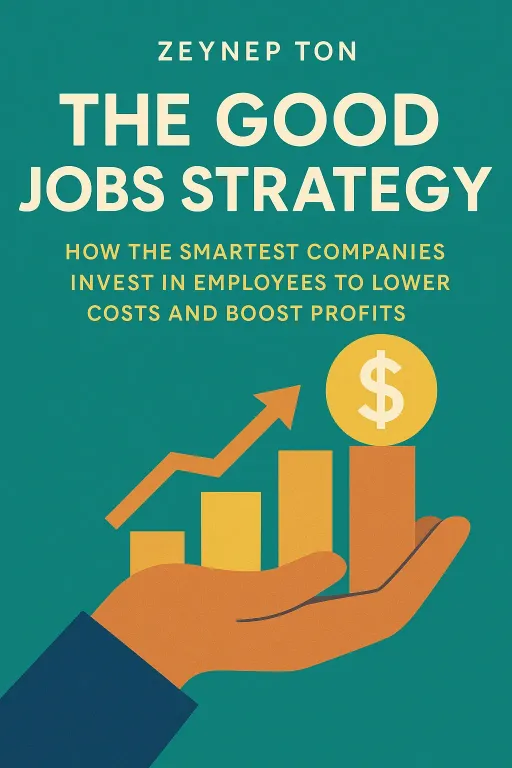
Nova: Exactly! That’s what we’re all taught. But the answer, surprisingly, is Company B. And today, we're going to unpack the data and the stories behind this paradox using Zeynep Ton's incredible book, "The Good Jobs Strategy." It’s a book that really challenges us to rethink the entire relationship between people and profit.
Jackson: I love a counter-intuitive finding. In data analysis, that’s usually where the most valuable insights are hiding. I’m intrigued.
Nova: I knew you would be! As a data analyst with a PhD, you're the perfect person to explore this with. The book argues that treating employees well isn't charity; it's a strategic choice that, when combined with smart operations, creates an unstoppable competitive advantage. Today we'll dive deep into this from two perspectives. First, we'll uncover the hidden systems at play by contrasting the 'vicious cycle' of bad jobs with the 'virtuous cycle' of good ones. Then, we'll get practical and explore the specific operational levers, the 'how-to' guide, that smart companies use to make this strategy a reality.
Deep Dive into Core Topic 1: The Two Cycles
SECTION
Nova: To really get this, we have to understand what the book calls the 'vicious cycle of retail.' And there's no better way to see it than through the eyes of a real person. The book introduces us to a woman named Janet. In 2005, after her small video rental business failed, she took a job at a big-box retail chain, starting at about eight dollars an hour.
Jackson: A familiar story for many people, unfortunately. A new start.
Nova: Right. And Janet was a hard worker. Over seven years, she was promoted multiple times, eventually becoming a customer service manager responsible for dozens of employees. But after all that time and all those promotions, her pay had only climbed to $11.60 an hour. Her annual income was around $22,000.
Jackson: So her reward for seven years of loyalty and increased responsibility was a wage that's still hovering around the poverty line for a small family.
Nova: Exactly. And it gets worse. Her schedule was pure chaos. She’d work a 2 p. m. to 11 p. m. shift one day, then be expected back at 10:30 a. m. the next. Sometimes she'd finish at 9 p. m. and have to be back at 5 a. m. for a "clopening" shift. She said, "My life is always in turmoil because you can't sleep. You can't just go to sleep on cue." She had health insurance, but the deductible was $3,500. On her salary, that meant she couldn't afford a recommended surgery. She felt helpless, not just for herself, but for her customers. Understaffing meant long lines, angry shoppers, and she couldn't get help from other employees because they were just as swamped.
Jackson: That's a powerful story, Nova. What strikes me is that Janet is trapped in a system designed for failure. From a data perspective, her employer is likely only tracking direct labor cost per hour, not the hidden costs of her stress, her inevitable errors, or the lost sales from frustrated customers walking away. It's a classic case of optimizing for the wrong, easily-measured metric. You're measuring the cost of the input—her time—but completely ignoring the quality of the output.
Nova: You've just perfectly described the vicious cycle. The company cuts labor costs, which leads to overworked, undertrained, and stressed employees like Janet. That leads to poor service and operational mistakes. That, in turn, leads to lower sales and profits, which then pressures management to cut costs even further, and the cycle just spirals downward.
Jackson: It's a negative feedback loop. Each action reinforces the negative trend. And it's so hard to break because the initial action—cutting labor costs—looks like a smart, immediate financial win on a spreadsheet.
Nova: Exactly. Now let's flip the coin and look at the 'virtuous cycle' through the story of Patty at QuikTrip, the convenience store chain. Patty started right out of high school, planning to work there temporarily. But she quickly saw it was a real career. After seven years—the same amount of time as Janet—she was earning almost triple Janet's salary. By 2010, she was making over $70,000 a year as a manager.
Jackson: Seventy thousand a year at a convenience store? That is… not what I would have predicted.
Nova: Right? And it came with affordable healthcare and a stable schedule that allowed her to attend her kids' school activities. She said, "You don't have to worry about, Am I going to get laid off tomorrow? or, Where's the next meal coming from?" And here's the kicker for your data-loving brain, Jackson: QuikTrip, the company paying Patty so well, has sales per square foot that are 50% higher than the industry average and profits per store that are more than double the average.
Jackson: So QuikTrip is building a positive feedback loop. Higher investment in people like Patty leads to lower turnover, which means they retain experienced, productive employees. That high productivity and great service drives higher sales and profit, which then funds the initial investment and allows for even more. It's a completely different operating system.
Nova: It is! And you just said the magic words: "operating system."
Jackson: It makes me think about teacher retention in schools. The districts that invest more in teacher support, professional development, and competitive salaries often see lower turnover. Those experienced, motivated teachers then lead to better student engagement and outcomes. It feels like the same virtuous cycle, just in a different sector.
Nova: That's a perfect parallel. And it proves this isn't just a retail phenomenon. It's a human capital strategy.
Deep Dive into Core Topic 2: The Operational Levers
SECTION
Nova: You've hit on the key, Jackson—it's a different. And that's not just about being nice or paying people more. The book argues it's about making four specific, and often counter-intuitive, operational choices that make the high investment in people pay for itself. Let's zoom in on one that I think you'll find fascinating: 'Offer Less'.
Jackson: 'Offer Less'? That sounds like the opposite of what every business tries to do. The assumption is always that more choice is better for the customer.
Nova: That's the fallacy! The book talks about the "tyranny of choice." There's a famous study where researchers set up a jam tasting booth. When they offered 24 types of jam, more people stopped to look, but only 3% actually bought a jar. When they offered only 6 types of jam, 30% of people bought one.
Jackson: That's a tenfold increase in conversion rate. It's choice paralysis. The cognitive load of deciding between 24 options is so high that people just opt out.
Nova: Precisely. And the book brings this to life with a brilliant story, a skit students created to compare buying pickles at a traditional supermarket versus at Trader Joe's. In the supermarket, the customer is lost in a massive aisle with dozens of pickle jars, all different prices and types. The employee they find doesn't know anything about them. It's overwhelming and frustrating.
Jackson: I have lived that exact experience. It’s stressful.
Nova: Then, the skit shifts to Trader Joe's. The customer asks for pickles. The employee, who is cross-trained and knows the products, walks them over to a small selection of just three types. The employee says, "Oh, the bread-and-butter pickles are my favorite, they're amazing on sandwiches." The customer trusts the recommendation, makes a quick, confident choice, and the pickles are half the price of the ones at the other store.
Jackson: That pickle story is brilliant because it's so relatable. And it's a perfect analogy for curriculum design in education. Do we offer students 50 elective choices, many of which are superficially taught, or a curated pathway of 5 high-quality, deeply-taught courses? The 'Offer Less' strategy suggests the latter leads to deeper learning and less confusion. It's about strategic curation, not just reduction. The expertise of the teacher, or the Trader Joe's employee, is what makes the limited selection valuable.
Nova: You're absolutely right. And the book adds a crucial piece of context here. It discusses Walmart's 'Project Impact,' where they tried to 'offer less' by cutting 15% of their products to declutter stores. And it was a huge failure. Sales plummeted.
Jackson: Why did it fail for them but work for Trader Joe's?
Nova: Because they only did half of the equation! They cut the products, but they didn't have the well-paid, well-trained, knowledgeable employees to guide customers through the new, smaller selection. They didn't have the 'pickle expert.' They just had fewer pickles and confused customers.
Jackson: Ah, so the system is interconnected. You can't just pull one lever. Reducing product variety only works if you simultaneously increase your investment in employee knowledge. The employee becomes the substitute for the inventory. That's the key insight. It’s not just 'Offer Less,' it’s 'Offer Less, and Invest More in People.'
Nova: Exactly! And that same logic applies to the other operational choices, like 'Standardize and Empower.' Model companies standardize the routine, predictable tasks to make them efficient, but they empower employees to use their judgment to solve unique customer problems. QuikTrip, for example, involved its own store managers in creating the standards. They didn't just impose rules from the top down. They explained the 'why' behind every standard, linking it to customer value.
Jackson: That speaks directly to the 'Habits' and 'Mindset' I'm interested in. It's not about creating mindless automatons. It's about creating a standardized foundation so that an employee's cognitive energy can be saved for the things that truly require human judgment and creativity. You automate the mundane to empower the human. That's a leadership mindset that respects people's intelligence.
Synthesis & Takeaways
SECTION
Nova: So it all comes back to this beautiful, integrated system. The 'good jobs strategy' isn't just about higher pay; it's about coupling that investment with smart operational choices—like offering less or standardizing and empowering—to create a virtuous cycle that benefits everyone.
Jackson: Exactly. It's a fundamental mindset shift. It moves away from viewing labor as a simple line-item cost to be minimized, and toward seeing it as a key driver of a complex, dynamic system. The companies that win are the ones that understand the whole system, not just one isolated variable on a spreadsheet.
Nova: That's so well put. It’s about seeing the entire equation. So for everyone listening, especially leaders and analysts like Jackson, the takeaway is this: The next time you look at a spreadsheet showing labor costs, ask yourself: What are the hidden costs of investing? What's the price of high turnover, low morale, and poor execution? That's the question at the heart of the Good Jobs Strategy.
Jackson: And the follow-up question is, how can we start to measure those things? How do we quantify the value of a happy customer who comes back, or the cost of a brilliant idea an overworked employee never had the time to think of? That's the real challenge for any data-driven leader. It’s not just about the data you have, but about seeking out the data you’re missing.
Nova: A perfect final thought. It’s about looking for the value that exists just beyond the balance sheet. Jackson, this has been absolutely fascinating. Thank you.
Jackson: The pleasure was all mine, Nova. A truly thought-provoking book.