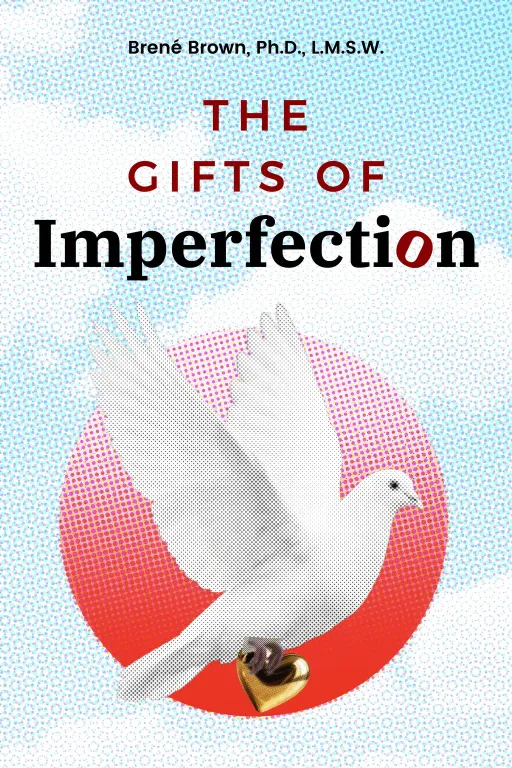
** The Authenticity Blueprint: A Leader's Guide to The Gifts of Imperfection
Golden Hook & Introduction
SECTION
Nova: Have you ever been in a high-stakes meeting, about to present a complex, nuanced idea you truly believe in, only to be told: 'Just keep it light and breezy. People like light and breezy.'? That single moment captures a massive tension for leaders today: the pressure to be authentic versus the pressure to simply please. It's a battle between our integrity and what we think we're 'supposed to be.' In her groundbreaking book,, researcher Brené Brown argues that the path to a fulfilling life and career—what she calls 'Wholehearted living'—lies in embracing that discomfort. Today we'll dive deep into this from two powerful perspectives. First, we'll explore the 'Authenticity Dilemma'—that daily battle between being real and just giving people what they want. Then, we'll discuss how to break free from the 'Perfectionism Shield' that holds so many high-achievers back, and how to replace it with self-compassion.
Nova: And to help us unpack all of this, I'm thrilled to have Simons2345 here, who has spent over fifteen years leading product teams in the media world. Simon, that 'light and breezy' pressure must sound incredibly familiar.
Simons2345: Nova, it's the soundtrack of my job. You're constantly translating deep, sometimes messy, user needs into something palatable for a dozen different stakeholders, each with their own agenda. That phrase is a perfect encapsulation of the daily tightrope walk.
Deep Dive into Core Topic 1: The Authenticity Dilemma
SECTION
Nova: Well, you're going to love this story from the book, because it shows what happens when that tightrope snaps. Brené Brown, who at the time was a relatively unknown shame researcher, gets invited to speak at this very swanky women's networking lunch at a fancy country club. She's excited to talk to a 'normal' audience, not just academics.
Simons2345: Okay, I can already feel the tension building.
Nova: Exactly. The event organizer, who Brené describes as very uptight, learns what her research is about and is horrified. She tells Brené, point-blank: "We don't do shame here." She gives her a list of rules: Don't talk about the hard stuff, don't use the word 'shame,' and above all, keep it 'light and breezy.'
Simons2345: Oh, wow. So she was basically asked to present a version of her work that wasn't her work at all.
Nova: Precisely. And Brené, feeling pressured and paralyzed, agrees. She gets on stage and delivers this generic, disconnected talk about joy and meaning without ever touching on the things that get in the way. She said the audience just smiled, nodded, and ate their chicken salad. The talk was a complete disaster, not because they hated it, but because it wasn't real. There was no connection. Simon, as a leader, what's the cost of 'selling out' your authentic vision for the sake of that kind of safety?
Simons2345: The cost is everything. It's trust, it's innovation, it's team morale. In the product world, if you build something 'light and breezy' that ignores the real, messy user problem, the product ultimately fails. But the damage is deeper than that. Your team, the engineers, the designers who have poured themselves into understanding that messy problem, they see you compromise. They see you choose the easy path over the right one, and they lose faith. You're essentially building your product, and your team culture, on a foundation of inauthenticity.
Nova: That's so powerful. And it's why Brown's definition of authenticity is so important. She says it's the of letting go of who we think we’re supposed to be and embracing who we are. It's not a fixed trait, it's a conscious choice we make over and over. How does that land with you, thinking about it as a constant effort?
Simons2345: It's both daunting and liberating. It's daunting because it's work. It's not a 'set it and forget it' personality trait. But it's liberating because it means you don't have to be 'born authentic.' It's a muscle you build. It also implies that you'll fail at it some days, and that's part of the practice. Which, I think, leads to the real question: how do you handle the pushback? Because when you stop being 'light and breezy,' not everyone is going to be happy.
Nova: You're so right. People get comfortable with the version of you that's easy to digest. When you show up with your full, complex self, it can be disruptive.
Simons2345: It is. And as a leader, you have to be prepared for that. You have to be willing to sit in that discomfort, both your own and your team's, to get to a more honest place. It's the only way to build something that truly matters, whether it's a product or a relationship.
Deep Dive into Core Topic 2: Breaking the Perfectionism Shield
SECTION
Nova: That's the perfect pivot, Simon. Because the pushback we fear from others is often dwarfed by the intense pressure we put on ourselves. This brings us right to the second huge idea from the book: letting go of perfectionism.
Simons2345: The one that I think every high-achiever, myself included, struggles with.
Nova: Absolutely. And Brené is so clear on this: perfectionism is not the same as healthy striving. It's not about being our best. She calls it a twenty-ton shield. It's the belief that if we live perfect, look perfect, and act perfect, we can minimize or avoid the painful feelings of blame, judgment, and shame.
Simons2345: It's a defense mechanism. It's about playing defense, not offense.
Nova: Exactly! And she tells this small but brilliant story. While writing this very book, she needed to email a famous author for permission to use a quote. The author graciously replied, gave permission, and then gently pointed out that Brené had misspelled her name in the email.
Simons2345: Oh, I can feel the cringe from here. That's a perfectionist's nightmare.
Nova: Total nightmare! Her immediate, internal reaction wasn't, 'Oops, I made a typo.' It was, 'I'm a sloppy hack. I'm a fraud.' That's the voice of shame. And this is the distinction she says is the whole ballgame: Guilt is 'I did something bad.' Shame is 'I bad.' How do you see that distinction playing out in a high-achieving team environment?
Simons2345: It's constant, and it's critical. A bug makes it into production. A feature launch misses its target metric. The perfectionist, shame-based mindset says, 'My team is flawed,' or 'I am a failure as a leader.' It becomes about identity. The healthy, guilt-based, self-compassionate mindset says, 'We made a mistake. What did we learn? How do we fix it and move on?' One is a dead end that leads to blame and fear. The other is the absolute engine of agile development and growth. You can't innovate if you're terrified of the shame of failure.
Nova: Yes! You can't innovate from a place of fear. And the antidote she proposes is self-compassion. Which has three parts: being kind to yourself instead of judgmental; recognizing common humanity—that everyone makes mistakes; and mindfulness—not over-identifying with the feeling. It sounds so simple, but in a corporate culture that often celebrates flawlessness, it feels completely revolutionary.
Simons2345: It is revolutionary. And it's a leader's job to model it. It's one of the most important things we can do. If I, as a manager, beat myself up publicly over a small mistake, I'm sending a clear message to my team that that's the standard. That perfection is expected. But if I say, 'Oops, I messed that up. My bad. Here's how we'll fix it,' I give them permission to be human. I give them permission to take smart risks, to be creative, and to own their mistakes without shame. That's how you build psychological safety.
Nova: You create a culture of guilt, which is productive, instead of a culture of shame, which is toxic.
Simons2345: Exactly right. You're creating a space where it's safe to learn.
Synthesis & Takeaways
SECTION
Nova: So, as we wrap up, it feels like we've landed on two powerful, interconnected ideas for any leader listening. First, choosing the daily practice of authenticity, even when it's uncomfortable, is what builds trust and ultimately leads to better, more meaningful outcomes.
Simons2345: And second, that actively dismantling our own perfectionism and replacing it with self-compassion isn't just a 'nice-to-have' for our own well-being. It's a critical leadership function for creating a resilient, innovative team culture where people feel safe enough to do their best work.
Nova: It's been such an insightful conversation. Simon, to leave our listeners with something to chew on, what's one question you'd pose to a fellow leader listening to this right now, based on our discussion?
Simons2345: I'd ask them to think about their next big meeting or presentation. What is one thing you're holding back—an idea, a concern, a piece of data—for fear of it not being 'light and breezy' enough? And what might happen, what new possibilities might open up, if you had the courage to share it anyway? Just reflect on that. The answer might surprise you.
Nova: A perfect, or rather, an imperfectly perfect place to end. Simons2345, thank you so much for bringing such clarity and real-world wisdom to these ideas.
Simons2345: It was my pleasure, Nova. A fantastic conversation.