

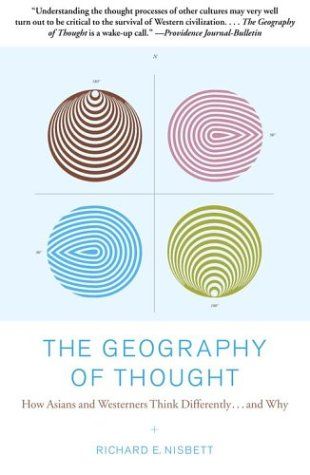
The Geography of Thought: How Culture Shapes How We Think
Golden Hook & Introduction
SECTION
Nova: What if I told you that the way you think, the way you solve problems, even the way you literally see the world, isn't universal? That it's been silently programmed by the culture you grew up in?
Atlas: Whoa, programmed? That sounds a bit unsettling, Nova. I always assumed, you know, a brain is a brain. We all process things pretty much the same way, just with different information.
Nova: That’s a common and understandable assumption, Atlas. But it’s one that a groundbreaking book fundamentally challenges. Today, we're diving into "The Geography of Thought: How Culture Shapes How We Think" by the renowned psychologist Richard E. Nisbett. Nisbett spent decades immersed in cross-cultural research, and his work didn't just tweak our understanding; it completely revolutionized how we view human cognition. It earned widespread acclaim for daring to challenge the Western-centric view that our way of thinking was the default for everyone.
Atlas: So he’s saying there isn't just one universal human mind? That our environment fundamentally rewires our perception? That's a pretty big claim. What kind of differences are we talking about here? Are we talking about accents in thought?
The Cultural Lenses of Perception & Reasoning
SECTION
Nova: It's far more profound than an accent, Atlas. Nisbett demonstrates a deep chasm between what he calls Western analytical thinking and East Asian holistic thinking. Western thought, rooted in Greek philosophy, tends to focus on individual objects and their attributes, using rules and categories to understand the world. It’s like dissecting a machine to understand its parts.
Atlas: Okay, so breaking things down into their smallest components, finding the rules, and making sense of them. That sounds very familiar, especially in problem-solving.
Nova: Exactly. Now, East Asian thought, influenced by Confucianism, Taoism, and Buddhism, emphasizes interconnectedness, context, and relationships. It’s about seeing the whole picture, how all the parts interact within a dynamic system. It’s less about the individual fish and more about the entire pond.
Atlas: The entire pond. That’s a great analogy. But how does this manifest in something as basic as, say, perception? Do people from different cultures actually things differently, or is it more about how they interpret what they see?
Nova: They literally perceive differently. Nisbett cites a fascinating experiment where participants were shown an animated scene of an underwater world. Later, when asked to recall what they saw, Westerners tended to focus on the biggest, fastest-moving fish in the foreground. They'd describe its color, its size, its movement.
Atlas: The focal object, the star of the show, if you will.
Nova: Precisely. East Asians, on the other hand, were far more likely to describe the background, the plants, the rocks, the water currents, and how the fish interacted with its environment. They remembered the context, the relationships, the whole dynamic scene. It's a fundamental difference in where their attention spontaneously lands.
Atlas: That's incredible! So, it’s not just a cultural preference for storytelling; it's a cognitive difference in what information is prioritized and even encoded in memory. I imagine that has massive implications for communication, for understanding intentions, for everything really.
Nova: It absolutely does. Think about how we attribute cause, for instance. A Westerner, observing someone fall, might immediately blame the individual's clumsiness. An East Asian, however, is more likely to consider the slippery pavement, the crowded street, the circumstances. One focuses on the individual agent, the other on the situational factors.
Atlas: That’s going to resonate with anyone who’s ever tried to solve a problem in a diverse team. If one person is always looking for the individual fault and another is always looking at the systemic issues, you're going to have completely different proposed solutions. It’s like they’re speaking different cognitive languages.
Nova: They are, in a very real sense. And this isn't about one being superior to the other. It's about recognizing that these are two powerful, valid, and deeply ingrained ways of processing reality. Ignoring them means missing half the picture, or worse, misinterpreting intentions entirely.
Beyond Individual Mindsets: Collective Beliefs and Global Impact
SECTION
Nova: And that naturally leads us to the second key idea we need to talk about, which often acts as a counterpoint to what we just discussed, and that’s how these ingrained ways of thinking might affect collective beliefs about learning and ability. We can use Carol Dweck's groundbreaking work on "Mindset" as a lens here. Dweck, another highly respected psychologist, showed us the power of individual fixed versus growth mindsets—the belief that intelligence is either static or can be developed.
Atlas: I’m familiar with Dweck’s work; it’s had a huge impact on education and individual development. The idea that believing you can grow makes you more resilient and eager to learn is incredibly empowering. But how does that connect to cultural thought patterns?
Nova: What's even more interesting is how entire cultures can lean towards one or the other, creating a collective mindset. Imagine a culture where the emphasis is heavily on innate talent, where being "smart" is a fixed attribute. Failure in that context can be devastating, seen as proof of a lack of ability. This can stifle innovation because people become risk-averse, fearing exposure of their perceived limitations.
Atlas: Wow, that’s actually really inspiring. So, a culture with a predominant 'fixed mindset' could actually, almost unconsciously, slow down its own progress because of how it interprets mistakes or challenges. It’s like a collective self-fulfilling prophecy.
Nova: Exactly. Conversely, a culture that collectively emphasizes effort, persistence, and learning from mistakes—a growth mindset writ large—will naturally foster environments where experimentation is celebrated, learning is continuous, and resilience is built into the social fabric. Nisbett's work shows us cultures that naturally lean towards a more holistic, interconnected view also often emphasize effort and process over innate ability.
Atlas: That makes me wonder, how does this translate to leading a diverse team? If I have team members from cultures with different collective mindsets, say, one from a highly analytical, fixed-mindset culture and another from a holistic, growth-oriented one, what then? It feels like a minefield for miscommunication.
Nova: It can be if you're unaware. The key is cultural intelligence and adaptability. As a leader, it means recognizing that a team member from an analytical, individualistic culture might expect direct feedback focused on individual performance, while someone from a more holistic, collective culture might prefer feedback delivered within a broader context, perhaps focusing on team contribution or systemic factors.
Atlas: So, it's not just about what you say, but you say it, and understanding the underlying cognitive framework it's being received through. It takes a lot more than just good intentions.
Nova: Absolutely. And in global markets, understanding these deep-seated cognitive differences is paramount. A marketing campaign that emphasizes individual achievement might resonate strongly in one culture but fall flat, or even be seen as inappropriate, in another that values collective harmony or group success. It’s about tailoring not just the message, but the very of the message to the cultural thought pattern.
Atlas: It sounds like Nisbett and Dweck, together, are giving us a powerful framework for understanding why people, and even entire societies, behave and think the way they do. It’s not about judging; it’s about genuinely understanding the mental operating system.
Synthesis & Takeaways
SECTION
Nova: Precisely. The central insight here is that our minds are not blank slates universally programmed. They are profoundly shaped by the cultural context we inhabit. It’s a powerful, often invisible, force that dictates our perception, our reasoning, and our collective beliefs about learning and ability. Ignoring this diversity means operating with a significant blind spot, especially in our interconnected world.
Atlas: So, it's about acknowledging our own "mental zip code" and being curious about others'? That's a great way to put it. For our listeners who are leading diverse teams or navigating global markets, this feels incredibly actionable. What's one concrete step we can take to start applying this?
Nova: One concrete step is simply to cultivate mindful observation. Pay attention to your own default assumptions when you encounter a problem or a new idea. Are you immediately searching for individual causes, or are you looking at the broader system? Then, actively seek out and truly listen to diverse perspectives, especially those that challenge your initial cognitive reflex. Ask, "How might someone from a different background genuinely see this situation differently?"
Atlas: That’s such a hopeful way to look at it, Nova. It turns potential conflict into an opportunity for deeper understanding and, ultimately, more effective leadership. It’s about expanding our own mental geography, isn’t it?
Nova: It truly is. As Nisbett himself eloquently states, "The greatest challenge facing humanity is to learn to live together in a global village." And that learning begins with understanding how profoundly different our minds can be, and how beautiful that diversity truly is.
Atlas: What an incredible journey into the mind. Thank you, Nova.
Nova: Thank you, Atlas.
Nova: This is Aibrary. Congratulations on your growth!