

Stop Guessing at Nature's Code: The Guide to Data-Driven Biological Insight.
Golden Hook & Introduction
SECTION
Nova: Atlas, rapid-fire. I say a word, you give me the first thing that comes to mind. Ready? "Biology."
Atlas: Overwhelming.
Nova: "Data."
Atlas: Answers.
Nova: "Disease."
Atlas: Mystery.
Nova: Okay, so you’re seeing the problem and the solution already, aren't you? That feeling of overwhelming complexity, the search for answers through data, and the enduring mystery of disease. It’s what drives so much scientific inquiry, and it’s precisely what renowned physician-scientist Siddhartha Mukherjee tackles in his seminal works.
Atlas: Oh, I love that connection! Mukherjee is someone who just seems to grasp the enormity of life itself, doesn't he? How does one person even begin to unravel something so vast?
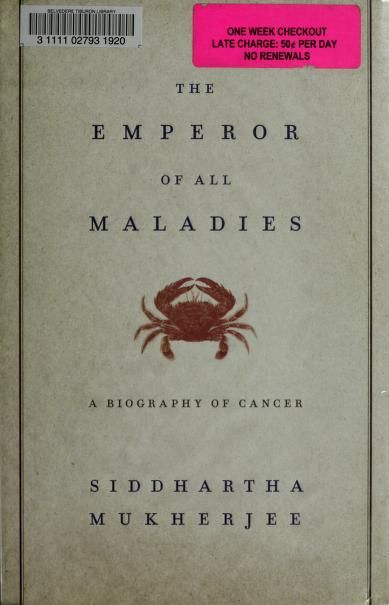
Nova: Well, he does it with a profound understanding of history, a keen eye for scientific detail, and an extraordinary gift for storytelling. Today, we're diving into his Pulitzer Prize-winning book, "The Emperor of All Maladies: A Biography of Cancer," and its brilliant companion, "The Gene: An Intimate History." Mukherjee has this unique ability to weave clinical experience, historical narrative, and cutting-edge science into stories that resonate deeply, making the seemingly impenetrable world of biology not just accessible, but utterly captivating.
Atlas: That’s amazing. And you’re saying he actually provides a framework for cutting through all that biological noise I just mentioned?
Nova: Absolutely. He shows us that understanding biological systems isn't about wild guesses or sudden epiphanies. It's about a relentless, data-driven journey. And that journey, particularly in the realm of disease, is what we’re going to explore today.
The Iterative Nature of Biological Insight
SECTION
Atlas: So how does he do it? How does Mukherjee help us make sense of something as complex as, say, cancer, which he calls the "Emperor of All Maladies"?
Nova: He takes us on a historical odyssey. "The Emperor of All Maladies" isn't just a book about cancer; it's a biography of our understanding of cancer. And what it reveals, in stark detail, is the power of iterative, data-driven progress. For centuries, our understanding of disease, especially cancer, was a chaotic mess of theories. People believed in humoral imbalances, demonic possessions, miasmas – you name it. Treatments were often barbaric, ineffective, and sometimes, frankly, deadly.
Atlas: That sounds rough. I imagine a lot of our listeners can relate to that feeling of trying to solve a problem with incomplete or even misleading information, just on a different scale.
Nova: Exactly. Mukherjee illustrates this beautifully with the early history of cancer. Imagine physicians trying to understand a disease without even knowing what a cell was, let alone a gene. They observed lumps, noted their spread, and tried to cut them out, often with gruesome results. But even in this darkness, there was data. Painstaking, often crude, but data nonetheless. They recorded what worked, what didn't, what recurred. It was empirical observation, slowly, painstakingly, building a picture.
Atlas: Hold on, so when you say 'rigorous data collection,' what does that actually look like in practice when you’re dealing with something so unknown? Isn't there a lot of 'noise' in that early data?
Nova: There was immense noise! But the rigor came from the consistent re-evaluation. Take, for instance, the long, arduous path to identifying cancer not as some external curse or a systemic imbalance, but as a cellular disease, driven by abnormal cell division. This wasn't a sudden 'aha!' moment. It involved centuries of microscopists, pathologists, and clinicians meticulously observing tissues, noting cellular changes, and challenging prevailing theories. Every failed treatment, every puzzling recurrence, every autopsy report was a piece of data, pushing the needle forward.
Atlas: So it's not just about collecting numbers, it's about constantly questioning what those numbers mean, and being willing to admit your previous understanding was flawed. That’s going to resonate with anyone who’s ever had to pivot based on new information.
Nova: Precisely. Mukherjee highlights figures like Rudolf Virchow, who in the mid-19th century, firmly established that all cells come from other cells, and that cancer was fundamentally a disease of rogue cells. This was a monumental re-evaluation, completely shifting the framework. It wasn't about being 'wrong'; it was about refining our understanding with better, more granular data over time. It’s a testament to how scientific progress often looks less like a straight line and more like a winding, sometimes backtracking, path.
Genomics as the Granular Data Revolution
SECTION
Nova: And if "The Emperor" showed us the slow, arduous climb through historical data, "The Gene" reveals the turbocharged ascent we're on now, thanks to genomics. We’ve moved from trying to understand cancer through its symptoms and broad cellular changes to understanding it at its fundamental code.
Atlas: That makes sense, but what exactly do you mean by 'granular data' in this context? I hear 'genomics' and I think DNA, but how does that translate into something truly revolutionary for treating disease?
Nova: Think of it this way: for centuries, we were trying to fix a complex machine – the human body – with only a blurry diagram, observing its external malfunctions. Genomics is giving us the full blueprint, down to every tiny component, every circuit, every line of code. We can now read the entire human genome, identifying the specific genetic mutations, the precise errors in the code, that drive a disease like cancer. This is data at an unprecedented level of detail – truly granular.
Atlas: Wow, that’s a pretty powerful analogy. So you’re saying we’re moving beyond just observing symptoms or even general cellular changes, and we’re digging right into the DNA itself?
Nova: Exactly. This shift allows for what we call 'targeted interventions.' Instead of a broad-spectrum chemotherapy that's essentially a poison blanket, killing both cancerous and healthy cells, we can now design drugs that specifically target the proteins produced by those mutated genes. We’re not just treating the disease; we’re disarming it at its source.
Atlas: That’s incredible. Can you give an example? Like how does that actually work in treating something like cancer?
Nova: Absolutely. Consider a type of breast cancer that tests positive for a mutation in the HER2 gene. Historically, all breast cancers were treated similarly. But with genomics, we discovered that HER2-positive cancers are driven by an overactive HER2 protein. Now, we have drugs like Herceptin that specifically bind to and block that HER2 protein, effectively ‘targeting’ the cancer cells while leaving healthy cells relatively unharmed.
Atlas: That’s a huge leap from the early, brutal treatments you described in "The Emperor of All Maladies." So, this new precision, does it eliminate the 'noise' completely, or just change its nature? And for our listeners who are Future-Focused and interested in Emerging Biotechnologies, what are the practical implications of this level of data?
Nova: It definitely changes the nature of the noise, rather than eliminating it. Now the 'noise' might be sifting through the vast amounts of genomic data to find the mutations, or understanding how multiple mutations interact. But the precision it offers is transformative. For future-focused individuals, this isn't just about better treatments for existing diseases; it's about personalized medicine, where treatments are tailored to an individual's unique genetic makeup. It's about early detection, even disease prevention, by identifying genetic predispositions. It’s fundamentally reshaping our approach to health, from reactive treatment to proactive, personalized care. It’s data science at its most powerful, giving us the tools to understand and ultimately rewrite nature’s code.
Synthesis & Takeaways
SECTION
Nova: So, when you look at Mukherjee’s work, from the historical battles against cancer to the intimate code of the gene, the central message is clear: the only way to truly conquer biological complexity is through relentless, data-informed inquiry. It’s a powerful testament to human curiosity and our ability to learn from both our past and our cutting-edge present.
Atlas: That’s actually really inspiring. It sounds like he’s showing us that understanding disease isn't about guessing in the dark anymore; it's about turning on the lights, bit by bit, through data. It reminds me how crucial that data-driven mindset is in any field, not just biology. It’s about not being overwhelmed by complexity, but systematically breaking it down.
Nova: Exactly. And that systematic breakdown is fueled by curiosity. It's about asking the right questions and then diligently seeking the data to answer them, even if those answers challenge our long-held beliefs. It’s the framework for all future biological insight.
Atlas: I love that. It’s a call to action for anyone who feels overwhelmed by a complex problem. Don’t guess, go find the data.
Nova: Absolutely. So, as a tiny step this week, we challenge you: identify one biological problem you're curious about, big or small, and then go find a dataset related to it. Start your own journey into nature's code.
Atlas: That's a fantastic idea. What an episode!
Nova: This is Aibrary. Congratulations on your growth!