Steering Global Transformation
Golden Hook & Introduction
SECTION
Nova: Here is a number that should keep every strategist awake at night: ninety-three percent of the data we have in the world today was created in just the last few years. We are drowning in information, yet we seem to be starving for a clear direction on how to actually steer our collective future.
Atlas: That is a staggering stat. It feels like we are sprinting on a treadmill that keeps accelerating, and we are just trying to keep our balance. We have all this capability, all this processing power, and yet the biggest systemic problems, especially when it comes to our planet, feel like they are moving in the wrong direction.
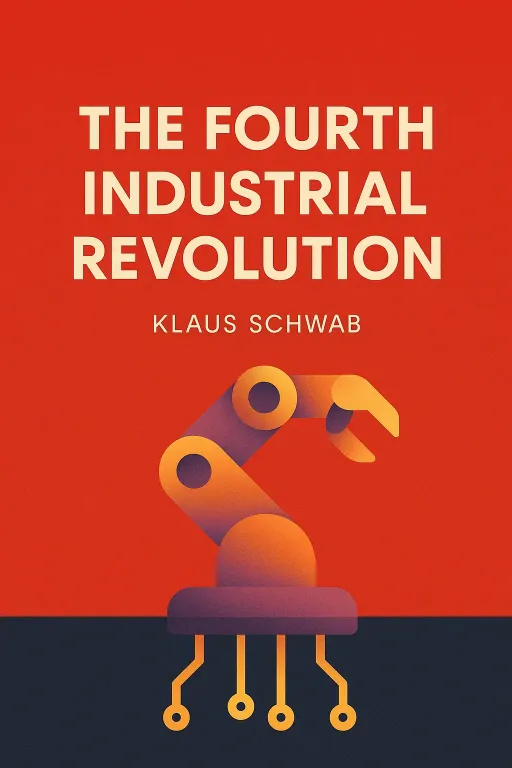
Nova: Exactly. And that tension is exactly where we want to live today. We are looking at two essential frameworks for navigating this chaos. First, we have Klaus Schwab’s The Fourth Industrial Revolution. Schwab, as the founder of the World Economic Forum, has spent decades at the center of the global conversation, and he argues that we are in the middle of a fundamental shift where digital, physical, and biological systems are colliding.
Atlas: And then, to balance that out, we have The Future We Choose by Christiana Figueres and Tom Rivett-Carnac. These are the architects of the Paris Agreement, so they are not just theorists. They are people who have navigated the most complex political and environmental negotiations in history.
Nova: Right. They bring this concept of stubborn optimism to the table, which is the necessary fuel for surviving the transition Schwab describes. Today, we are going to bridge those two worlds: the high-velocity tech landscape and the deep, systemic environmental mission.
The Fourth Industrial Revolution and the Architect's Dilemma
SECTION
Atlas: Okay, let's start with the tech side. Schwab’s book has been discussed in every boardroom from Davos to Silicon Valley. But for the listener who is a focused architect or a strategist, what is the actual takeaway here? Is it just that robots are taking over, or is there a deeper structural shift we need to be tracking?
Nova: It is deeper than just automation. The core of Schwab’s argument is that previous industrial revolutions were about things like steam, electricity, or early computing. This one is different because the barriers between the physical, digital, and biological worlds are evaporating. Think about synthetic biology or AI that can design new materials at the molecular level.
Atlas: That sounds like science fiction. But walk me through what that looks like in a real-world scenario. How does that impact someone managing a business or a complex system today?
Nova: Consider the energy grid. In the past, you built a power plant, you sent electricity out, and you billed the customer. That is a linear, physical model. Now, you have a decentralized grid where every home is a potential battery, managed by AI, responding to weather patterns in real-time. The digital layer—the software managing the flow—is as important as the physical wires.
Atlas: I see the shift. It is the integration of the system. But here is where my skepticism kicks in. This kind of complexity often leads to fragility, not resilience. If you have a system that relies on AI to manage a decentralized energy grid, and that AI fails, or the data stream is compromised, the whole thing crashes. How do we reconcile this rapid tech advancement with the need for stability?
Nova: That is the million-dollar question. Schwab actually addresses this by saying our governance models are the bottleneck. Our laws, our corporate structures, and our ethical frameworks were built for the age of steam and early manufacturing. They are too slow for an age where a biological breakthrough can happen on a Tuesday and change the market on a Wednesday.
Atlas: So, the architect’s job isn't just to adopt the tech, but to design the governance around it?
Nova: Precisely. If you are a leader, your role is to build systems that are adaptive. You cannot rely on static five-year plans when the very tools you are using to execute those plans are evolving every six months. You have to build in what engineers call redundancy and what strategists call optionality.
Stubborn Optimism as a Strategic Tool
SECTION
Atlas: That makes sense. But let’s pivot to the environmental side. Because when I look at the climate challenge, it feels like the opposite of the Fourth Industrial Revolution. Tech feels like it is moving too fast, but climate action feels like it is moving at a glacial pace. How do Figueres and Rivett-Carnac bridge that gap?
Nova: They do it by reframing optimism. In The Future We Choose, they explicitly define optimism not as a feeling or a mood, but as a strategic tool. They argue that if you look at the data—and they have looked at plenty of it—the situation is dire. But if you fall into despair, you become paralyzed.
Atlas: I know that feeling well. It is easy to look at the numbers and decide that the problem is too big for any one person or one company to solve. It leads to apathy.
Nova: Exactly. And apathy is the enemy of strategy. Figueres was the Executive Secretary of the UN Framework Convention on Climate Change, and she spent years watching people get stuck in that exact paralysis. She learned that the only way to get nations to agree on the Paris Agreement was to maintain a radical, stubborn optimism. It is the belief that the future is not something that happens to us, but something we create through our current choices.
Atlas: That’s a powerful distinction. It shifts the burden from predicting the future to constructing it. But how does that apply to someone who isn't a diplomat? How does a pragmatic strategist use stubborn optimism on a Tuesday afternoon?
Nova: You start by asking what they call the present-future question. Instead of asking, "How do we survive the climate crisis?", you ask, "What does a successful, resilient future look like, and what is the one logical step we can take today to get closer to that?"
Atlas: That is an excellent mental model. It turns a massive, abstract existential threat into a series of smaller, actionable design problems. It’s like breaking down a software architecture. You don't try to build the whole app at once; you build the MVP, the Minimum Viable Product, that gets you to the next version of reality.
Nova: That is the perfect analogy. And when you combine that with the Fourth Industrial Revolution, you get a very clear blueprint. You use the tools of the Fourth Industrial Revolution—the AI, the data, the biotech—to solve the design problems you identified through that lens of stubborn optimism.
Atlas: I love that. So, let’s make this concrete. If I am a strategist in a high-stakes environment, how do I align these two things? Give me a scenario.
Nova: Let’s look at supply chain management. A typical firm today is trying to optimize for cost and speed. A company applying these principles would look at their supply chain and ask, "How can we use digital twin technology to map our entire carbon footprint in real-time, and then use AI to optimize for circularity rather than just cheap shipping?"
Atlas: So, the tech is the enabler, but the optimism is the driver. You wouldn't bother building that complex digital twin if you didn't believe it was possible to achieve a net-zero supply chain. You would just settle for the status quo.
Nova: You nailed it. If you lack that core belief, the tech is just a shiny toy. If you have the belief but no tech, you are just a dreamer. The combination is where the real impact happens.
Synthesis and Practical Application
SECTION
Atlas: It’s interesting how these two books, despite being about very different subjects—one about the mechanics of a technological shift, the other about the psychology of environmental survival—actually point to the same conclusion. We are the architects of our own reality.
Nova: That is the takeaway. We have the tools to reshape the physical world, but we need the mental framework to decide what that shape should be. The Fourth Industrial Revolution gives us the power, and The Future We Choose gives us the purpose.
Atlas: For the listeners who value efficiency and actionable blueprints, I think the challenge is to stop viewing tech and sustainability as separate buckets. Don't look at "innovation" and "ESG" as two different departments. They are the same thing. Innovation is how you solve the sustainability problem.
Nova: That is a profound way to put it. The most successful people in the next decade will be the ones who can bridge that gap. They will be the ones who can look at a complex, messy, data-heavy problem and see an opportunity to build a better system.
Atlas: So, for the final thought, how do we leave the listeners with something they can do today?
Nova: I would suggest this: Take thirty minutes this week and look at your current project, your current role, or your business model. Ask yourself: "If I were to apply the most advanced tech available to this problem, what would it look like?" Then, ask the second question: "Does this solution actually lead to a more resilient, sustainable future?" If the answer to the second question is no, then the tech isn't the solution. It is just more noise.
Atlas: That is a sharp filter. It keeps you from getting distracted by the shiny new tools and forces you to focus on the outcome. It turns the Fourth Industrial Revolution into a tool for progress rather than just a source of disruption.
Nova: Exactly. We are not just participants in this change. We are the ones steering it. The speed of the change is intense, but our ability to direct that speed is even greater if we choose to use it.
Atlas: This has been a great conversation, Nova. It feels like we’ve taken two massive, complex topics and actually found the thread that connects them.
Nova: It is always about the connection, Atlas. When you see how the pieces fit, the complexity doesn't feel like a burden anymore. It feels like a canvas.
Atlas: I like that. A canvas. Well, for everyone listening, take that canvas and start designing. This is Aibrary. Congratulations on your growth!