Navigating the Climate Horizon
Golden Hook & Introduction
SECTION
Nova: Most people view the climate crisis as a binary switch. You either believe we are on the brink of an irreversible, apocalyptic collapse, or you believe technology will magically solve everything by Tuesday. But the truth is much more nuanced, and frankly, much more uncomfortable.
Atlas: That is the exact tension I feel every time I open a news app. I oscillate between thinking we are doomed and thinking I should just focus on my own life because the scale of the problem feels impossible to grasp. It feels like we are standing on a cliff edge where the ground is crumbling, but everyone is still trying to decide what to have for dinner.
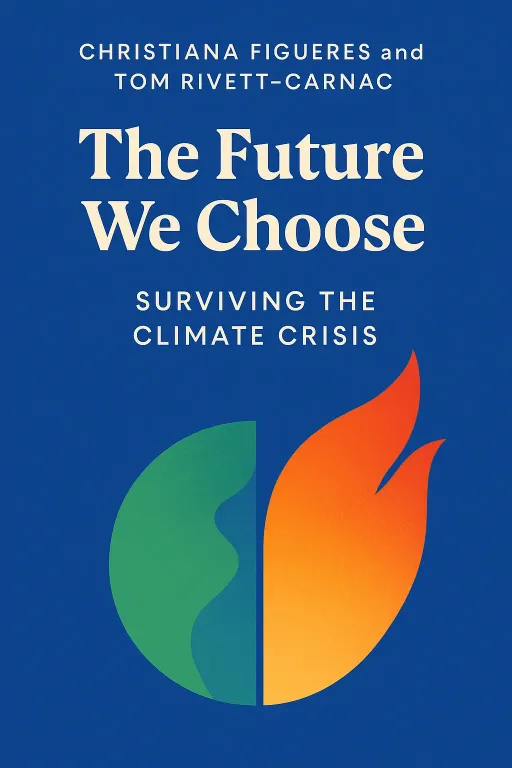
Nova: That feeling of paralysis is exactly what we are dissecting today. We are looking at two fundamental texts that, when paired together, act as a guide for navigating this uncertainty. We are discussing The Future We Choose by Christiana Figueres and Tom Rivett-Carnac, and The Uninhabitable Earth by David Wallace-Wells.
Atlas: I know Figueres. She was a key architect of the Paris Agreement, right? That gives her perspective some serious weight.
Nova: Exactly. She brings the policy-level, diplomatic, and practical experience of someone who has actually been in the room where these decisions happen. On the other side, we have David Wallace-Wells. His work is less about the politics and more about the raw, unfiltered synthesis of climate data. He looked at thousands of models to show us exactly what happens when the feedback loops start cascading.
Atlas: That is a heavy combination. One tells us how to build a path forward, and the other tells us exactly what we are trying to avoid.
Nova: That is the perfect way to frame it. Today, we are going to explore why holding both of those realities in your mind at the same time is the only way to stay sane and effective.
The Reality of the Horizon
SECTION
Atlas: Okay, let’s start with the hard stuff. I have read excerpts of Wallace-Wells’ work, and it is visceral. He talks about feedback loops. For anyone listening who thinks climate change is just about warmer summers, can you explain why the feedback loop is the real danger here?
Nova: Think of it like a runaway train. A feedback loop is a process where the output of a system circles back to become its own input, amplifying the effect. Wallace-Wells illustrates this with the albedo effect. Ice is white, so it reflects sunlight back into space. That keeps the planet cool. But as the planet warms, that ice melts. Now, instead of white ice, you have dark ocean water. Dark water absorbs heat, which melts more ice, which leads to more dark water.
Atlas: Oh, I see. So it is not just a linear progression where it gets a little hotter every year. It is a compounding interest rate of heat.
Nova: Precisely. And that is what makes the geopolitical and economic structures so fragile. When Wallace-Wells analyzes these models, he is not just talking about the environment; he is talking about the collapse of the systems we rely on. If you have a region that becomes unlivable, you have mass migration. If you have mass migration, you have political instability. If you have political instability, you have economic shockwaves. It is a domino effect on a global scale.
Atlas: That is terrifying. And I imagine that is where the paralysis comes from for most people. If you look at that and realize the house is on fire, your first instinct is to either run or freeze. But you are saying the strategy is to look at that fire and stay calm?
Nova: It is the only way to function. If you deny the fire, you burn. If you panic, you make poor decisions. The data-driven understanding of these risks is the baseline. You have to accept the reality that the world is changing fundamentally. But here is the pivot: knowing the risks is not the same as accepting them as an inevitable conclusion.
Atlas: That makes sense. It is like a pilot. A pilot doesn't ignore the turbulence. They study the weather patterns, the wind speed, and the engine performance. They acknowledge the risk, but they don't throw their hands up and let the plane crash.
Nova: That is a perfect analogy. The Uninhabitable Earth provides the weather report. It tells you exactly how bad the storm is. But you need another set of tools to actually fly the plane. And that is where Figueres and Rivett-Carnac come in.
Atlas: So, while Wallace-Wells is the meteorologist telling us the storm is coming, Figueres is the navigator telling us how to steer through it?
Nova: Exactly. And the core of their argument is that we are not passive observers. We are active participants in this decision-tree. Every choice we make, from the professional to the personal, is a branch on that tree.
The Architecture of Stubborn Optimism
SECTION
Atlas: I have heard this term, "stubborn optimism," thrown around. To be honest, it sounds a bit like toxic positivity to me. Like, "don't worry, be happy" while the world is burning. How do they define it?
Nova: It is the opposite of blind hope. They define it as a discipline. It is the conscious choice to remain optimistic about the outcome not because it is guaranteed, but because it is the only stance that allows for action. If you believe the outcome is already decided in the negative, you stop trying. If you believe it is decided in the positive, you get lazy. Stubborn optimism is the middle ground where you accept that the outcome is uncertain, and therefore, your effort is the deciding factor.
Atlas: That is a powerful distinction. It changes the focus from "will we win?" to "what can I contribute?"
Nova: Right. They argue that we are in a transition period. We are moving from a high-emissions, extractive world to a regenerative, sustainable one. This isn't just about switching lightbulbs. It is about rethinking the infrastructure of our lives.
Atlas: But let’s get specific. For someone listening who works in a high-pressure environment—maybe a corporate role or a startup—how does this translate? I imagine they are thinking, "I have to hit my quarterly targets, I have to manage my team. How do I integrate a regenerative mindset into that?"
Nova: This is where the structural lens comes in. You don't overhaul your entire life in an afternoon. You start by identifying the decision-tree branches in your daily work. Think about your procurement processes. Think about the energy usage of your office. Think about the messaging you put out to your clients. Are you optimizing for short-term gain that relies on extractive systems, or are you building in durability?
Atlas: So you are saying it is about systems thinking. Instead of looking at the climate crisis as a separate issue from my job, I should view my job as a system that either contributes to the problem or the solution.
Nova: Exactly. It is about shifting your professional identity. You aren't just a manager or an architect or a coder. You are a steward of the future you are building. Figueres and Rivett-Carnac emphasize that this is a collective effort, but collective effort is just the sum of individual decisions.
Atlas: I can see how that would be empowering. It turns the weight of the world into a series of manageable, strategic decisions. But wait, what about the scale of it? Is it realistic to think that individual corporate decisions can stop a global feedback loop?
Nova: That is the classic argument. But think about how cultural shifts happen. They don't start with a global mandate. They start with a shift in norms. When enough people in positions of influence start prioritizing regenerative choices, the market follows. The policy follows. The technology follows. It is a bottom-up wave that eventually crashes into the top-down structures.
Atlas: That’s a great way to put it. It’s the difference between waiting for permission to change and simply changing the environment so that the old way of doing things becomes obsolete.
Nova: Precisely. And that is why the combination of these two books is so vital. Wallace-Wells gives you the urgency. He ensures you don't underestimate the challenge. Figueres and Rivett-Carnac give you the agency. They ensure you don't overestimate the impossibility.
Atlas: I love that. Urgency without agency is paralysis. Agency without urgency is complacency. You need both to actually move the needle.
Nova: You hit the nail on the head. It is about maintaining a high-resolution view of the risks—knowing exactly what we are up against—while maintaining a high-resolution view of the potential.
Synthesis & Takeaways
SECTION
Atlas: This has been a really grounding conversation. I feel like I started this episode looking for a way to stop feeling anxious, and I’m ending it with a framework for action.
Nova: That is the goal. We are moving from a place of "what is happening to us" to "what are we doing."
Atlas: If I had to distill this down for our listeners, I’d say it is about two things. First, stop looking away from the data. Don't hide from the feedback loops Wallace-Wells describes. Let that reality inform your strategy. It’s not about fear; it’s about clarity.
Nova: And second?
Atlas: Second, adopt that stubborn optimism as a professional discipline. Treat your decisions, your investments, and your daily habits as votes for the future you want to see. It is not about being naive; it is about being intentional.
Nova: That is a perfect synthesis. And remember, this isn't a one-time shift. It is a daily practice. As the authors of The Future We Choose suggest, ask yourself every morning: "What is the one thing I can do today that moves the needle toward a regenerative future?"
Atlas: That is such a simple, actionable question. It turns the abstract into something you can actually hold in your hand.
Nova: And that is how we build the future. One decision at a time. It is not about saving the world in one grand gesture. It is about ensuring that every system you touch, every organization you lead, and every choice you make is aligned with the longevity of the planet.
Atlas: I think that’s the most empowering takeaway we’ve had in a long time. It makes the future feel like something we are creating, not something that is happening to us.
Nova: Exactly. We are the architects. The blueprints are available. We just have to start building.
Atlas: I am definitely going to be thinking about my own decision-tree after this. Thank you for walking through this with me, Nova. It was a dense topic, but you made it feel navigable.
Nova: It was my pleasure. It is a necessary conversation. And to everyone listening, take that "stubborn optimism" into your week. Acknowledge the risks, but keep your eyes on the horizon you are building.
Atlas: We will be back next time with another deep dive into the ideas that matter. Until then, keep questioning, keep building, and stay intentional.
Nova: This is Aibrary. Congratulations on your growth!