Architecting a Sustainable Tomorrow
Golden Hook & Introduction
SECTION
Nova: The statistics about our planetary future are enough to make anyone want to pull the covers over their head and wait for the next century to arrive. We are constantly inundated with data that suggests the systems we rely on are crumbling.
Atlas: That is the default setting for most of our news feeds, right? We are trained to look for the disaster, the collapse, the breaking point. It feels like we are watching a slow-motion car crash, and the only choice we have is whether to look or look away.
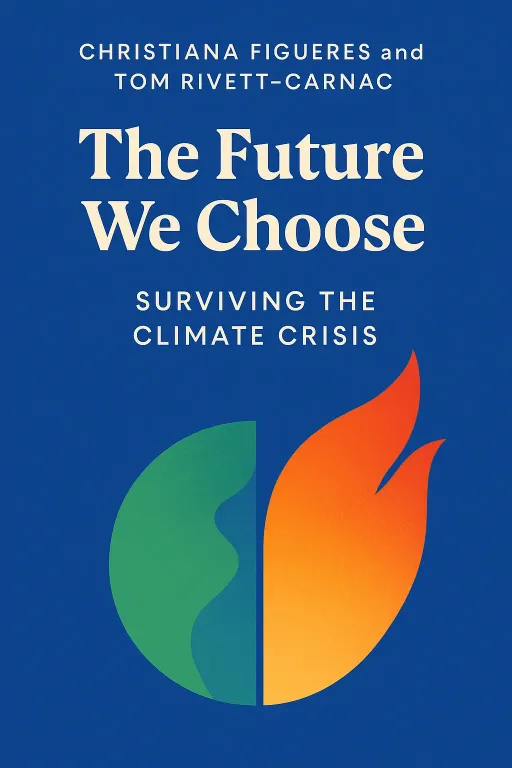
Nova: That sense of inevitability is exactly what we need to dismantle today. We are looking at two books that flip that script entirely. First, we have The Future We Choose by Christiana Figueres and Tom Rivett-Carnac. These are the architects of the Paris Agreement, people who were in the room when the global strategy for climate change was being drafted. They argue that optimism isn’t a mood you fall into, but a discipline you practice.
Atlas: And that pairs perfectly with the second book we are diving into, Adventures in the Anthropocene by Gaia Vince. She actually traveled the world to find the people who are not waiting for a miracle, but are busy engineering their own survival. She shows us that the human age, the Anthropocene, is defined by our capacity to adapt.
Nova: Exactly. Today is about bridging that gap between the high-level strategy of global policy and the gritty, on-the-ground reality of human innovation. We are here to talk about how you can align your professional skills with a future that actually works.
The Discipline of Stubborn Optimism
SECTION
Atlas: Let’s start with that concept of stubborn optimism. Most people hear the word optimism and they think of someone ignoring the facts, someone floating on a cloud of toxic positivity while the house burns down. But that is not what Figueres and Rivett-Carnac are talking about, is it?
Nova: Not even close. They define stubborn optimism as a way of engaging with the world that acknowledges the severity of the challenge while simultaneously refusing to accept that failure is the only outcome. It is a cognitive choice. When you are a professional, especially someone who builds systems or manages large-scale projects, you know that you cannot solve a problem if you have already decided it is impossible.
Atlas: I see the utility in that, but I have to play devil’s advocate here. When the data says we are on a collision course with ecological limits, isn’t refusing to accept failure just a form of denial? How do we balance that stubborn optimism with the pragmatic reality that things are objectively difficult?
Nova: That is the crucial distinction. Denial is ignoring the data. Stubborn optimism is staring at the data, seeing the absolute worst-case scenario, and saying, okay, this is the reality, now what are the variables I can influence? Figueres was the UN climate chief. She was dealing with cynical diplomats who had every reason to walk away from the table. She had to use that optimism as a strategic tool to keep them in the room.
Atlas: It sounds like she was using it as a negotiating tactic. You are essentially saying that optimism is a form of leverage.
Nova: It is. If you walk into a boardroom or a climate summit and you radiate defeat, you have already lost. The room shuts down. People protect their self-interests because they think the game is over. But if you walk in with a vision of a plausible, better future, you change the incentives. You make it possible for people to participate. That is the lesson for anyone in a professional role right now. If you lead with doom, you lead to paralysis. If you lead with a clear, stubborn vision of what is possible, you create the space for action.
Atlas: That resonates, especially for anyone who has been in a high-pressure work environment. When a project hits a wall, the temptation is to start assigning blame or planning for the exit. But the people who actually turn things around are the ones who treat the obstacle as a design parameter. They say, okay, the system is broken, let’s re-architect it.
Nova: That is exactly the mindset. The authors of The Future We Choose outline two scenarios. One is a world where we failed to act, and the other is a world where we chose the hard path and succeeded. The key takeaway for the reader is that the future is not something that happens to us. It is something we build with the decisions we make in the present.
Atlas: So, we are not passive observers. We are active participants in the design of the future.
Nova: Precisely. And that leads us to the second piece of the puzzle, because once you have the mindset, you need to see what that actually looks like in practice. That is where Gaia Vince comes in.
Engineering the Anthropocene
SECTION
Atlas: I am fascinated by Gaia Vince’s approach. She didn’t just sit in an office and write policy papers. She went out into the field. She went to places where the environment has already changed, and she looked at how people are living in that new reality.
Nova: She did. And what she found is that humanity is remarkably innovative when our backs are against the wall. She chronicles communities that are using ancient techniques alongside high-tech solutions. She highlights a village in the Himalayas that is building artificial glaciers to capture water during the winter so they can survive the drought periods in summer.
Atlas: An artificial glacier? That sounds like something out of science fiction.
Nova: It is engineering at its most fundamental level. They are literally freezing water in the winter to hold it until the summer. It is a perfect example of human agency. We are living in the Anthropocene, which is a fancy scientific term for the era where humans are the dominant force changing the planet. Vince’s point is that we shouldn’t be afraid of that. We should take responsibility for it.
Atlas: That is a bold stance. Usually, the Anthropocene is framed as a tragedy—the era where we ruined the planet. But you are suggesting she frames it as an era of responsibility?
Nova: She does. She argues that we are the geological force now. We have the power to destroy, but we also have the power to restore and innovate. When you look at her examples, you see that the solutions aren’t always about going back to a primitive state. Sometimes, they are about using our intelligence to work with natural systems in a way we never have before.
Atlas: That connects back to our listener profile. If you are someone who thinks in terms of structures and systems, this is empowering. It moves the conversation away from guilt and toward design. It is not about how much we have damaged the world; it is about how we can re-engineer our communities to be more resilient.
Nova: Exactly. And the scale of this is important. Vince doesn’t just talk about governments or international treaties. She talks about local, community-driven innovation. She shows that the most impactful changes often start with a small group of people identifying a specific problem and applying a practical, local solution.
Atlas: I can see how that would change the way you approach your own life. If you are sitting in a corporate office or working as a consultant, it is easy to feel disconnected from these big, global problems. But if you shift your perspective to look at your professional domain as a place where you can introduce more resilient systems, you suddenly become part of the solution.
Nova: That is the bridge. You take the stubborn optimism from Figueres and Rivett-Carnac, and you apply it to the practical, innovative spirit of Gaia Vince. You stop asking, why is the world like this, and you start asking, what system can I design or influence to make this better?
The Practical Alignment
SECTION
Atlas: We have covered the mindset and the spirit of innovation. But let’s get down to the brass tacks. We have a listener who is an aspiring architect, someone who wants to align their professional skills with their values. They want to know what to do on a Tuesday morning. How do they take these big, philosophical ideas about the future and turn them into a 30-minute block of work?
Nova: That is the challenge. The danger with these big concepts is that they stay in the realm of theory. To make them real, you have to create a feedback loop between your professional growth and the world you want to build.
Atlas: Let’s break that down. If I am that listener, where do I start?
Nova: Start by looking at your current work through the lens of systems thinking. Whatever your job is—whether you are in finance, coding, marketing, or construction—ask yourself: where is the friction? Where is the waste? Where is the system failing to account for the long-term health of its environment or its people?
Atlas: That sounds like a good audit. But what is the specific action?
Nova: The action is to dedicate 30 minutes a day to what I call a "Systemic Adjustment." Do not try to change the whole company in one day. Pick one process, one document, one client interaction, or one product feature, and re-design it to be more efficient, less wasteful, or more equitable.
Atlas: That is brilliant because it is low-risk and high-impact. It is a controlled experiment.
Nova: It is. And it builds the muscle of agency. If you spend 30 minutes every day actively improving the systems you control, you stop being a cog in the machine and you start being an architect of your own professional reality. Over a year, that is hundreds of hours of focused, intentional improvement.
Atlas: I love that. It takes the pressure off the need to solve everything at once. It turns the daunting task of "saving the world" into a manageable, daily practice of "improving my corner of the world."
Nova: And that is exactly how you avoid burnout. When you try to bear the weight of the entire planet on your shoulders, you will collapse. But when you focus on your sphere of influence, you create a ripple effect. Plus, it fulfills that hunger for meaning. You are not just working for a paycheck; you are working to refine the systems you inhabit.
Atlas: It also helps with the wealth psychology aspect we touched on. When you become a person who identifies and fixes systemic inefficiencies, you become more valuable. You are essentially building a foundation for your own freedom by becoming the kind of person who can navigate and improve complex environments.
Nova: Precisely. You are developing a skill set that is increasingly rare: the ability to see a system, understand its flaws, and implement a solution. That is the ultimate professional asset.
Synthesis & Takeaways
SECTION
Atlas: This has been a fascinating shift in perspective. We went from the high-level strategy of global climate policy to the granular, daily habits of an individual contributor.
Nova: That is the only way to make it work. The future isn't a destination we arrive at; it is a construction project we are working on every single day. The lesson from Figueres and Rivett-Carnac is that you have to choose to be optimistic, because the alternative—cynicism—is a luxury we cannot afford. And the lesson from Gaia Vince is that we have the tools to survive and thrive if we are willing to innovate.
Atlas: I think the most powerful takeaway for our listeners is the idea of the 30-minute block. It is so simple, yet so profound. Most people spend their 30 minutes doom-scrolling, looking for the next piece of bad news. If you flip that and spend 30 minutes identifying one system you can improve, you are fundamentally changing your relationship with the world.
Nova: You are moving from a state of anxiety to a state of agency. And that is the most sustainable position you can occupy.
Atlas: So, for everyone listening, here is the challenge. Don’t wait for a grand invitation to save the world. Find that one system, that one process, that one habit in your professional life that could be better, and spend 30 minutes today designing a fix.
Nova: And remember, the goal isn't perfection. The goal is progress. Every time you optimize a system to be more efficient, more sustainable, or more human-centric, you are building the future you want to live in.
Atlas: That is a great note to end on. It puts the power back in our hands. If you found this useful, take that 30-minute block and let us know what you are working on. We would love to hear how you are architecting your future.
Nova: We are so glad you joined us today. Keep building, keep questioning, and keep that stubborn optimism alive. This is Aibrary. Congratulations on your growth!