Charting the AI Horizon: Visions and Realities
Golden Hook & Introduction
SECTION
Nova: Five words to describe AI's future? I'd say: "Vividly imagined, urgently managed."
Atlas: And I'd add: "Sparkling visions, immediate policy." Let's unpack that.
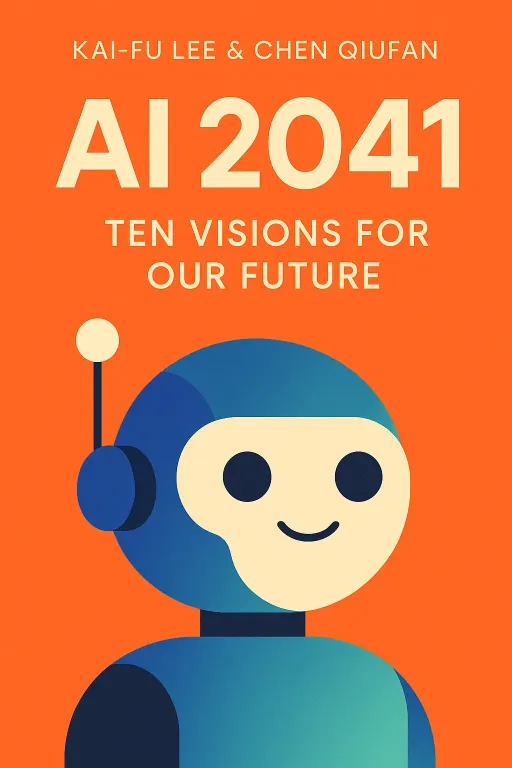
Nova: Absolutely. Today, we're charting the AI horizon by looking at two powerful, yet distinct, perspectives. First, we're diving into the imaginative world of AI 2041, a collection of narrative-driven visions by AI pioneer Kai-Fu Lee and acclaimed novelist Chen Qiufan.
Atlas: And then we'll pivot to the sharp, analytical lens of Darrell M. West's The Future of Work, which grounds us in the immediate policy and economic realities we need to confront right now.
Nova: It's a fascinating duality, isn't it? One book sparks the awe of what, and the other prepares us for the and it actually arrives.
Atlas: Exactly. Kai-Fu Lee, with his decades at the forefront of AI development, and Chen Qiufan, who knows how to weave a compelling story, bring us ten glimpses of daily life transformed by AI. It’s less a textbook and more a series of potent 'what ifs' designed to make the future feel tangible.
Nova: And Darrell M. West, from his vantage point at a leading policy institution, offers a more direct confrontation with the tectonic shifts automation and AI are already causing in our labor markets and societal structures. It’s essential reading for anyone thinking about strategy and governance.
Atlas: So, we're armed with both the dream and the blueprint. Where do we begin with these dazzling, yet daunting, visions? Nova, paint us a picture from AI 2041.
The Narrative Horizon: AI 2041's Visions
SECTION
Nova: Let’s start with a vision that feels both intimate and expansive: 'The Second Life' from AI 2041. Imagine a world where your digital twin, an AI persona, not only manages your schedule and communications but also becomes your confidante, your creative partner, even a way to connect with deceased loved ones through sophisticated AI reconstructions. It’s not just about efficiency; it’s about augmenting human experience, memory, and connection.
Atlas: That’s… a lot. So, this isn't just a super-advanced Siri; it's a digital echo of yourself, capable of complex emotional interaction and creative output?
Nova: Precisely. In the book, they illustrate this through a character who uses her AI twin to help her grieve, to continue a dialogue with her late husband, and even to co-write a novel. It explores the profound emotional and ethical landscapes we might navigate when AI can so deeply mirror human consciousness and memory.
Atlas: It sounds like it blurs the lines between life and simulation, doesn't it? For someone leading a team, or even just managing personal relationships, the idea of an AI companion that can offer that level of emotional support – or perhaps, dependency – is mind-boggling.
Nova: And that’s the power of their narrative approach. They don't just present the technology; they show its ripple effect on human relationships, on our sense of self, and on our understanding of consciousness. Another vignette, 'Smart Cities,' shows us a city managed by AI, optimizing everything from traffic flow and energy consumption to public safety and personalized urban experiences. Picture your commute being perfectly timed, your waste managed proactively, and your public spaces adapting in real-time to citizen needs.
Atlas: That sounds incredibly appealing from an efficiency standpoint. For any city planner, or even a business leader thinking about optimizing operations, the allure of a perfectly orchestrated system is powerful. But when I hear 'AI managing a city,' my mind immediately goes to the practicalities. What happens when the system makes a mistake? Who is accountable? And what about the human element – the serendipity, the organic growth, the very things that make cities vibrant beyond mere efficiency?
Nova: That's exactly where the 'expert foresight' comes in. While the narrative is compelling, the authors are drawing on real technological trajectories. They show how AI can enable hyper-personalization in healthcare, for instance, with AI analyzing your unique genetic makeup, lifestyle, and environment to provide bespoke medical advice and treatments. It moves beyond one-size-fits-all medicine to truly individualized care.
Atlas: That's a powerful image. Personalized medicine, AI companions, hyper-efficient cities – these are the grand visions that capture the imagination. But, Nova, for those of us who are in the trenches, trying to implement change or even just understand the immediate impact, these visions can feel a galaxy away. They can even feel a little… utopian, perhaps? Are we sure we're not just dreaming?
The Pragmatic Present: The Future of Work's Realities
SECTION
Nova: That’s precisely the bridge Darrell M. West’s The Future of Work helps us build. He takes us from the dazzling possibilities of 2041 and asks, "What about tomorrow? What about next year? What about the people whose jobs are changing?"
Atlas: Right. West’s work, often rooted in deep analysis from institutions like Brookings, doesn't shy away from the complex, often messy, realities of technological acceleration. He’s looking at the immediate challenges of automation and AI on employment, wages, and the very fabric of our economic and social systems.
Nova: So, instead of a digital twin managing your grief, he might be looking at the economic impact of AI automating customer service roles, or the skills gap emerging as AI transforms industries like manufacturing or even law.
Atlas: Exactly. He highlights that while AI can create new jobs, it also displaces existing ones, often disproportionately affecting certain demographics or skill levels. The challenge isn't just about AI can do, but we manage its societal integration. This involves critical questions about retraining programs, lifelong learning initiatives, and adapting social safety nets.
Nova: This is where the "urgent management" part of my five-word description comes in. It’s not enough to imagine a smarter city; we need to strategize how to retrain the workforce that city relies on.
Atlas: And it goes deeper. West often explores the policy implications. For example, how do we tax automation? What are the ethical considerations of AI in hiring or loan applications? These are not abstract philosophical debates for 2041; these are immediate policy challenges that governments and businesses are grappling with. He’s asking about the economics of AI: will it exacerbate inequality? How do we ensure broad-based prosperity rather than concentrated wealth?
Nova: So, while AI 2041 might show us a doctor enhanced by AI for hyper-personalized diagnostics, West’s work might be looking at the potential job losses for radiologists or the new training required for medical professionals to effectively AI diagnostics. It’s the contrast between the aspirational future and the grounded present.
Atlas: Precisely. He’s very focused on the societal adaptation aspect. How do our institutions – education, government, corporations – need to transform to keep pace? It’s about navigating the transition. He’s not saying AI is bad, but he’s sounding a clear alarm that without thoughtful policy and strategic adaptation, the benefits might not be shared equitably, and the disruptions could be severe.
Nova: This is crucial for anyone who sees themselves as a "Future Shaper" or "Strategic Communicator." It’s not just about articulating a grand vision; it’s about understanding the immediate hurdles and advocating for the policies and practices that will enable that vision to be realized responsibly. It’s about translating the 'what if' into the 'how to.'
Atlas: And this is where the two books really complement each other. AI 2041 gives us the destination, the inspiring possibilities that make the effort worthwhile. The Future of Work gives us the map, the potential pitfalls, and the urgent need for preparation and policy. Without the vision, we lack motivation. Without the pragmatic analysis, we risk chaos.
Bridging Vision and Strategy: Shaping the AI Horizon
SECTION
Nova: So, for our listeners who are driven by innovation and impact, who want to advance knowledge and shape futures, how do we synthesize these two powerful viewpoints? How do we wield both imagination and analysis?
Atlas: This is where the "Visionary Leader" and "Strategic Communicator" in our user profile truly come into play. The core of navigating this AI horizon isn't just about understanding the technology; it's about understanding and our capacity to guide it. The user's growth recommendation to "embrace the unknown" is key here. AI 2041 provides the canvas for that unknown, showing us diverse potential futures.
Nova: And Darrell West's work provides the framework for how we that unknown. It’s about developing a mindset of "strategic foresight," as the profile suggests. It means dedicating time, even just 10 minutes daily, not just to reacting to current events, but to actively imagining potential futures and their implications.
Atlas: That 10 minutes daily is fascinating. It’s a small commitment, but applied consistently, it can shift one’s perspective from being a passive observer of change to an active architect of it. It’s about asking: 'Given these visions and these realities, what strategic choices do I need to make today for myself, my team, or my organization?'
Nova: And this directly connects to the "Next Destination" areas: AI Ethics, Change Management, and Systems Thinking. AI 2041 sparks the ethical questions – what kind of AI companion do we want? What are the boundaries of AI in personal lives?
Atlas: And The Future of Work provides the urgent need for ethical frameworks and robust change management. If AI is going to displace jobs, how do we ethically manage that transition? How do we communicate the changes to employees in a way that fosters trust and adaptation, rather than fear? This requires deep systems thinking to understand how these technological shifts interact with economic, social, and political structures.
Nova: It's about seeing the interconnectedness. A breakthrough in AI healthcare might require new regulations and retraining programs, all while considering the ethical implications for patient data and access. It’s a complex, interwoven system.
Atlas: For leaders, this means fostering a culture that can embrace the unknown, as the profile suggests. It's about encouraging experimentation, learning from failures, and constantly scanning the horizon for both opportunities and threats. It's about clear communication – being able to articulate a compelling vision, yes, but also being transparent about the challenges and the strategic steps being taken.
Nova: And the drive for "impact" and "advancing knowledge" becomes the guiding star. When we combine the imaginative power of AI 2041 with the pragmatic planning from The Future of Work, we can aim for futures that are not only technologically advanced but also equitable, sustainable, and human-centric. It's about using AI to solve real problems, not just to create new ones.
Atlas: It's about consciously choosing the future we want to build. We're not just passive recipients of technological progress. We can, and must, shape it. The visions give us the 'why,' the analysis gives us the 'how,' and the user's own drive for leadership and impact gives us the 'who' and the 'what' – who will lead this change, and what actions will they take?
Synthesis & Takeaways
SECTION
Nova: So, as we wrap up, the core message is this: The future isn't a fixed point, nor is it a purely imagined utopia or dystopia. It's a dynamic landscape that we are actively shaping, moment by moment, decision by decision.
Atlas: And the power to shape it comes from holding two seemingly opposing forces in balance: the boundless imagination to envision what’s possible, fueled by narratives like those in AI 2041, and the rigorous analysis to understand the immediate realities and necessary actions, as laid out in The Future of Work.
Nova: For our listeners, particularly those driven to lead, communicate, and shape futures, this means actively cultivating both visionary thinking and strategic planning. It’s about embracing the unknown with curiosity, and grounding that exploration with practical foresight.
Atlas: So, for our listeners looking to shape this future, dedicate just 10 minutes daily to strategic foresight – what small step can you take today to begin charting your AI horizon?
Nova: And what's one aspect of AI's future, whether a grand vision from AI 2041 or a practical challenge from The Future of Work, that you're now looking at differently?
Atlas: This is Aibrary. Congratulations on your growth!