Navigating Tomorrow's Landscape Today
Golden Hook & Introduction
SECTION
Nova: Most of us think in linear terms. One, two, three. But what if the future isn't just arriving, it's? And what if your current skills are on a collision course with a future you can barely imagine?
Atlas: Whoa, that's a pretty intense opening, Nova. Sounds less like a podcast and more like a sci-fi movie trailer. Is the future really that dramatic?
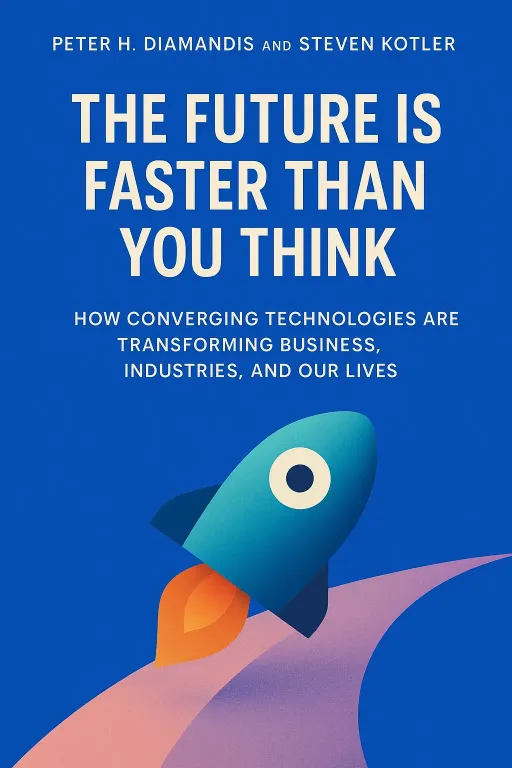
Nova: Honestly, Atlas, it might be even more dramatic than we realize. Today, we're diving into two pivotal books that lay bare this reality. First, "The Future Is Faster Than You Think" by the dynamic duo, Peter H. Diamandis and Steven Kotler. These guys, coming from their work at Singularity University, aren't just futurists; they're entrepreneurs who've built entire ecosystems around understanding and leveraging exponential technological change.
Atlas: Right, and to complement that, we're also looking at Kevin Kelly's "The Inevitable." Kelly, as a co-founder of Wired magazine, has this incredible vantage point, observing technology's long game for decades. His work offers a framework for understanding not just the speed, but the of these changes. It’s a great pairing to help us make sense of what feels like chaos.
The Exponential Tsunami: Understanding Converging Technologies
SECTION
Nova: Exactly. Let's start with Diamandis and Kotler's core message: the future isn't just fast; it's fast. And it's not just one technology accelerating, but many of them converging. Think of it like this: if you walk one step, then two, then three, that's linear. But if you walk one step, then two, then four, then eight, that's exponential.
Atlas: Okay, I get the difference between linear and exponential in theory. But how does that in the real world? Because for most of us, it often feels like we're just trying to keep up with the latest software update, not preparing for an "explosion."
Nova: That’s a great point. The human brain is wired for linear thinking. To really grasp exponential, imagine a chessboard. If you put one grain of rice on the first square, two on the second, four on the third, by the time you're halfway through the board, you have a massive pile. But by the last square, you have more rice than exists on Earth. That's how AI, robotics, virtual reality, and biotech are growing.
Atlas: Wow. So it’s not just getting bigger; it’s getting bigger, fast.
Nova: Precisely. And here’s the crucial part: it's not just that each of these fields is accelerating on its own. It's their that creates unprecedented opportunities and challenges. Think about AI merging with biotech. Traditionally, drug discovery takes years, billions of dollars, and countless failed experiments.
Atlas: I know, it’s a grueling process.
Nova: Now, imagine AI algorithms sifting through vast databases of molecular structures, predicting how they’ll interact with diseases, and simulating drug efficacy in silico. We're already seeing AI identifying potential new antibiotics in days, not years, or designing novel proteins for therapies. This convergence isn't just speeding things up; it's enabling entirely new capabilities that were once pure science fiction.
Atlas: That’s actually really inspiring. But for someone in their professional field, say, in finance or marketing, how does this "exponential convergence" impact their day-to-day? Because that sounds like a lot to wrap your head around. It feels overwhelming to even know where to start.
Nova: That's where the "Tiny Step" comes in, which we'll get to later. But for now, think about how AI is already 'cognifying' everything, making every product and service smarter. In finance, AI isn't just automating tasks; it's predicting market shifts with unprecedented accuracy, identifying fraud, or personalizing investment advice. In marketing, AI analyzes consumer behavior at scale, creating hyper-targeted campaigns. These aren't just incremental improvements; they're foundational shifts driven by converging technologies.
The Inevitable Forces: Navigating the Future Landscape
SECTION
Atlas: Okay, so things are moving at a dizzying pace, and different tech fields are high-fiving each other to make things even crazier. But are there any? Anything we can hold onto amidst this technological tornado? Because feeling overwhelmed by choices is a real thing when the landscape shifts so fast.
Nova: That’s a brilliant question, and it's exactly what Kevin Kelly addresses in "The Inevitable." He argues that while specific inventions are unpredictable, there are 12 "technological forces" – or tendencies – that are already shaping the next 30 years. These aren't predictions of will be invented, but our world will evolve around these technologies.
Atlas: So, like, currents in a river? You don't know exactly where every leaf will go, but you know the general direction of the flow.
Nova: Exactly! And three of these forces are particularly relevant to understanding our changing landscape: 'Cognifying,' 'Flowing,' and 'Becoming.' 'Cognifying' means embedding AI into everything. Not just computers, but our homes, our cars, our clothes, our tools – everything becomes smarter, more responsive.
Atlas: So, my toaster will eventually know how I like my bread toasted based on my mood?
Nova: Potentially! And 'Flowing' refers to the constant, real-time streams of data, information, and experiences. Nothing is static; everything is in flux. Our identities, our work, our entertainment – it's all becoming a continuous stream. And then there's 'Becoming,' which is the idea that everything is in a perpetual state of beta. Products are never finished; they're constantly updated, evolving. We're moving from a world of nouns to a world of verbs.
Atlas: That's a great way to put it. "Becoming." Honestly, that sounds a bit like my life right now – always updating, never quite finished! But how do these specific forces, like 'Cognifying' and 'Becoming,' specifically impact professional fields? What new skills do I, or our listeners, need to cultivate to remain relevant and innovative?
Nova: That's the million-dollar question, isn't it? If everything is 'Cognifying,' then understanding to leverage AI, not just use it, becomes critical. It's about designing prompts, interpreting results, and integrating AI into workflows. For 'Becoming,' the key skill is adaptability and continuous learning. The idea of a fixed skillset for a fixed career is fading. It's about being a lifelong learner, embracing new tools, and even unlearning old methods.
Atlas: So it's less about having answer, and more about knowing how to and constantly.
Nova: Precisely. It’s about cultivating what Diamandis and Kotler call a "future-fluent" mindset – not just tolerating change, but actively seeking it out, experimenting, and seeing opportunities where others see only disruption. It’s recognizing that the ability to adapt, to pivot, to learn, and to collaborate with intelligent systems will be far more valuable than any single technical skill.
Synthesis & Takeaways
SECTION
Nova: So, to bring it all together: the future is indeed faster than we think, driven by exponential growth and the convergence of powerful technologies. But it's not entirely random. Kevin Kelly's "inevitable forces" give us a framework, a compass if you will, to navigate these turbulent waters.
Atlas: That makes so much sense. It's not about predicting the exact future, but understanding the of these currents. And for someone like our "Curious Strategist" listener, who feels overwhelmed by choices but is driven by meaningful progress, this gives us a way to make more informed decisions.
Nova: Absolutely. Understanding these trends isn't just about survival; it's about seizing unprecedented opportunities for innovation and impact. It’s about shifting from a reactive mindset to a proactive, future-fluent one. Instead of being swept away, we can learn to surf these waves.
Atlas: That's a fantastic analogy. So, for our listeners who are feeling this, what's one small, tiny step they can take this week to start engaging with this future?
Nova: Dedicate just 30 minutes this week to researching one emerging technology or one of Kelly's forces that excites or concerns you most. Maybe it's AI in biotech, or the concept of 'Cognifying' everything. See how it's currently being applied and imagine its potential trajectory. Just 30 minutes. It's a small investment with a huge potential return in clarity.
Atlas: Just 30 minutes to start building that future-fluent mindset. That's totally doable.
Nova: It absolutely is.
Atlas: This is Aibrary. Congratulations on your growth!