The Tech-Human Convergence
Golden Hook & Introduction
SECTION
Nova: If you think your analytical mind is your greatest asset in today's market, you are actually preparing yourself to be replaced by a spreadsheet on steroids.
Atlas: Oh, that is a brutal way to start the conversation. But honestly, it hits incredibly close to home. We spend our entire careers perfecting our logical, data-crunching skills, thinking that is what makes us valuable.
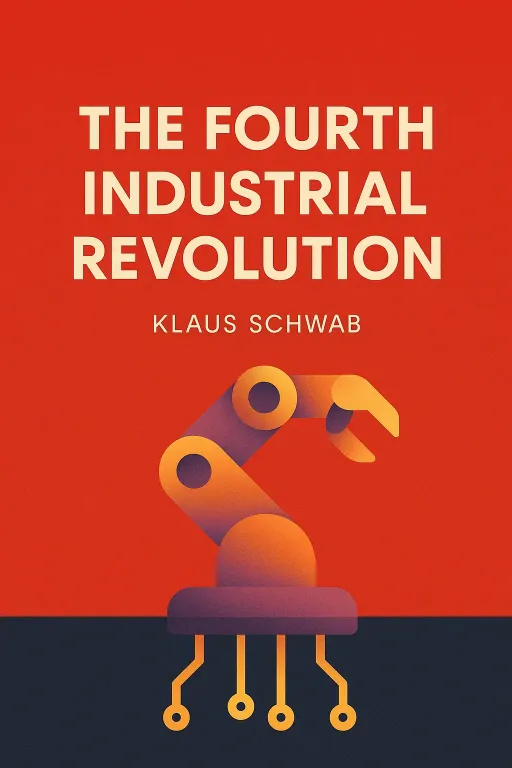
Nova: It is a common trap. Today we are diving into two monumental works that completely reshape how we view the future of work and humanity. We have Klaus Schwab's groundbreaking book, The Fourth Industrial Revolution, and Ray Kurzweil's classic futurist manifesto, The Age of Spiritual Machines.
Atlas: I can see how those two belong together. Schwab is the founder of the World Economic Forum, so he is looking at this from a massive, global systems level. And Kurzweil is the legendary inventor and futurist who has spent decades predicting the exact trajectory of artificial intelligence.
Nova: Exactly. Schwab gives us the structural blueprint of how the physical, digital, and biological worlds are fusing together. Meanwhile, Kurzweil takes us deep into the timeline of when machines will match and eventually exceed our computational capabilities.
Atlas: That combination raises a massive, unavoidable question for anyone trying to navigate their career or scale an organization. When the analytical heavy lifting is fully automated, what is actually left for us? What uniquely human skills do we need to cultivate to remain indispensable?
Nova: That is the core of our exploration today. We are going to look at this from three perspectives. First, we will break down Schwab's view on the fusion of realms and the urgent need for human-centric governance. Then, we will explore Kurzweil's mind-bending predictions on exponential growth and machine consciousness. Finally, we will focus on how you can transition from an analytical manager to an intuitive, empathetic leader who scales impact through thoughtful design.
The Fusion of Realms
SECTION
Nova: Let us start with Klaus Schwab and his concept of the Fourth Industrial Revolution. He argues that this is fundamentally different from any previous technological transition. The scale, scope, and complexity are entirely unprecedented.
Atlas: Right, because the previous revolutions were mostly about linear progress. Steam engine, electricity, early computing. Those were tools that we used. But Schwab is talking about something much more intimate.
Nova: Yes, he describes a world where the boundaries between the physical, digital, and biological domains are completely dissolving. Think about advanced prosthetics that are controlled directly by neural signals, or gene editing algorithms that use machine learning to predict how DNA sequences will behave.
Atlas: Wow, that is a wild shift. It is the integration of the technology directly into our biology and our physical spaces. The tool is no longer separate from the user.
Nova: That is the key factor. Schwab has spent over fifty years bringing together heads of state, business leaders, and academics at Davos. He has observed firsthand that the speed of this transition is exponential, not linear. In the past, society had generations to adapt to new technologies. Now, we have years, sometimes months, before a entire industry is disrupted.
Atlas: I imagine a lot of our listeners who are managing teams or trying to build sustainable systems are feeling that exact whiplash. It feels like you are trying to build a bridge while the canyon itself is moving. How does Schwab suggest we handle that kind of instability?
Nova: He advocates for what he calls proactive, agile governance. The old way of regulating technology was reactive. A new tool would come out, we would see what went wrong, and then we would write laws to fix it. Schwab argues that this approach is completely obsolete. If we wait for the consequences to manifest, the technology will have already scaled beyond our control.
Atlas: That makes perfect sense, but it sounds incredibly difficult to execute. How do you govern something that is changing faster than the bureaucratic process can even move?
Nova: It requires designing systems that are human-centric from the very beginning. Instead of focusing solely on efficiency and optimization, organizations must build flexibility and empathy into their core structures. You design the system to serve the human outcome, not the other way around.
Atlas: That is a massive shift in mindset. It means we have to stop looking at technology as just a way to cut costs or speed up production. We have to start looking at it as a partner in human capability.
Nova: Yes, and that partnership is exactly what leads us to the second major pillar of our discussion today. When we talk about partnering with technology, we have to look at how intelligent that technology is actually becoming.
The Ghost in the Computational Machine
SECTION
Nova: This brings us to Ray Kurzweil and his masterwork, The Age of Spiritual Machines. Kurzweil is famous for his law of accelerating returns. He points out that human beings are hardwired to think linearly, which makes us terrible at predicting the future of technology.
Atlas: I can definitely relate to that. We assume that the progress we see next year will be roughly the same as the progress we saw last year.
Nova: Exactly. But technology progresses exponentially. If you take thirty linear steps, you end up thirty yards away. If you take thirty exponential steps, where you double the distance with each step, you actually travel over a billion yards. You circle the globe multiple times.
Atlas: That is a staggering difference. It explains why things like artificial intelligence seemed to progress slowly for decades and then suddenly exploded overnight.
Nova: Kurzweil predicted this back in the late nineties. He argued that as computational power continues to double, we will reach a point where machines do not just process data faster than us, they actually surpass human computational capabilities entirely. And that forces us to redefine what we mean by consciousness.
Atlas: That sounds a bit out there. Are we talking about machines that actually feel emotions, or just machines that are so good at simulating them that we cannot tell the difference?
Nova: Kurzweil argues that the distinction eventually disappears. If a machine can perfectly understand human emotion, respond with genuine empathy, and make creative decisions that inspire people, the practical difference between simulation and reality becomes irrelevant.
Atlas: Let me check if I got that right. If the output is indistinguishable from human consciousness, then for all practical purposes, we have to treat it as conscious.
Nova: That is his central argument. It challenges our deepest assumptions about what makes us unique. If a machine can write a beautiful symphony, diagnose a disease better than a doctor, and write flawless code, then the analytical, logical tasks we pride ourselves on are no longer our exclusive domain.
Atlas: That is a deeply humbling thought. It means the traditional definition of a smart person, someone who is great at memorizing facts, analyzing data, and finding logical patterns, is exactly the profile of the role that is easiest to automate.
Nova: It is the ultimate paradox. The very skills that our educational systems and corporate structures have rewarded for the last century are the ones that are being commoditized the fastest.
Atlas: So if we cannot compete on pure analytical power, we have to find a different arena. We have to look at what lies beyond logic.
The Empathetic Sanctuary
SECTION
Nova: This is where we address our deep question for the day. As artificial intelligence increasingly automates these analytical tasks, what uniquely human, empathetic leadership skills must you cultivate to remain indispensable?
Atlas: That is the pivot point. If the machine is the ultimate analyst, then the human must become the ultimate architect of connection and purpose.
Nova: Yes, and that shift requires a completely different approach to how we manage our minds and our time. To lead with empathy and intuition, you have to create space for deep, focused reflection. In a world of constant digital noise, attention is the ultimate luxury.
Atlas: Oh, I know that feeling of constant fragmentation. You start your day intending to focus on big-picture strategy, but then the notifications start piling up, and suddenly you have spent eight hours reacting to minor emergencies. You are busy, but you are not actually moving the needle.
Nova: You are running on a treadmill. To break that cycle, you have to protect your focus like a sanctuary. There is a powerful practice of dedicating the first sixty minutes of your day to deep work. No emails, no social media, no external inputs. Just pure, uninterrupted time to synthesize complex systems and trust your intuition.
Atlas: That sounds amazing, but I imagine a lot of leaders are thinking, if I disappear for the first hour of every day, my team will panic, or I will miss something critical. How do you implement that without causing chaos?
Nova: It comes down to system scaling. You do not manage tasks; you scale impact through thoughtful design. If your presence is required every minute for the organization to function, you have not built a system, you have built a personal bottleneck.
Atlas: That is a powerful distinction. A true leader designs the engine so it runs sustainably, which then frees up the leader to focus on high-stakes communication and alignment.
Nova: Exactly. Your value is not in solving the immediate problem yourself. Your value is in creating the environment where the team can solve it, and in communicating the vision with such clarity and grace that everyone knows exactly where they are heading. That requires deep empathy. You have to understand the human dynamics, the fears, and the motivations of your team.
Atlas: It sounds like we are moving from the era of the commander who has all the answers to the era of the facilitator who asks the right questions.
Nova: Yes, the machine will always have the answers. But the human leader must have the wisdom to ask the questions that actually matter. Intuition is not just a vague feeling. It is the rapid synthesis of years of experience, emotional intelligence, and contextual understanding. It is something a purely logical algorithm cannot replicate.
Synthesis & Takeaways
SECTION
Atlas: This has been an incredibly rich discussion. We started with Schwab's warning about the blurring lines of our physical, digital, and biological realities, and the need for human-centric design. Then we looked at Kurzweil's timeline of exponential growth, showing us that the analytical landscape is shifting beneath our feet.
Nova: And it all leads back to how we choose to show up as leaders. The rise of technology does not diminish the value of humanity. It amplifies the necessity of our most human qualities. Empathy, intuition, and high-stakes communication are the new currencies of high-impact leadership.
Atlas: It is a beautiful call to action. To protect that first hour of the day, to step off the tactical treadmill, and to focus on scaling systems that allow us to lead with grace and purpose.
Nova: The future belongs to those who can synthesize complex systems while remaining deeply connected to the human spirit.
Atlas: Thank you for sharing these insights today, Nova. This is Aibrary. Congratulations on your growth!