Navigating the Global Frontier
Golden Hook & Introduction
SECTION
Nova: Most people treat sustainability like a tax on their business. They see it as a cost to be paid, a box to check, or a burden to carry. But the most successful architects of the future are realizing that sustainability is actually the only way to avoid total obsolescence in the next decade.
Atlas: That is a sharp pivot. Usually, when we talk about high-performance business or rapid technological change, we assume the environment is the thing getting squeezed. You are suggesting that the squeeze is actually coming from the other direction, and if we don't adapt, we lose.
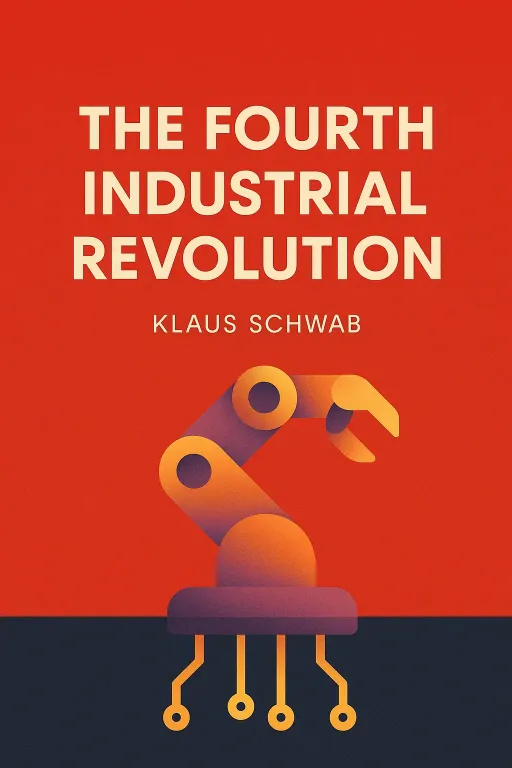
Nova: Exactly. And the tension between those two forces—the relentless acceleration of technology and the hard limits of our planet—is the defining challenge for any leader today. We are looking at two seminal works that map this terrain. First, The Fourth Industrial Revolution by Klaus Schwab, which details how physical, digital, and biological worlds are merging. And second, The Future We Choose by Christiana Figueres and Tom Rivett-Carnac, which provides the moral and strategic compass we need to navigate that merger.
Atlas: I know those names. Klaus Schwab, the founder of the World Economic Forum, has been at the center of global discourse for decades. He wrote that book to essentially sound the alarm that we are in a period of change unlike anything in human history. And Figueres and Rivett-Carnac, they were the key architects of the Paris Agreement. They are not just theorists; they are people who had to get nearly two hundred countries to agree on a single, massive, existential goal.
Nova: Right. It is the perfect pairing. Schwab gives us the "what"—the sheer, overwhelming scale of technological integration. Figueres and Rivett-Carnac give us the "how"—the mindset required to steer that integration toward a regenerative world rather than a destructive one.
Atlas: That sets the table perfectly. Let's dig into the "what" first, because that Fourth Industrial Revolution concept sounds massive, almost intimidating. How do we make sense of that as a practical, actionable blueprint?
The Convergence of Systems
SECTION
Nova: Think about the previous industrial revolutions. The first was steam, the second was electricity, the third was computing. The Fourth, as Schwab describes it, is not defined by one single technology. It is defined by the convergence of everything. It is where your digital data, your physical hardware, and your biological reality collide.
Atlas: That sounds abstract. Can you make that concrete? What does it actually look like in the day-to-day life of a professional or a business?
Nova: Consider precision medicine. You have a digital device, like a wearable, that monitors your biological data in real-time. That data is processed by an AI—a digital technology—to adjust your medication or your diet. The physical, digital, and biological are no longer separate silos. They are a single, integrated system. This is happening in manufacturing, in energy, and in finance. We are essentially building a global nervous system.
Atlas: That brings up a massive point for the kind of leaders listening to us. If everything is connected, then the old way of managing—where you could optimize one department or one product line in isolation—is dead. If you change one variable, the entire system ripples.
Nova: Precisely. Schwab argues that this speed and scope are unprecedented. The barrier to entry for disrupting an entire industry has dropped to almost zero because the tools are so powerful and so accessible. For the Strategic Architect, this means your competitive advantage is no longer about having the best resources. It is about having the best.
Atlas: That creates a paradox, though. If the system is this complex and moving this fast, how do you keep from burning out? Our listeners are constantly trying to balance high performance with personal well-being. If the world is a giant, hyper-connected nervous system, does that mean the individual has to be hyper-connected too?
Nova: That is where the trap lies. The mistake is trying to react to every signal the system sends you. Schwab notes that the leaders who succeed in this revolution are the ones who can filter the noise. They are not just faster; they are more intentional. They treat their own attention as a scarce resource, just like capital or energy.
Atlas: I love that. It frames the "deep work" recommendation we often talk about not just as a productivity hack, but as a survival strategy. If the world is a firehose of data, you have to be the one who decides which cup to fill.
Nova: Exactly. But here is the critical part that connects to our second book. If you are using that "deep work" time to just optimize for growth without considering the systemic impact on the environment or society, you are essentially accelerating a car toward a cliff. You are moving fast, but you are moving in the wrong direction.
The Regenerative Mindset
SECTION
Atlas: That is a great transition to Figueres and Rivett-Carnac. If Schwab is the map of the terrain, The Future We Choose is the guide on how to walk it. They talk about two distinct futures, right?
Nova: Yes. They paint a picture of a "catastrophic" future versus a "regenerative" one. And they are very clear that this is not a prediction; it is a choice. The "catastrophic" future is what happens if we continue with our current, extractive mindset. The "regenerative" future is what happens if we shift our entire operating system to value restoration over extraction.
Atlas: What does "regenerative" actually mean in a business context? It sounds like a buzzword. How does a leader actually implement that without losing their edge?
Nova: It means shifting from a "linear" mindset to a "circular" one. In a linear world, you take resources, you make a product, you sell it, and you create waste. That is a dead-end street. A regenerative mindset asks: How can this product, this service, or this business model leave the system better than I found it?
Atlas: That feels like a massive shift. I can hear some of our listeners thinking, "That sounds great for a non-profit, but I have investors who want quarterly growth." How do you bridge that gap?
Nova: That is the most important question. The bridge is the realization that the old model of growth—the one that ignores externalities—is becoming the most expensive way to do business. Regulation, consumer demand, and resource scarcity are making the "extractive" model a liability. The leaders who are adopting regenerative practices are finding that they are actually creating more resilient supply chains, more loyal customers, and more innovative products.
Atlas: It is a long-term play masquerading as a short-term cost.
Nova: Exactly. Figueres and Rivett-Carnac argue that the leaders who will define this century are the ones who can hold two thoughts in their head at once: the need for relentless, high-performance innovation, and the need for radical, systemic responsibility. They call it "stubborn optimism."
Atlas: I like that phrase. Stubborn optimism. It is not just, "Everything will be fine." It is, "I am going to work to make it fine, regardless of the odds."
Nova: Right. And it is about agency. You mentioned the "Strategic Architect" profile earlier. These people want blueprints. They want to know what they can do today. One of the most powerful things Figueres and Rivett-Carnac suggest is that leaders need to ask themselves a very specific question about every project they greenlight: Does this contribute to a regenerative world, or does it perpetuate the old, extractive cycle?
Atlas: That sounds like a simple filter, but it is incredibly powerful. If you apply that to your project management, to your hiring, to your supply chain, it changes every decision. It stops being about "doing good" and starts being about "doing it right."
Integrating the Two Worlds
SECTION
Nova: And that brings us back to the intersection of these two books. If you are a leader in the Fourth Industrial Revolution, you have these incredible, god-like tools at your disposal. You have AI, you have biotechnology, you have hyper-connectivity. If you use those tools to simply extract more, faster, you are failing. If you use those tools to innovate toward a regenerative, sustainable future, you are leading.
Atlas: I can see how this applies to the high-performance optimizer. You mentioned earlier that the first 60 minutes of the day should be deep work. Imagine if those 60 minutes were dedicated not just to clearing the inbox, but to solving one of these systemic problems.
Nova: That is the shift. Most people use their deep work time to optimize the system. The high-performance leader uses their deep work time to the system. That is the difference between a manager and a legacy-builder.
Atlas: I want to push on that. What is a concrete example of this? Suppose I am running a tech team. I am in the middle of this Fourth Industrial Revolution stuff. How do I actually inject "regenerative" thinking into my sprint planning?
Nova: It starts with asking about the "biological" aspect of Schwab's framework. You are building digital tools. What is the impact on the biological world? Is your software creating digital clutter that consumes massive amounts of energy? Are you designing your user experience to manipulate human psychology in a way that creates anxiety, or are you designing for human flourishing?
Atlas: That is a fascinating way to look at it. You are treating the user's attention and the server's energy as finite resources, not infinite ones. That is a direct application of the regenerative mindset.
Nova: Precisely. And that is where the "Strategic Architect" comes in. You are looking at the architecture of your product, not just the features. You are asking, "Does this architecture sustain the human being using it, or does it deplete them?"
Atlas: It makes me think about the way we talk about burnout. We often treat burnout as a personal failure—like, "I need to meditate more." But if we look at it through the lens of the Fourth Industrial Revolution, maybe burnout is actually a design flaw.
Nova: That is a profound insight. If your systems—your work environment, your software, your communication channels—are designed to extract maximum output without regard for the biological limits of the human, then burnout is the inevitable output of that system. It is not a bug; it is a feature of an extractive design.
Atlas: So, the "Strategic Architect" doesn't just manage their time better. They redesign the environment so that high performance is the natural byproduct of a healthy system.
Nova: Yes. And that is the ultimate competitive advantage. If your team is thriving because your systems are regenerative, you will out-innovate the team that is burning out, every single time.
Synthesis & Takeaways
SECTION
Atlas: We have covered a lot of ground here. We started with the sheer, overwhelming complexity of the Fourth Industrial Revolution, and we moved toward the necessity of a regenerative, intentional mindset to navigate it.
Nova: And the core takeaway is this: Technology is not neutral. It is a force multiplier. If you have an extractive, short-term mindset, technology will help you extract faster and fail harder. If you have a regenerative, long-term mindset, technology will help you create a legacy that lasts.
Atlas: I think about the "Deep Question" we posed at the beginning. How do the emerging technologies in your industry intersect with environmental and societal sustainability? I hope our listeners take that question and actually sit with it during their next deep work session.
Nova: That is exactly the point. Don't just read about these trends. Use them. The most successful people aren't the ones who know the most about the Fourth Industrial Revolution; they are the ones who can translate that knowledge into a regenerative strategy for their own life and work.
Atlas: It reminds me of a quote from Figueres and Rivett-Carnac. They emphasize that we are the first generation to feel the impact of climate change and the last generation to be able to do something about it. That is not a burden; it is a massive opportunity for the leaders of our time.
Nova: It is the ultimate challenge. And for the Strategic Architect, the High-Performance Optimizer, the Conscious Leader—it is the only challenge worth solving.
Atlas: I am leaving this conversation with a lot to think about. Specifically, the idea that my "deep work" isn't just about productivity; it is about systemic design.
Nova: That is the right lens to hold. Start by auditing your own systems—your daily routines, your project goals, your team's communication habits. Are they extractive, or are they regenerative?
Atlas: That is a great place to start. And for our listeners, we want to know what you think. How are you integrating these massive technological shifts with a sustainable, regenerative approach? We would love to hear your stories of how you are building that legacy.
Nova: Thank you for joining us in this exploration. Remember, the future is not something that happens to you; it is something you design.
Atlas: This is Aibrary. Congratulations on your growth!