Mastering the Technological Horizon
Golden Hook & Introduction
SECTION
Nova: The most dangerous assumption you can make today is that technology is just a tool sitting on your desk. It is not a tool anymore. It is the environment. And if you are trying to build a career or a business without understanding the architecture of that environment, you are essentially trying to build a skyscraper on shifting sand.
Atlas: That is a stark way to put it, but honestly, it feels accurate. We talk about technology like it is something we use, but it feels more like something we are living inside of. It’s the water we are swimming in.
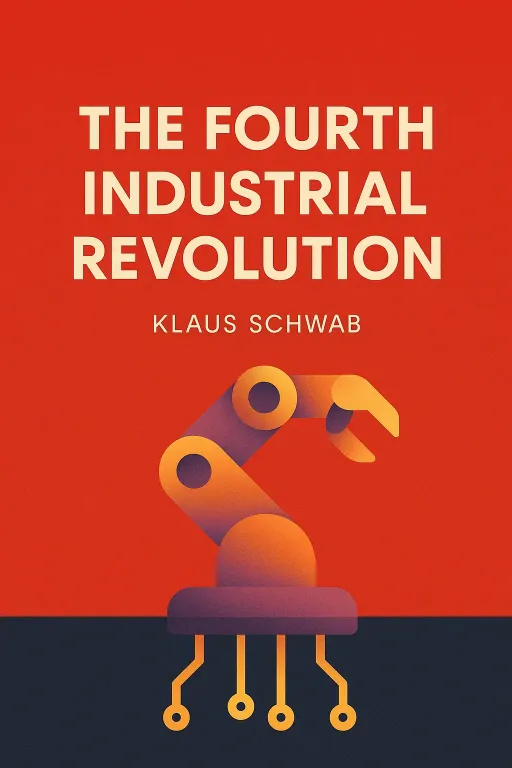
Nova: Exactly. And that is why we are diving into two essential texts today that define this era. First, we have The Fourth Industrial Revolution by Klaus Schwab, which maps out how physical, digital, and biological worlds are merging. And to understand the engine driving that merger, we are looking at The Master Algorithm by Pedro Domingos.
Atlas: I have been waiting to get into these. Schwab gives us the big picture—the "what is happening"—and Domingos gives us the "how it actually works." For anyone listening who is trying to be intentional about their growth, this is the blueprint for the next decade.
Nova: That is the perfect word for it. A blueprint. Because if you do not understand how these algorithms—these master algorithms—are making decisions, you are not an architect of your own future. You are just a tenant in someone else’s building.
The Convergence of Worlds
SECTION
Atlas: Let’s start with that big shift Schwab talks about. He describes this Fourth Industrial Revolution as a fundamental change. But I think a lot of people hear that and just think, "Okay, faster internet and better smartphones." How is this different from the digital revolution we already went through?
Nova: It is different because it is not just about the digital realm anymore. Think about your own experience. In the last revolution, the digital world was a separate space you logged into. Now, the digital, the physical, and the biological are colliding. We are seeing sensors that monitor biological health, materials that are digitally engineered at the molecular level, and decision-making that happens in real-time across global supply chains.
Atlas: That makes sense. It is the difference between a website and a smart city. One is a screen; the other is an integrated organism. But when you say it is "merging," that sounds a bit abstract. What does that look like for a professional trying to navigate this?
Nova: It looks like the end of silos. If you are an architect—and I mean that both literally and metaphorically—you can no longer just focus on the design of a building. You have to understand the data flow, the energy efficiency, the automated maintenance, and the biological impact of the materials. The complexity has compounded.
Atlas: That is the part that gets me. The compounding complexity. It feels like every time you master one layer, another one gets added on top. It is exhausting to try to keep up.
Nova: That is the point where most people get overwhelmed and stop trying. But the growth seeker looks at that complexity and sees a competitive advantage. Because most people are reacting to the complexity, the ones who understand the foundational systems are the ones who are setting the terms.
Atlas: I see what you are getting at. It is about shifting from being a consumer of technology to being a strategist who understands how these systems interact. But how do you actually do that without getting lost in the weeds?
Nova: You focus on the underlying mechanics. Schwab argues that leadership in this era requires a different kind of agility. You have to be comfortable with the fact that the tools you use today might be obsolete in three years. Your value is not in knowing the specific tool; it is in understanding the principles of the system.
Atlas: That resonates. It reminds me of the difference between learning how to use a specific software and learning how to think in systems. One creates a technician; the other creates an architect.
Demystifying the Master Algorithm
SECTION
Nova: And that leads us perfectly into the second part of our discussion. If Schwab is the architect showing us the new landscape, Pedro Domingos is the engineer explaining the physics of how it is built. In The Master Algorithm, he demystifies machine learning.
Atlas: I have to be honest, machine learning sounds like a buzzword that gets thrown around in boardrooms to make things sound smarter. What is the core insight there?
Nova: The core insight is that we are moving from a world where we write rules for computers to follow, to a world where we give computers data and they create their own rules. Domingos explains that there are five main tribes of machine learning, each trying to build a single "master algorithm" that can learn anything from data.
Atlas: Five tribes. That sounds like a fantasy novel. What are they?
Nova: They are the Symbolists, the Connectionists, the Evolutionaries, the Bayesians, and the Analogizers. Each one has a different way of learning. For example, the Connectionists, which is what we see in neural networks, try to mimic the human brain. The Symbolists try to mimic human logic.
Atlas: Okay, wait. That is actually helpful. Instead of just thinking of AI as a magic black box, you are saying it is actually just different approaches to solving problems.
Nova: Exactly. And the reason this matters for the professional is that when you understand how these models learn—whether it is through logic, through evolution, or through pattern matching—you stop being afraid of them. You start seeing them as tools you can direct.
Atlas: That is a massive mental shift. Most people look at AI and see an unpredictable force. You are suggesting that if you understand the of model, you can predict its behavior and, more importantly, its limitations.
Nova: Spot on. If you know you are dealing with a model based on decision trees, you know it is great for structured, logical paths. If you are dealing with a neural network, you know it is great for messy, high-dimensional pattern recognition. You wouldn't use a hammer to paint a wall, right?
Atlas: Of course not.
Nova: So why would you use a pattern-matching algorithm to try to force a logical, rule-based decision? Understanding the model is the key to strategic leadership.
The Pragmatic Architect
SECTION
Atlas: I want to circle back to the user profile we have in mind here. We are talking to the aspiring architect, the growth seeker. They are busy. They are trying to build something meaningful. They do not have time to go get a PhD in computer science. How do they apply this without getting buried?
Nova: That is the most important question. The answer is not to become a coder. It is to become an informed participant in the conversation. You do not need to build the neural network; you need to be able to ask the right questions about it.
Atlas: Okay, so what is the right question?
Nova: Ask what the objective function is. Ask how the model handles edge cases. Ask what data it was trained on. When you ask those questions, you immediately shift from a passive user to a critical stakeholder.
Atlas: That is empowering. It changes the dynamic from "The computer said so" to "Why did the system arrive at this conclusion?" It brings human judgment back into the loop.
Nova: And that is exactly where the human element becomes the most valuable asset. The algorithms are great at optimization, but they are terrible at purpose. They can tell you how to get from point A to point B the fastest, but they cannot tell you if point B is a place you actually want to go.
Atlas: That is the "Architect" mindset. The machine is the contractor that builds the structure, but you are the one who designs the vision.
Nova: Yes. And that brings us to the "Tiny Step." It is not about intensity; it is about consistency. If you dedicate just ten minutes of your daily learning window to understanding one model—even if you just read a simple explainer on how decision trees work—you are building a mental library.
Atlas: Ten minutes. That is manageable. That is the difference between scrolling through a feed for ten minutes and actually building your own foundation.
Nova: Think about the compounding effect. If you do that for a year, you have a solid, working knowledge of the technological landscape that most people in your industry will not have. You will be the one in the room who can bridge the gap between the technical team and the business strategy.
Atlas: It also helps with the impostor syndrome. When you know the basics of how these things work, you realize that the experts are just people who have spent more time with the same concepts. It levels the playing field.
Synthesis & Takeaways
SECTION
Nova: That is a great point. It is not magic. It is just math and logic. And once you demystify it, you can take control of it.
Atlas: So, we have covered the broad shift—the Fourth Industrial Revolution—and the mechanics of the engine—the Master Algorithm. But if we had to distill this into one lasting insight for the listeners, what would it be?
Nova: It is that we are in a transition period. We are moving from an era of "doing" to an era of "architecting." The value is no longer in the manual labor of execution. The value is in the system design. The people who will thrive are the ones who can look at the physical, digital, and biological tools available and synthesize them into something that solves a real human problem.
Atlas: I love that. The focus shifts from "How do I do this task?" to "How do I build a system that achieves this outcome?"
Nova: And you do that by staying curious. By using that ten-minute window to learn one new thing about how these systems function. You are not building a shed; you are building a skyscraper. You have to lay the foundation, one brick at a time.
Atlas: It is a marathon, not a sprint. Consistency beats intensity every single time. And honestly, looking at it that way makes the whole "technological horizon" feel less like a threat and more like an opportunity.
Nova: It is an invitation. The tools are available. The question is whether you are going to pick them up and start building.
Atlas: I think that is a perfect place to leave our listeners. Start small, stay curious, and keep building that foundation.
Nova: Thank you for joining us on this deep dive into the architecture of the future. We hope this gave you a clearer perspective on how to navigate the horizon.
Atlas: Keep growing, and we will catch you in the next one. This is Aibrary. Congratulations on your growth!