

Balancing High-Speed Execution with Personal Integrity
Golden Hook & Introduction
SECTION
Nova: The tech industry's favorite mantra—move fast and break things—has left a trail of wreckage that we are still cleaning up today. We often treat speed as a virtue, but when the dust settles, we frequently find that what we actually broke was the trust of the people we rely on most.
Atlas: That is a harsh reality to face. We are conditioned to believe that if we aren't moving at a breakneck pace, we are falling behind. But I have seen countless teams sprint toward a deadline, only to realize they are running in the wrong direction because they never took the time to align on what actually matters. It feels like a high-stakes game where the rules change every single day.
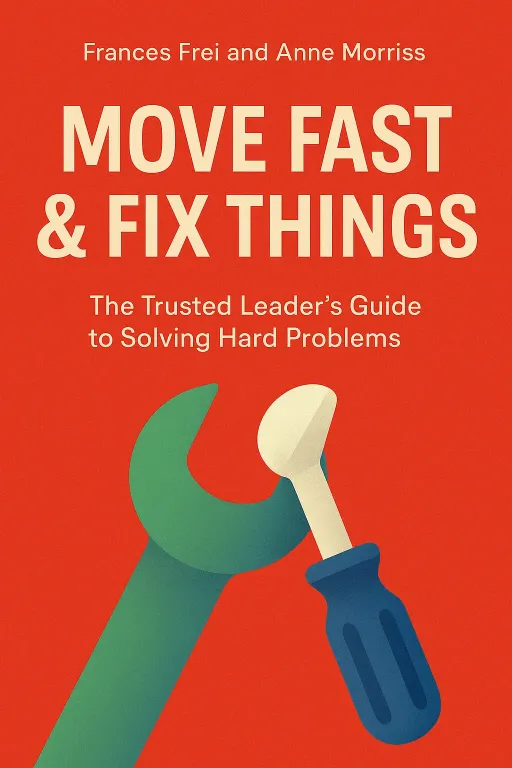
Nova: That tension is exactly what we are dissecting today. We are looking at two very different, yet surprisingly complementary, blueprints for success. First, we have the rigorous leadership framework from Move Fast and Fix Things by Frances Frei and Anne Morriss. They spent years analyzing why organizations collapse under pressure, specifically during their time helping to turn around the culture at companies like Uber.
Atlas: And to balance that corporate rigor, we are bringing in the ancient, almost counter-intuitive wisdom from The Four Agreements by Don Miguel Ruiz. It is a fascinating juxtaposition. You have the Harvard-trained experts dealing with complex organizational systems, and then you have a Mexican author drawing on Toltec tradition to protect our inner peace.
Nova: Exactly. The goal for today is to build a bridge between these two worlds. We want to explore how you can maintain high-speed execution without sacrificing your personal integrity or the trust of your team. Because the most effective leaders are not the ones who move the fastest; they are the ones who move with the most clarity.
The Speed Trap and the Trust Triangle
SECTION
Atlas: Let me push back on that for a second, Nova. If you are in a startup or a high-growth environment, and you decide to slow down to focus on clarity, your competitors are going to eat your lunch. Is there a way to actually move fast while being mindful, or is that just a nice sentiment that falls apart the moment a quarterly target is missed?
Nova: That is the million-dollar question, and it is where Frances Frei and Anne Morriss offer a distinct perspective. They argue that the reason we fail when we move fast is that we are trying to sprint with a broken engine. In their research, they identified what they call the Trust Triangle. If you want to move fast, you have to be able to diagnose which side of the triangle is wobbling: Empathy, Logic, or Authenticity.
Atlas: I have heard of the Trust Triangle, but explain it through the lens of a high-pressure deadline. Why does a team usually wobble?
Nova: Think about a project launch. The team is stressed. If the leader lacks Empathy, they are pushing for results without acknowledging the human cost. The team feels used, and their engagement drops. If the leader lacks Logic, they might be incredibly empathetic and well-liked, but the strategy is incoherent. The team is running, but they are running in circles. And if the leader lacks Authenticity, they are saying one thing and doing another. The team senses the disconnect, and trust evaporates.
Atlas: That makes sense. It is the classic breakdown. A leader who is all empathy but no logic creates a team that loves them but achieves nothing. A leader who is all logic but no empathy creates a team that hits targets but burns out in six months.
Nova: Precisely. And when you are in a high-speed environment, you do not have time to fix everything at once. Frei and Morriss suggest that you have to identify the wobble. If your team is stuck, ask yourself: Is it that they do not feel heard? That is an empathy issue. Is it that the strategy makes no sense? That is a logic issue. Or is it that they do not trust your intentions? That is an authenticity issue. Once you isolate the specific wobble, you can fix it and get back to speed.
Atlas: So, the secret isn't slowing down, but rather becoming a diagnostic leader. You are essentially saying that speed is a function of trust. If you have high trust, you can move faster because you do not have to spend time checking for hidden agendas or managing fragile egos.
Nova: That is the core of it. Trust is a speed multiplier. When trust is low, you have to verify everything. You have to write longer emails, hold more meetings, and double-check every output. That is the friction that kills speed. By investing in the Trust Triangle, you are removing the friction from your organizational system.
The Four Agreements as Professional Guardrails
SECTION
Atlas: I can see how the Trust Triangle functions as a diagnostic tool for a leader. But let’s bridge this over to the individual level. We are talking about high-stress environments. This is where Don Miguel Ruiz’s The Four Agreements comes into play. How do these ancient principles keep a professional from losing their mind when the project is failing?
Nova: Ruiz proposes four simple agreements: Be impeccable with your word, don't take anything personally, don't make assumptions, and always do your best. In a corporate setting, these sound almost too simple, but they are incredibly difficult to master. Take the first one: Be impeccable with your word.
Atlas: That sounds like basic business ethics. Don't lie. Keep your promises.
Nova: It goes deeper than that. Being impeccable with your word means using your energy in the direction of truth and love for yourself. In a meeting, being impeccable means not gossiping, not overpromising to appease a stakeholder, and not speaking negatively about a team member behind their back. When you are impeccable with your word, you create a standard of reliability. People know that what you say is exactly what you mean. That builds the Authenticity side of the Trust Triangle we just discussed.
Atlas: Okay, I see the connection. If I am not gossiping or making empty promises, I am naturally fostering a more authentic environment. But what about the second agreement? Don't take anything personally. That is a tough one in a professional setting. If my boss critiques my work, that feels personal.
Nova: That is a common reaction. But consider this: when someone critiques your work, they are usually reacting to their own internal state, their own pressures, and their own limited perspective. Their critique is a reflection of them, not a definition of you. When you take it personally, you waste energy defending your ego instead of using the feedback to improve the logic of your work.
Atlas: That is a pivot. Instead of viewing feedback as an attack, you view it as data. It removes the emotional charge that leads to defensiveness. That actually saves time. I have seen projects stalled for days because two people are locked in a silent feud over a perceived slight in a meeting.
Nova: Exactly. That is emotional drag. It slows the entire organization down. By adopting the mindset of not taking things personally, you keep the flow of information clean. You are not filtering facts through a screen of insecurity. You are just processing the data.
The Intersection of Systems and Soul
SECTION
Atlas: We have the structural side from Frei and Morriss—the Trust Triangle—and the internal, behavioral side from Ruiz. How do we combine these into a daily practice? A listener who is a manager in a high-growth company might be thinking, this sounds great, but I have a stand-up meeting in ten minutes. How do I apply this right now?
Nova: Start with a micro-audit. Before you walk into that meeting, ask yourself which agreement you are most likely to break. Are you going to make assumptions about why the project is behind? Are you going to take a colleague's frustration personally? And then, look at the Trust Triangle. Is your team wobbling because you haven't been authentic about the risks, or because you haven't been empathetic to their workload?
Atlas: I like that. It turns the theory into a diagnostic checklist. You are not just reacting; you are architecting the interaction. And it addresses that feeling of chaos we talked about at the beginning. When you have these frameworks, the chaos becomes manageable.
Nova: It changes your relationship with pressure. Most people view pressure as something that forces them to compromise. They think they have to sacrifice their integrity, or their team's well-being, to hit the numbers. But the research from Frei and Morriss and the wisdom from Ruiz suggest the opposite. Compromising your integrity is actually a performance tax. It makes you slower, not faster.
Atlas: That is a powerful reframing. It suggests that the most strategic thing you can do is to hold your ground on these principles. If you are impeccable with your word, you spend less time cleaning up communication messes. If you maintain empathy, you retain your best talent and avoid the cost of turnover.
Nova: Think about the long-term compounding effect. If you are the leader who consistently uses logic to solve problems, who treats people with empathy, and who is impeccably honest, you build a reputation that precedes you. People will want to work with you. They will trust you. And when you have that level of trust, you can move at incredible speeds because you are not constantly looking over your shoulder.
Atlas: It sounds like we are describing the difference between a sprinter who burns out and a marathon runner who sets the pace. The sprinter relies on raw energy and often breaks things along the way. The marathon runner relies on systems and integrity, and they end up going much further, much faster, in the long run.
Nova: That is the essence of it. And it brings us back to the deeper purpose. We are not just working to hit a target. We are working to build environments where people can actually perform at their best. When you align your daily hustle—the emails, the meetings, the deadlines—with these deeper principles, the work itself becomes a form of self-actualization. You are not just building a product; you are building a culture.
Synthesis & Takeaways
SECTION
Atlas: I have to admit, I started this conversation thinking we were going to talk about how to optimize workflows or hack productivity to move faster. But we ended up talking about something much more fundamental. We are talking about the character of the individual and the trust of the team.
Nova: That is because you cannot hack your way to high performance without a foundation. The most effective systems in the world are built on trust. Without it, you are just running faster on a treadmill that is going nowhere. The takeaway for our listeners this week is to choose one agreement and one side of the Trust Triangle to focus on.
Atlas: Let’s make it concrete. If you are a leader, pick one area of the Trust Triangle—Empathy, Logic, or Authenticity—that you suspect is wobbling in your team right now. Ask yourself, what is one specific action I can take to shore that up? And if you are an individual contributor, pick one of the Four Agreements. Maybe it is not making assumptions. The next time you feel that surge of anxiety about a colleague's silence or a vague email, pause and ask yourself if you are filling in the blanks with your own fears.
Nova: That is a perfect application. It turns the philosophy into a tangible experiment. And remember, this is not about being perfect. You are going to break your word sometimes. You are going to take things personally. The practice is not in being flawless; it is in the recovery. It is in noticing the wobble and correcting it.
Atlas: I love that. It gives us permission to be human while still striving for excellence. It is about the trajectory, not the perfection.
Nova: Exactly. You are building a system, both inside yourself and within your team, that is resilient enough to handle high-speed execution without falling apart. You are creating the space for true, sustainable performance.
Atlas: This has been a great shift in perspective. It makes me realize that the most strategic move I can make today is to be more intentional about how I show up for the people I work with.
Nova: And that is the only way to build something that lasts. Thank you for joining us in this exploration of how to move fast, fix things, and keep your integrity intact. This is Aibrary. Congratulations on your growth!









