

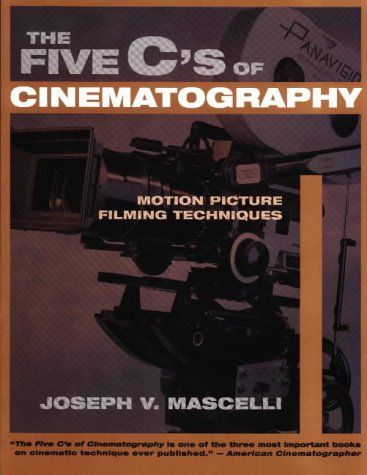
The five C's of cinematography
Motion Picture Filming Techniques
Introduction
Nova: Imagine you are on a film set in 1965. The cameras are the size of small refrigerators, the film stock is expensive, and every second of footage costs a fortune. There is no room for error. In the middle of all this, a man named Joseph V. Mascelli writes a book that becomes so essential, so foundational, that it is still required reading in film schools today. It is called The Five Cs of Cinematography.
Atlas: It is wild to think that a book from the sixties is still the go-to guide. I mean, we have drones now. We have iPhones that shoot in 4K. Is a sixty-year-old manual really still relevant to someone making a YouTube video or a TikTok today?
Nova: That is exactly what makes it so fascinating. Mascelli was not just talking about the technology of his time. He was codifying the actual grammar of visual storytelling. He called it the five Cs: Camera Angles, Continuity, Cutting, Close-ups, and Composition. These are the universal rules of how our brains process moving images.
Atlas: So, it is like the physics of film? Gravity does not change just because you have a faster car, and storytelling does not change just because you have a better camera?
Nova: Precisely. Mascelli was a combat cinematographer during World War II. He was part of the 165th Signal Photo Company. When you are filming in a war zone, you do not get a second take. You have to get the shot right the first time, and you have to make sure it actually tells a story that people back home can understand. That no-nonsense, high-stakes background is what makes this book so practical and enduring.
Atlas: Okay, I am sold. If a guy who filmed in a war zone says these are the five things you need to know, I want to know them. Let us break down these five Cs and see if they still hold up in the digital age.
Key Insight 1
The First C: Camera Angles
Nova: Let us start with the first C, which is Camera Angles. Mascelli argues that the angle of the camera is not just about where you put the tripod. It is about the relationship between the audience and the story. He breaks it down into three main types: Objective, Subjective, and Point of View.
Atlas: Objective sounds like you are just a fly on the wall, right? Like you are watching the scene unfold from a distance?
Nova: Exactly. The objective angle is the most common. The audience is an unseen observer. The characters never look at the camera. It is the standard way we watch movies. But then you have the Subjective angle, where the camera actually becomes the eyes of a character. When the camera moves, the character is moving. When someone looks into the lens, they are looking at you, the viewer.
Atlas: That is always a bit jarring when it happens. It feels personal, almost invasive.
Nova: It is! And Mascelli warns that you have to use it sparingly because it breaks the fourth wall. But then there is the third type, the Point of View or POV shot. This is the middle ground. It is usually an over-the-shoulder shot where we see what the character sees, but we still see a bit of the character in the frame. It keeps us grounded in their perspective without making us feel like we are literally in their body.
Atlas: I noticed he also talks a lot about the height of the camera. Like, why does it matter if the camera is a foot higher or lower?
Nova: It changes the power dynamic completely. Mascelli explains that a high angle, looking down on a subject, makes them look small, weak, or vulnerable. A low angle, looking up, makes them look powerful, heroic, or even threatening. Think about every superhero movie you have ever seen. When the hero lands, the camera is almost always low, looking up at them. It is a psychological trick that works every single time.
Atlas: It is funny how we just accept that subconsciously. We do not think, oh, the camera is low, so he must be brave. We just feel it.
Nova: That is the goal of good cinematography. It should be invisible. If you notice the camera angle, the cinematographer has almost failed. You should just feel the emotion the angle is meant to convey.
Key Insight 2
The Second C: Continuity
Nova: The second C is Continuity, and this is where a lot of beginner filmmakers get into trouble. Mascelli calls this the invisible art of making sure the audience never gets confused about where things are in space.
Atlas: Is this like when a character has a half-full glass of water in one shot and it is empty in the next? I love spotting those mistakes.
Nova: Those are the obvious ones, but Mascelli is more concerned with spatial continuity. The big one is the 180-degree rule. Imagine two people talking. If you draw a straight line between them, the camera should stay on one side of that line for the entire scene.
Atlas: Wait, why? If I move the camera to the other side, what happens?
Nova: If you cross that line, the characters will suddenly appear to have swapped places on the screen. The person who was on the left is now on the right. It disorients the viewer. Their brain has to take a split second to figure out where everyone went, and in that split second, you have lost them. They are no longer in the story; they are thinking about the camera.
Atlas: That makes sense. It is like a map. If the map keeps flipping north and south, you are going to get lost. But does this apply to movement too? Like if a car is driving?
Nova: Absolutely. Mascelli calls this screen direction. If a car is driving from left to right in the first shot, it must continue driving from left to right in the next shot. If it suddenly appears to be driving right to left, the audience thinks the car has turned around and is going back where it came from.
Atlas: I have definitely seen that in action movies where I get confused about who is chasing whom. It is usually because they broke the screen direction rules.
Nova: Exactly. Mascelli’s background in combat filming really shines here. In a chaotic battle, if you do not maintain screen direction, the audience has no idea which army is which. He emphasizes that continuity is about protecting the viewer's mental model of the scene. If you break it, you break the spell of the movie.
Key Insight 3
The Third and Fourth Cs: Cutting and Close-ups
Nova: Now, the third C is Cutting, which might seem strange for a book on cinematography. Usually, we think of cutting as the editor's job, right?
Atlas: Yeah, I thought the cinematographer just shoots the footage and hands it off. Why is it one of Mascelli's five Cs?
Nova: Because Mascelli argues that you cannot be a good cinematographer if you do not understand how the film will be edited. You have to shoot for the edit. He talks about the master scene technique, where you film the whole scene in one wide shot, and then you go back and film the coverage—the medium shots and close-ups.
Atlas: So you are giving the editor the pieces of a puzzle that actually fit together.
Nova: Precisely. And that leads directly into the fourth C: Close-ups. Mascelli treats close-ups as their own category because they are the most powerful tool in a filmmaker's arsenal. He calls them the emotional heart of the film.
Atlas: I mean, a close-up is just zooming in, right? What is the big secret there?
Nova: It is way more than just zooming. Mascelli explains that a close-up isolates a subject from their environment. It forces the audience to look at one thing and one thing only: the character's emotion. But there are rules! You have to worry about headroom—the space above the head—and nose room, which is the space in front of the character's face.
Atlas: Nose room? That sounds like something you'd tell a kid to stop doing.
Nova: It is actually about where the character is looking. If a character is looking to the right, you should leave more empty space on the right side of the frame. Mascelli says this gives them room to breathe. If you put their face right against the edge of the frame they are looking toward, it feels cramped and uncomfortable.
Atlas: Unless you want the audience to feel uncomfortable? I bet some directors do that on purpose.
Nova: They do! But Mascelli’s point is that you have to know the rule to break it effectively. He also talks about the psychological impact of the extreme close-up—just the eyes or the mouth. It creates an intense, almost claustrophobic intimacy. It tells the audience: this moment is vital. Do not look away.
Key Insight 4
The Fifth C: Composition
Nova: Finally, we reach the fifth C: Composition. This is the art of arranging everything within the four walls of the frame. Mascelli goes deep into the Rule of Thirds, which most people have heard of, but he explains why it works.
Atlas: Right, the grid. You put the interesting stuff on the lines or the intersections. But why is that better than just putting the person in the middle?
Nova: Because the middle is static. It is balanced, but it is boring. Mascelli argues that by placing subjects off-center, you create a sense of movement and tension. It makes the eye travel across the frame. He also talks about leading lines—using things in the environment like a road, a fence, or even a shadow to point the viewer's eye toward the subject.
Atlas: It is like he is a magician directing our attention without us realizing it.
Nova: That is exactly what it is. He also discusses the concept of depth. A flat image is boring. Mascelli encourages cinematographers to think in three layers: the foreground, the middle ground, and the background. If you put an object close to the lens in the foreground, it gives the scene a sense of scale and makes the world feel real and three-dimensional.
Atlas: I have noticed that in a lot of great movies. There is often a lamp or a piece of furniture just slightly out of focus in the corner of the frame. It makes me feel like I am actually in the room.
Nova: That is the foreground element at work! Mascelli also loved triangle composition. If you have three characters, you should try to arrange them in a triangle shape within the frame. It is naturally pleasing to the human eye and creates a sense of stability. Or, if you tilt the triangle, you can create a sense of unease.
Atlas: It is amazing how much math and geometry is hidden in a beautiful shot. It is not just about pointing a camera at something pretty; it is about constructing an image that guides the human brain.
Conclusion
Nova: We have covered a lot of ground today, from the 180-degree rule to the emotional power of the close-up. Joseph V. Mascelli’s The Five Cs of Cinematography might have been written in 1965, but its lessons are more relevant than ever. Whether you are filming a Hollywood blockbuster or a video for your friends, these principles are the foundation of visual language.
Atlas: It is really eye-opening. I used to think cinematography was just about having a fancy camera and good lighting. But now I see it is more like being a conductor. You are conducting the audience's eyes, their emotions, and their understanding of the story through these five simple but deep concepts.
Nova: That is a perfect way to put it. The technology will always change. We went from black and white to color, from film to digital, from theaters to smartphones. But the way we perceive space, motion, and emotion remains the same. Mascelli didn't just write a technical manual; he wrote a guide to the human experience of seeing.
Atlas: I think the biggest takeaway for me is that there is a reason behind every shot. If you can master the five Cs, you stop being someone who just records things and you start being a storyteller.
Nova: Exactly. So next time you pick up a camera, ask yourself: What is my angle? Is my continuity solid? How will this cut? Do I need a close-up here? And how is my composition? If you can answer those five questions, you are well on your way to cinematic mastery.
Atlas: This has been a great deep dive. I am definitely going to look at movies differently tonight.
Nova: That is the goal! This is Aibrary. Congratulations on your growth!