

The Learning Curve Trap: How to Master New Skills with Less Friction
Golden Hook & Introduction
SECTION
Nova: The 10,000-hour rule? It's a myth, at least for functional mastery. What if you could learn almost any new skill you need in just 20 hours, or even master complex fields in months instead of years?
Atlas: Whoa, hold on a second. That sounds like something out of a sci-fi movie. Are you telling me I don't need to dedicate my entire life to become proficient at something?
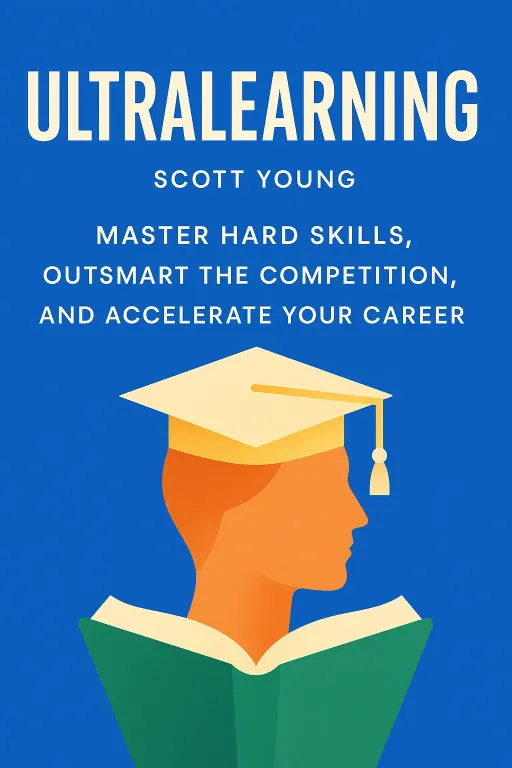
Nova: Exactly! And that's what we're diving into today. We're looking at two incredible books that shatter the traditional learning paradigm. First up, by Scott Young. Young is a fascinating character; he famously completed MIT's entire 4-year computer science curriculum in just 12 months, all on his own, without attending a single class. He's a living testament to rapid, self-directed learning.
Atlas: That's wild. And then on the other side of the coin, we have by Josh Kaufman. I know Kaufman from his work in business and personal development; he has a knack for distilling complex topics into incredibly actionable frameworks. He's all about making big goals achievable for busy professionals, which I know our listeners can appreciate.
Nova: Precisely. Both fundamentally solve the problem of slow learning by providing actionable strategies for accelerated skill mastery. Let's start with Scott Young's Ultralearning, because it really sets the stage for a mindset shift.
Deep Dive into Core Topic 1: Ultralearning: The Intensive Path to Mastery
SECTION
Nova: So, Ultralearning isn't just about learning fast; it's about learning and. Young outlines nine principles, but the core idea is self-directed, immersive learning. Think of it like this: instead of passively absorbing information, you're actively designing your own curriculum, pushing yourself to the limits, and getting direct feedback.
Atlas: Okay, 'intensely' and 'self-directed' sounds... a little intimidating for someone already juggling a demanding career. What does that actually look like in practice? Is this just for academic prodigies?
Nova: Not at all. Young's own example is powerful: learning a new language in a few months by immersing himself in a foreign country and speaking only that language. He details how he went from zero to conversational fluency by actively structuring his environment for maximum exposure and immediate application. Imagine spending three months in Brazil, forcing yourself to speak only Portuguese from day one. It's about deconstructing the skill, focusing on the most critical parts, and then immersing yourself in a way that forces direct application.
Atlas: So, instead of a textbook, it's 'sink or swim'? I get the immersion part, but how does someone in a high-pressure role deconstruct a skill like, say, advanced negotiation tactics, and then 'immerse' themselves without quitting their job?
Nova: That's where the 'directness' principle comes in. For negotiation, it's not just reading books; it's role-playing, analyzing real negotiation transcripts, practicing with colleagues, and seeking immediate feedback on your performance. Young's approach encourages identifying the core components of the skill and then practicing them in the most direct way possible, even if it feels uncomfortable. It's about being brutally honest about what you need to learn to perform the skill, rather than what feels good to study.
Atlas: That makes sense. It's like, instead of just reading about swimming, you jump in the pool. But what if you're not a natural swimmer? How do you avoid drowning in that intensity?
Nova: That's a great question, and it highlights the need for smart strategy, not just brute force. Young emphasizes planning your project, focusing on one thing at a time, and deliberately practicing the actual skill, not just its prerequisites. It's about minimizing the gap between what you study and what you actually need to do. He even talks about 'retrieval' – actively testing yourself and recalling information, rather than just re-reading it. It's a much more active, demanding process, but the results are exponentially faster.
Atlas: So, it's like building muscle memory for your brain, but you're also the personal trainer and nutritionist, all rolled into one. I can see how that would yield results, but it still sounds like a significant commitment. What if you just need to get up to speed quickly, without aiming for full mastery?
Deep Dive into Core Topic 2: The First 20 Hours: Rapid Skill Acquisition
SECTION
Nova: That's a brilliant segue, Atlas, because that's precisely where Josh Kaufman's 'The First 20 Hours' comes in. If Ultralearning is about mastering complex fields, Kaufman is about getting to functional proficiency, quickly, without the overwhelming intensity from day one. He argues you can learn almost any new skill to a functional level in just 20 hours of focused, deliberate practice. It’s about conquering the initial frustration barrier.
Atlas: Twenty hours? That sounds almost too good to be true. I've spent twenty hours trying to figure out a new software update, let alone a whole skill!
Nova: The key is 'focused, deliberate practice' and a clever four-step method. First, deconstruct the skill: break it down into the smallest possible learnable chunks. Second, learn enough to self-correct: don't try to master everything upfront, just enough to recognize your mistakes. Third, remove practice barriers: eliminate distractions and make it easy to start. And fourth, practice for at least 20 hours: commit to that focused time.
Atlas: Okay, so it's not just randomly fiddling for 20 hours. It's strategic. Can you give me an example that really brings this to life for our listeners, especially those looking to pick up a new strategic skill?
Nova: Absolutely. Kaufman famously learned to play the ukulele in 20 hours. He didn't try to learn every chord or song. He deconstructed it: 'What are the most common chords? What strumming patterns are essential for basic songs?' He learned just enough to play a few simple songs, removing barriers by having the ukulele always accessible. Within 20 hours, he was playing songs, not perfectly, but functionally. For our listeners, imagine wanting to understand educational market trends. Instead of trying to read every report, you deconstruct it: 'What are the 3-5 key metrics I need to track? What are the top 2-3 reports I absolutely must read? Who are the 5 essential thought leaders to follow?' Then you dedicate 20 focused hours to just those elements. You're not becoming a market analyst, but you're becoming functionally knowledgeable enough to have an informed conversation.
Atlas: That’s a great way to put it. So, it's about being surgical with your learning, not just broad. It removes the intimidation factor of feeling like you need to become an expert overnight. It's about getting 'good enough' to start making an impact, which resonates deeply with anyone driven by results.
Nova: Exactly. It’s about minimizing the knowledge gap to get to a point where you can actually something, rather than just endlessly preparing. Imagine wanting to develop stronger negotiation skills. You don't need to read every book on the subject or take a year-long course. You could deconstruct it into 'active listening,' 'identifying core interests,' and 'framing offers.' Then, you practice those specific components for 20 hours, maybe through structured role-playing or by observing and analyzing real-world negotiations. The goal is to get functional, to get started, and to get past that initial, often painful, learning hump.
Atlas: I love that. It’s about reducing the friction. So many times, the biggest barrier to learning something new is just the sheer overwhelm of where to start, and the fear of not being good enough. Twenty focused hours sounds manageable, even for someone with a packed schedule.
Synthesis & Takeaways
SECTION
Nova: Exactly. So, when you put Ultralearning and The First 20 Hours together, you get a powerful roadmap. Ultralearning gives you the intensity and strategy for deep mastery, while The First 20 Hours provides the initial boost to get over the hump and achieve functional proficiency quickly. They address different stages and levels of skill acquisition, but both fundamentally challenge the idea that learning has to be slow and arduous.
Atlas: It’s about understanding your goal. If you need deep mastery, Ultralearning provides the framework. If you just need to get started and be competent, the 20-hour rule is your friend. This fundamentally solves the problem of slow learning by giving you a tailored weapon for any learning challenge. It's about being strategic with your time and effort, not just putting in the hours.
Nova: That's the profound insight, isn't it? It's not about how much time you spend, but how intentionally and effectively you spend it. The learning curve doesn't have to be a trap; it can be a launchpad if you approach it with these tactical insights. Think of it: the average person spends countless hours scrolling social media or passively consuming content. Redirecting just 20 of those hours, with focus and intent, can unlock a brand new skill that directly impacts your career or personal growth. It's a stark reminder that our potential is vast, if we only dedicate specific, strategic time to cultivate it.
Atlas: That gives me chills, honestly. It’s empowering to think about how much we can achieve with just a slight shift in approach. So, your tiny step for this week? Pick one small skill you've been wanting to learn, maybe developing stronger negotiation skills or even understanding a new sales technique, and spend 20 minutes today deconstructing it into its core components. Just 20 minutes to start your accelerated learning journey.
Nova: And share your chosen skill with us! We love hearing what you're tackling and how these methods are working for you.
Atlas: This is Aibrary. Congratulations on your growth!









