

The First 20 Hours
The Myth of Mastery: Why 20 Hours is Enough
The Myth of Mastery: Why 20 Hours is Enough
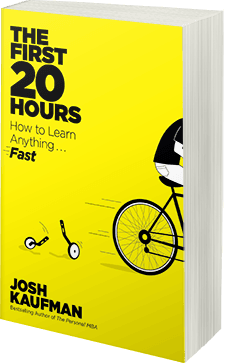
Nova: Welcome back to 'The Deep Dive,' the show where we take complex ideas and distill them into actionable knowledge. Today, we're tackling a concept that flies directly in the face of conventional wisdom: learning anything fast. We’re talking about Josh Kaufman’s book, The First 20 Hours: How to Learn Anything... Fast!
Nova: : That title alone is provocative, Nova. For years, we’ve been marinated in the Malcolm Gladwell gospel of the 10,000-Hour Rule. That idea suggests that true expertise requires a decade of dedicated effort. So, what gives? Is Kaufman suggesting we can become concert pianists over a long weekend?
Nova: Not quite! And that’s the crucial distinction. Kaufman isn't aiming for mastery; he’s aiming for —specifically, getting past the initial, painful stage of being grossly incompetent. He argues that the first 20 hours of focused, deliberate practice is the sweet spot to overcome the initial frustration barrier and become proficient enough to actually enjoy the skill.
Nova: : Grossly incompetent. I like that framing. Because let’s be honest, that initial phase is where 90% of people quit. You pick up the guitar, you try to code, you attempt to speak Mandarin, and within three sessions, you sound like a toddler banging on pots. It’s demoralizing.
Nova: Exactly. Kaufman’s research suggests that the steep drop-off in motivation happens you even hit 20 hours. His entire framework is designed to hack that initial failure point. He looked at skills he wanted to learn—like windsurfing or programming—and realized that the time spent wasn't about logging hours; it was about you were practicing.
Nova: : So, this isn't about shortcuts to becoming a world-class expert. It’s about reaching a functional level quickly. If I want to learn enough Spanish to navigate a trip to Madrid without embarrassing myself, 20 hours might be perfect. If I want to translate ancient texts, I still need the 10,000 hours.
Nova: Precisely. It’s about defining your target performance level. If your target is 'I want to play three recognizable songs on the ukulele,' that’s a very different commitment than 'I want to be a professional session musician.' The book is a manual for the former, which, frankly, is what most people actually want when they try something new.
Nova: : I’m intrigued. If this is a systematic approach, I assume Kaufman lays out a clear methodology. What’s the first step in this rapid acquisition process? How do we even structure those 20 hours?
Nova: That brings us perfectly into our first core insight. It all starts with breaking the skill down into its smallest, most essential components. Let's dive into Step One: Deconstruction.
Key Insight 1: The Power of Scoping
Deconstruct and Define: Scoping Your 20 Hours
Nova: Step one in Kaufman’s framework is to Deconstruct the skill and define your target performance level. This is arguably the most important step because it dictates everything else.
Nova: : Deconstruction sounds very technical. Can you give us an example of what that looks like in practice? If I wanted to learn touch typing, for instance, what am I deconstructing?
Nova: Great question. For touch typing, you aren't learning every single key combination or obscure shortcut. You are deconstructing it down to the absolute essentials: being able to type a standard English sentence without looking at the keyboard, at a reasonable speed, say 30 words per minute. You identify the 80/20 of the skill—the 20% of the sub-skills that will give you 80% of the functional result.
Nova: : So, for the ukulele, which Kaufman famously used as an example, the deconstruction isn't learning every chord in existence. It’s identifying the four or five most common chords that allow you to play hundreds of popular songs. You are creating a 'minimum viable skill set.'
Nova: Exactly. And this step forces you to confront the scope creep that kills most learning projects. People start learning guitar and immediately try to master barre chords when they can’t even cleanly switch between G and C. Kaufman insists you define what 'good enough' looks like you start practicing. If your target is too high, 20 hours will feel like a failure.
Nova: : I see the trap. If I set my target as 'Become a fluent conversationalist in French,' 20 hours is a joke. But if I set it as 'Be able to order food, ask for directions, and understand basic greetings,' that’s achievable and motivating.
Nova: It is. And this deconstruction process also helps you map out the learning path. Once you have those 5-10 essential sub-skills, you can sequence them logically. You don't try to learn the complex rhythm patterns of the ukulele before you can even fret a clean C chord. You sequence them for maximum early success.
Nova: : This feels like project management applied to personal development. It’s about creating a highly focused, bite-sized curriculum for yourself. What about the resources? Does Kaufman suggest spending hours researching the way to learn, which would eat into those 20 hours?
Nova: Absolutely not. He warns against 'research paralysis.' Once you’ve deconstructed the skill, you spend a amount of time—maybe 45 minutes to an hour—to gather the absolute minimum resources needed to start practicing the first sub-skill. Maybe one good beginner book, one excellent YouTube tutorial, or one structured online course. The key is to stop researching and start doing.
Nova: : So, Step One is: Define the destination, break the map into 5 small legs, and pack only the essential gear for the first leg. That makes the whole endeavor feel less like climbing Everest and more like a brisk hike.
Nova: It transforms an overwhelming goal into a series of manageable sprints. And once you have that focused map, you move to Step Two, which is all about making sure the practice you is actually effective. That leads us into the concept of learning enough to self-correct.
Key Insight 2: Designing Effective Practice
The Feedback Loop: Learning to Self-Correct
Nova: Moving on to Step Two: Learn Enough to Self-Correct. This is where the quality of those 20 hours really comes into play. If you practice something incorrectly for 20 hours, you’ve just become 20 hours better at doing it wrong.
Nova: : That’s a terrifying thought. How do you even know if you’re self-correcting properly when you’re a beginner? I don't know what a 'good' piano chord sounds like versus a 'bad' one.
Nova: That’s the paradox. You need just enough input to recognize your own errors. For programming, this might mean learning enough syntax to write a simple 'Hello World' program, and then immediately trying to write a slightly more complex one, using documentation or a reference guide to check your syntax errors. The goal isn't to memorize; it's to build an internal error-detection mechanism.
Nova: : So, it’s about finding the minimal viable feedback. For the ukulele, maybe I record myself playing the C chord transition, listen back, and realize my index finger is muting the high E string. That realization is the self-correction kicking in.
Nova: Precisely. And Kaufman emphasizes that this feedback doesn't always have to come from an expert teacher. It can come from the medium itself. A programming compiler gives immediate feedback. A language app corrects your pronunciation. If you’re learning to juggle, dropping the ball is the feedback. The key is to structure your practice so that feedback is immediate and unambiguous.
Nova: : That leads directly into Step Three, which I think is brilliant: Remove Practice Barriers. What kind of barriers are we talking about here? Is it just about finding time?
Nova: It’s much more tactical than just time management. It’s about friction. If you want to practice the piano, but the piano is covered in laundry and you have to move three pieces of furniture to sit down, that’s a barrier. If you want to code, but your development environment takes 15 minutes to load, that’s a barrier. Kaufman suggests identifying the single biggest friction point that prevents you from starting your practice session and eliminating it.
Nova: : That’s so relatable. I’ve seen people buy expensive gym equipment only to have it become a very expensive coat rack because the barrier to entry—getting dressed, driving, etc.—was too high. Kaufman is saying, make the desired action the path of least resistance.
Nova: Yes. For his windsurfing example, he realized the biggest barrier was getting the gear to the beach. So he made sure the board and sail were pre-rigged and ready to go the moment he arrived. He reduced the setup time from 30 minutes to 30 seconds. That small change meant he could squeeze in more high-quality practice sessions.
Nova: : So, to summarize the first three steps: 1. Scope it small. 2. Practice in a way that highlights your errors. 3. Make starting ridiculously easy. It sounds like a recipe for consistency, which is the real secret sauce.
Nova: It is. And once you have that focused, frictionless, self-correcting practice loop designed, you just have to feed it fuel. That fuel is the final, non-negotiable step: the 20 hours of deliberate practice.
Key Insight 3: The Commitment to Focused Effort
The Deliberate 20: Quality Over Quantity
Nova: We arrive at Step Four: Practice at least 20 hours. This is the number, but as we established earlier, it’s not just 20 hours of mindless repetition. It must be practice, focused on the sub-skills you identified in Step One.
Nova: : How does Kaufman define the structure of these 20 hours? Are we talking four hours a day for five days, or 30 minutes every day for 40 days? Does the distribution matter?
Nova: The distribution matters immensely for overcoming that initial frustration barrier. Kaufman strongly recommends breaking those 20 hours into short, intense bursts—think 45 minutes to an hour per session, done consistently. If you try to cram 10 hours into one weekend, you’ll burn out, your brain won't consolidate the learning, and you’ll hit that wall of incompetence hard.
Nova: : So, 45 minutes of highly focused work, four or five times a week, is far superior to one marathon session. That makes sense for neural plasticity. You need time for the brain to process and rewire overnight.
Nova: Exactly. And during those 45 minutes, you are hyper-focused on the specific sub-skill you are targeting that day. If you’re learning the ukulele, today you might spend 45 minutes on the transition between G and D, using a metronome, pushing your speed just slightly beyond your comfort zone. That’s deliberate practice.
Nova: : I remember reading about his own examples. He learned to program in a specific language, he learned the ukulele, and he learned windsurfing. Did he ever quantify the results of those 20 hours?
Nova: He did. For the ukulele, he was able to play simple songs with basic chords. For programming, he reached a point where he could build simple functional applications. The key takeaway from these examples is that he achieved a level of —he could the thing he set out to do. He wasn't a master coder or a professional musician, but he was no longer grossly incompetent.
Nova: : That’s the real value proposition. It shifts the goal from 'becoming a master' to 'achieving functional independence.' It democratizes skill acquisition. But I still have a lingering question about criticism. If it’s so simple, why hasn’t everyone done it? Are there skills this method simply won't work for?
Nova: That’s the healthy skepticism we need. Critics often point out that skills requiring massive physical dexterity or deep theoretical knowledge—like neurosurgery or professional ballet—can’t be reduced to 20 hours. And they are right, to an extent. Kaufman’s method is optimized for skills where the initial 20 hours gets you to a level.
Nova: : So, it’s less effective for skills where the learning curve is almost vertical, like advanced mathematics or mastering a complex physical sport where muscle memory takes years to build.
Nova: Correct. But even in those fields, the 20-hour framework can be used to master the. You can use 20 hours to master the basic footwork required for ballet, or the fundamental calculus theorems needed for advanced physics. It’s a universal entry ramp, not a universal finish line. The quality of those 20 hours, driven by deconstruction and self-correction, is what makes the difference between quitting and continuing.
Conclusion: The Next Skill You'll Conquer
Conclusion: The Next Skill You'll Conquer
Nova: We’ve covered a lot of ground today, moving from the daunting 10,000-hour myth to Josh Kaufman’s highly actionable 20-hour framework. Let’s synthesize the core takeaways for our listeners who are now itching to pick up a new skill.
Nova: : Absolutely. The biggest shift is mental. We need to stop viewing new skills as monolithic mountains. The four steps—Deconstruct, Learn to Self-Correct, Remove Barriers, and Practice 20 Hours—are a blueprint for turning overwhelming ambition into focused, short-term projects.
Nova: I think the most powerful takeaway is the emphasis on practice. Those 20 hours must be high-quality. You are not just showing up; you are actively seeking out your mistakes and designing your practice to fix them immediately. It’s about intensity, not just duration.
Nova: : And the removal of barriers is key to consistency. If you have to fight your environment just to start practicing, you’ve already lost the battle against procrastination. Make the desired action the easiest possible action to take.
Nova: So, what’s the actionable takeaway for today? I challenge everyone listening to identify one small, tangible skill they’ve always wanted to acquire—something that feels just slightly out of reach. Maybe it’s mastering Excel pivot tables, learning basic photo editing, or finally understanding how to tie a proper bow tie.
Nova: : And then, they must apply Step One immediately: Deconstruct it. What is the absolute minimum required to feel successful? Define that 'good enough' point. Once you have that target, you can schedule those focused 45-minute sessions.
Nova: It’s about embracing the beginner’s mindset, but with a strategic plan. You accept that you will be bad for a short while, but you refuse to stay bad for long. You are trading weeks of frustrating mediocrity for 20 hours of focused, directed effort that leads to functional competence.
Nova: : It’s a powerful reminder that competence is accessible, even if mastery remains a long journey. The first 20 hours is the gateway drug to lifelong learning.
Nova: Indeed. Stop waiting for the perfect time or the perfect teacher. Deconstruct, remove the friction, and start practicing deliberately. This is Aibrary. Congratulations on your growth!