

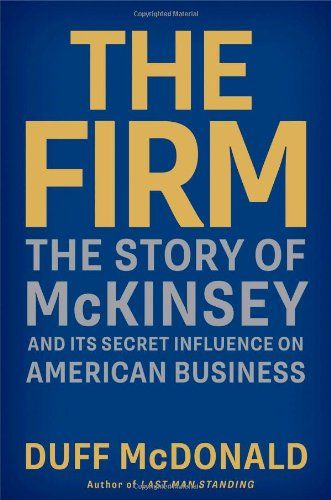
THE FIRM
THE STORY OF MCKINSEY AND ITS SECRET INFLUENCE ON AMERICAN BUSINESS
Introduction: The Invisible Hand of Consulting
Introduction: The Invisible Hand of Consulting
Nova: Welcome to the show. Imagine a single, private organization that has advised nearly every Fortune 100 CEO, shaped government policy across the globe, and whose recommendations are treated as gospel in the highest echelons of power. This isn't a shadowy cabal; it's a consulting firm. And Duff McDonald’s book, The Firm: The Story of McKinsey and Its Secret Influence on American Business, pulls back the curtain on this empire.
Nova: That’s the core of it, Alex. McDonald argues that McKinsey isn't just the room; they often the room. They’ve become an indispensable part of decision-making. The book isn't just a history; it’s a cultural biography that explains the cult-like devotion and the immense, sometimes troubling, power they wield.
Nova: It starts with a simple, almost arrogant, premise that McDonald highlights: If you want to be taken seriously in American business, you hire McKinsey & Company. Let’s trace that journey from its roots to its current global dominance. We’re talking about a firm founded way back in 1926. That’s almost a century of shaping strategy.
Key Insight 1: Building the Gospel of Efficiency
The Genesis of an Empire: From Logic to Law
Nova: McKinsey was founded by James O. McKinsey, an accounting professor from the University of Chicago. His initial philosophy was revolutionary for the time: don't just audit the books; use the data to solve the underlying business problems. He was selling structured thinking.
Nova: McDonald details the early focus on objectivity. McKinsey consultants were outsiders, bringing a clean, analytical slate to entrenched family businesses or bureaucratic giants. They weren't invested in internal politics. They were the ultimate impartial arbiters of what needed to be done. This objectivity became their most valuable, and most marketable, asset.
Nova: Absolutely. As the firm grew, especially after World War II, they started moving into government and advising on massive national projects. McDonald notes that the firm’s methodology—the structured problem-solving—became so successful that it started being applied everywhere, sometimes where it didn't quite fit. It became a template for success.
Nova: That shift is a major theme in the book. For decades, the McKinsey brand was about the —the structured approach. But as industries became more complex, clients started demanding deep industry knowledge. McDonald shows this was a necessary evolution, but it also meant the firm had to start hiring people who were already experts, rather than just training brilliant generalists from scratch. It diluted the purity of the original model, perhaps.
Nova: He points to the increasing complexity of global finance and technology in the late 20th and early 21st centuries. The sheer volume of specialized knowledge required meant the old model of sending three generalists to solve a banking crisis wasn't enough anymore. They needed people who spoke the language of quantitative finance fluently. It’s a constant tension: maintain the pure, analytical culture versus meeting the market demand for deep expertise.
Key Insight 2: The Two-Year Promotion Clock
The Engine Room: Culture and the 'Up or Out' Policy
Nova: This is where The Firm truly earns its title. The internal culture is legendary, and McDonald dedicates significant space to the 'Up or Out' policy. In simple terms, you are expected to be promoted to the next level within a set timeframe, typically about two years per rank, or you have to leave.
Nova: It is designed to be a relentless filter. McDonald explains that the firm views this as necessary Darwinism. They are hiring the absolute top talent from the top schools—the future CEOs and leaders of the world. The policy ensures that only the most adaptable, most driven individuals remain. It’s a self-cleaning mechanism that maintains the perceived quality of the brand.
Nova: That’s the paradox. On one hand, it fosters incredible dedication to the project at hand. You have to deliver stellar results because your performance review is tied directly to your promotion clock. On the other hand, it can breed internal competition. McDonald suggests that while the firm projects an image of seamless teamwork, the underlying reality is a constant, high-stakes internal competition for the limited partner spots.
Nova: Not exactly. McDonald found that the exit opportunities are phenomenal, which is part of the policy's success. If you survive the McKinsey gauntlet, you are essentially pre-vetted as a high-potential leader. They become the C-suite talent pool for corporations globally. They are the alumni network that keeps the firm relevant, even after they leave.
Nova: The book captures the mixed feelings. For many, being asked to leave is framed not as a failure, but as a transition to their career. The firm manages this narrative carefully. However, McDonald also uncovers the sheer exhaustion. The work hours are famously punishing, often involving constant travel and weekend work, which is a direct consequence of needing to cram two years of development into 24 months.
Nova: That’s the critical pivot point of the book, Alex. When the pressure to perform and deliver for the client becomes paramount, the lines of ethical judgment can blur. And that leads us directly to some of the firm’s most controversial engagements, where the pursuit of efficiency had devastating real-world consequences.
Key Insight 3: The Shadow of Influence
The Ethical Crossroads: When Advice Causes Harm
Nova: This is where the 'secret influence' part of the title becomes deeply unsettling. McDonald doesn't shy away from the firm’s involvement in some of the biggest corporate scandals of the last few decades. The most prominent example he explores is McKinsey’s work with Purdue Pharma.
Nova: McDonald details how McKinsey was hired by Purdue to help them aggressively increase sales of OxyContin. In one chilling internal document referenced in the book and later in congressional investigations, McKinsey consultants advised Purdue on how to 'turbocharge' sales, even suggesting ways to navigate the opioid crisis backlash. They were essentially optimizing the distribution of a highly addictive drug.
Nova: McDonald suggests it’s a systemic risk inherent in their model. The firm’s mantra is to advise the client on what want to achieve. If the client’s goal is maximizing profit, McKinsey’s job is to find the most efficient path to that goal, regardless of the societal fallout. McDonald quotes an observation that McKinsey advises clients simply 'to be more like McKinsey'—hyper-rational, data-driven, and results-obsessed.
Nova: Precisely. The book forces the reader to confront the difference between and. McDonald shows that when McKinsey advises governments on restructuring social services or when they advise corporations on mass layoffs, the impact is tangible and often painful for people outside the boardroom. The 'secret influence' isn't just about market share; it’s about shaping the very structure of society.
Nova: That’s the internal conflict McDonald explores. The firm recruits bright, idealistic people. The system then trains them to prioritize analytical rigor above all else. McDonald suggests that the 'Up or Out' culture, while driving performance, also pressures people to deliver what the client wants, which can lead to a form of ethical myopia. It's the 'Banality of Evil, MBA Edition,' as some critics have put it.
Key Insight 4: Penetrating the Veil of Secrecy
McDonald's Lens: Access and the 360-Degree View
Nova: Duff McDonald is a seasoned financial journalist, and his approach was to treat McKinsey not just as a business, but as a culture—a true 'cultural biography.' He spent years researching, parsing public records, but more importantly, gaining access to former and current employees.
Nova: McDonald leveraged the fact that many former consultants, having left the firm—either by choice or by the policy—are willing to talk once they are outside the orbit of the firm’s influence. He frames it as a necessary exposé. He wasn't just reporting on quarterly earnings; he was dissecting the firm’s internal mythology and comparing it to the reality experienced by its people.
Nova: Beyond the 'Up or Out' pressure, McDonald highlights the sheer scale of their global reach and how deeply embedded they are in government. He found that McKinsey consultants often move seamlessly between advising a regulator and advising the company being regulated. This revolving door creates an information asymmetry that is almost impossible for outsiders to penetrate.
Nova: He doesn't offer a simple fix, which is realistic. He suggests that increased transparency is key, especially regarding their government contracts and the nature of their advice in sensitive areas like public health or defense. He also points to the need for greater accountability when their recommendations lead to documented harm, as seen with the opioid crisis fallout.
Nova: Exactly. McDonald respects the intellectual rigor that built the firm, but he demands that the firm acknowledge the societal cost of its relentless pursuit of efficiency. He shows that the culture that creates brilliant strategists can also create blind spots large enough to obscure ethical lines.
Conclusion: The Price of Indispensability
Conclusion: The Price of Indispensability
Nova: We’ve covered nearly a century of influence, Alex. From its academic roots in the 1920s to the high-pressure 'Up or Out' culture that churns out global leaders, Duff McDonald’s 'The Firm' paints a comprehensive picture of McKinsey & Company.
Nova: Absolutely. The actionable insight for our listeners is this: When you hear about a major corporate restructuring, a government pivot, or a massive efficiency drive, remember that an outside firm likely provided the blueprint. We need to start asking not just 'Is this advice efficient?' but 'What are the hidden costs of this efficiency?'
Nova: It certainly is. Duff McDonald gave us the rare, 360-degree view of the world’s most influential, and most secretive, business institution. Understanding The Firm is understanding how the modern world gets managed.
Nova: My pleasure, Alex. This is Aibrary. Congratulations on your growth!