

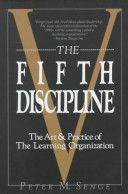
The Fifth Discipline
Introduction
Nova: Did you know that the average lifespan of a Fortune 500 company is actually less than fifty years? It is a startling statistic when you think about the massive resources and brilliant minds these organizations have at their disposal.
Nova: That is part of it, but Peter Senge, the author of the management classic The Fifth Discipline, argues it is something deeper. He says most organizations suffer from learning disabilities. They are literally unable to see the threats and opportunities right in front of them because of how they are structured.
Nova: Exactly. Published in 1990, this book became a phenomenon because it introduced the concept of the learning organization. It is a place where people continually expand their capacity to create the results they truly desire. It is not just about training employees; it is about a fundamental shift in how everyone thinks together.
Nova: That is exactly what we are diving into today. We are going to break down the five disciplines, look at why most companies are actually designed to fail at learning, and explore the famous Beer Game simulation that proves just how easily we lose control of the systems we build.
Key Insight 1
The Illusion of Learning
Nova: Before we get to the solutions, we have to look at the problem. Senge identifies seven learning disabilities that plague most organizations. The first one is a classic: I am my position. People see their jobs as a set of tasks rather than a part of a larger purpose.
Nova: Precisely. And that leads directly to the second disability: The enemy is out there. When things go wrong, we look for someone or something outside ourselves to blame. It is the economy, it is the competitors, it is the government.
Nova: That is the core of the issue. Senge also talks about the illusion of taking charge. We think being proactive means reacting aggressively to problems. But often, that kind of proactiveness is just reactiveness in disguise. We are putting out fires without asking why the building keeps catching fire.
Nova: Yes, he calls it the parable of the boiled frog. If you drop a frog into boiling water, it jumps out. But if you put it in room temperature water and slowly turn up the heat, it stays there until it is cooked. Organizations are great at reacting to sudden crises, but they are terrible at sensing slow, gradual threats.
Nova: Exactly. And the final big one is the delusion of learning from experience. We learn best from direct experience, but in complex systems, the consequences of our actions are often far away in time and space. If I make a decision today and the negative impact happens three years from now in a different department, I never connect the dots.
Nova: That is why Senge says we need a new set of disciplines. We cannot rely on our gut instincts anymore because our instincts were evolved for a much simpler world.
Key Insight 2
The Four Supporting Pillars
Nova: To build a learning organization, Senge outlines five disciplines. The first four provide the foundation. Let's start with Personal Mastery. This is not just about being good at your job; it is about a lifelong commitment to learning and personal growth.
Nova: Because an organization can only learn as fast as the people within it. Personal mastery involves clarifying what is important to us and seeing reality more clearly. It creates a creative tension between where we are and where we want to be.
Nova: Mental Models. These are the deeply ingrained assumptions and generalizations that influence how we understand the world. The problem is that these models are usually invisible to us.
Nova: Exactly. Learning organizations encourage people to bring these models to the surface and challenge them. Then we have Shared Vision. This is not a mission statement handed down from the CEO. It is a genuine, common identity and purpose that everyone actually believes in.
Nova: Right. Compliance is not learning. Commitment is. And that leads to the fourth discipline: Team Learning. This is where the intelligence of the team exceeds the intelligence of the individuals. It is about dialogue, not just discussion.
Nova: In a discussion, people try to win. They defend their views. In a dialogue, people suspend their assumptions and look for a deeper meaning together. It is about exploring complex issues from many points of view.
Nova: It is. But Senge argues that even with these four, you will still fail without the fifth discipline. You need a way to tie them all together, or they just become isolated tools.
Key Insight 3
The Cornerstone: Systems Thinking
Nova: This is the heart of the book. Systems thinking is the discipline that integrates the others. It is the ability to see the whole rather than just the parts. It is about seeing patterns of change rather than static snapshots.
Nova: Think about a rainstorm. If you only look at the clouds, you might think they are the cause of the rain. But a systems thinker looks at the entire water cycle: evaporation, wind patterns, topography. Everything is connected in a loop.
Nova: Precisely. Senge calls these feedback loops. There are reinforcing loops, which create exponential growth or decline, and balancing loops, which try to keep things in equilibrium. Most management problems come from ignoring these loops.
Nova: You nailed it. Senge actually lists eleven laws of the fifth discipline to help us recognize these patterns. One of my favorites is: The harder you push, the harder the system pushes back. He calls this compensating feedback.
Nova: Another law is: The easy way out usually leads back in. We love quick fixes, like hiring a consultant to solve a morale problem. But if the root cause is a broken promotion system, the morale will just drop again once the consultant leaves.
Nova: Exactly. But leverage points are often non-obvious. They are usually far away in time and space from the symptoms. To find them, you have to stop looking at linear cause-and-effect and start mapping the circles.
Case Study
The Beer Game and Archetypes
Nova: To prove how bad we are at this, Senge uses a simulation called the Beer Game. It was developed at MIT. It involves a simple supply chain: a retailer, a wholesaler, and a brewery. Each player just wants to meet customer demand while keeping inventory low.
Nova: You would think. But there is a time delay. It takes a few weeks for an order to be filled. In the game, a small increase in customer demand usually leads to massive over-ordering down the line. The retailer panics because they are out of stock, so they order double. The wholesaler sees the double order and panics, ordering quadruple from the brewery.
Nova: Exactly. It is called the bullwhip effect. The players always blame each other. The retailer blames the wholesaler for being slow, and the wholesaler blames the brewery. But the problem is not the people; it is the structure of the system and the delays.
Nova: Senge identifies several of these recurring patterns, which he calls systems archetypes. One is Shifting the Burden. This is when we use a short-term solution to fix a problem, which makes us lose the ability to fix the long-term root cause.
Nova: Right. It is a form of addiction. Another archetype is Limits to Growth. You have a reinforcing loop of success, but eventually, it hits a balancing loop, like market saturation or resource depletion. If you keep pushing the growth loop without addressing the limit, you crash.
Nova: Systems thinking gives us the language to talk about these patterns before they destroy us. It allows a team to look at a map of their organization and say, Oh, we are in a Shifting the Burden trap. How do we get out?
Conclusion
Nova: We have covered a lot of ground today. From the seven learning disabilities that keep organizations stuck in the past, to the five disciplines that can set them free. The core message of Peter Senge is that we are not victims of circumstances; we are the creators of our own reality through the systems we build.
Nova: That is a great way to put it. Senge says the leader's new work is being a teacher, a steward, and a designer. It is about helping people see the big picture so they can act with more wisdom and foresight.
Nova: That is the perfect place to start. If you can identify even one reinforcing loop or one shifting the burden archetype in your world, you are already practicing the fifth discipline. It is a journey, not a destination.
Nova: I am glad to hear it. Remember, the goal is not just to survive, but to thrive by expanding our collective capacity to create. This is Aibrary. Congratulations on your growth!