Power Control and the Architecture of Value
Golden Hook & Introduction
SECTION
Nova: You probably think your morning routine is entirely your own choice. You check your email, you glance at your banking app, you verify your schedule. But what if that sequence wasn't a series of personal decisions, but a pre-programmed response to a system designed to keep you compliant and predictable?
Atlas: That sounds a bit paranoid, even for us. I like to think my morning routine is about being productive, not about being a cog in a machine. I check my email because I have a job to do. I check my bank account because I need to know if I can afford groceries. That feels like agency, not compliance.
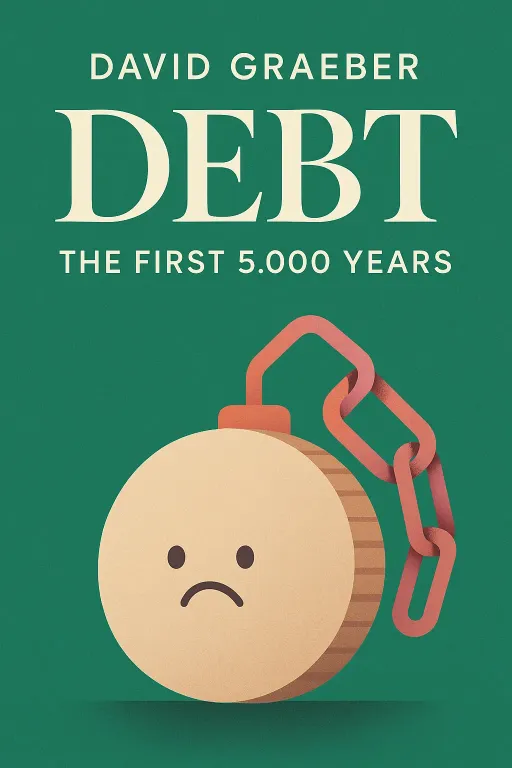
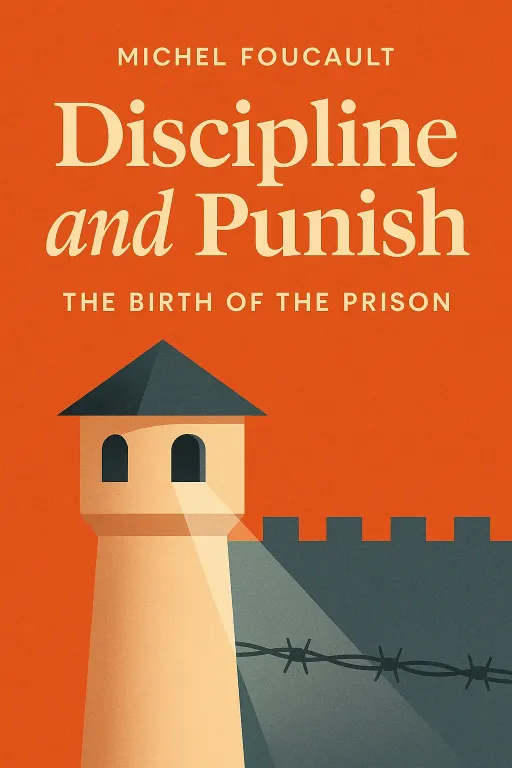
Nova: That sense of agency is exactly what we are going to dissect today. We are looking at two massive forces that define the modern human experience. First, we have the work of Michel Foucault, specifically his classic Discipline and Punish. He argues that our institutions—schools, offices, hospitals—don't just house us; they manufacture our behavior through subtle surveillance. Then, we are pairing that with The Evolution of Money by David Orrell and Roman Chlupatý. They take that concept of control and show how it lives in our wallets. They trace how currency went from physical gold to a virtual network that tracks our every move.
Atlas: Okay, I see where you are going. You are connecting the dots between the physical architecture of a prison and the digital architecture of our financial lives. It sounds like you are suggesting that we are living in a giant, invisible, self-policing system.
Nova: That is the core of it. Foucault wrote Discipline and Punish in the mid-seventies, and it remains one of the most significant works in philosophy because it shattered the idea that punishment is just about pain. It is about power. And when you read Orrell and Chlupatý, you see that money is the modern language of that power. It is not just a medium of exchange; it is a mechanism of systemic control. Today, we are going to explore how these two ideas merge to create the architecture of value in our lives, and more importantly, how you can actually audit your own habits to reclaim your autonomy.
The Architecture of Behavior
SECTION
Atlas: Let’s start with Foucault. I remember hearing about the panopticon back in college. It is that classic prison design, right? A circular building with a guard tower in the middle, where the prisoners never know if they are being watched, so they just behave as if they are. But how does that apply to a professional in the twenty-first century? I am not in a prison cell. I am in a home office.
Nova: That is the brilliance of Foucault’s observation. He realized that the panopticon was not just a building; it was a concept of visibility. In a traditional dungeon, you are punished after you commit a crime. But in the panopticon, the power is preventative. You behave because you are visible. Now, think about your home office. You have Slack, you have project management software, you have time-tracking tools. You are always 'active' or 'away.' You are constantly visible to the system.
Atlas: So, you are saying that the status dot on my messaging app is the modern guard tower? That seems like a stretch. I use that to communicate, not to police myself.
Nova: It functions as both. Here is the reality. When you know that your activity is logged, you change how you work. You don't just work; you perform work. You prioritize tasks that are visible—answering emails, updating status reports—over tasks that are deep, slow, and hard to measure, like long-term strategic thinking or truly creative problem-solving. The architecture of the software forces you into a specific kind of productivity. It creates a docile body, as Foucault would say. You become a person who is easy to manage because you have internalized the surveillance.
Atlas: That actually hits home. I have days where I feel like I have been hyper-productive, but when I look at my actual output, I have just cleared my inbox. I have responded to twenty pings, but I haven't moved the needle on a single major project. If I am being honest, I am acting like a prisoner who is just busy looking productive so the guard doesn't notice me.
Nova: Exactly. And the system encourages that. It rewards the visible output. Foucault pointed out that these micro-disciplines—the schedule, the uniform, the ringing bell—train you to value the system’s rhythm over your own internal rhythm. When you are at work, you are not just an individual; you are a data point in a feedback loop. You are being trained to be a predictable, efficient unit. And the danger is that you start to do this to yourself even when you are not at work. You track your steps, you track your sleep, you track your calories. You have become your own prison guard.
Atlas: That is a sobering way to put it. I track my habits because I want to improve, but you are suggesting that maybe I am just optimizing myself for a system that I didn't design. I am turning myself into a more efficient worker, but am I turning myself into a more fulfilled human?
Nova: That is the critical question. Foucault would argue that the goal of these institutions is not to make you happy; it is to make you useful. The system requires people who are predictable. If you are predictable, you are manageable. If you are manageable, the system stays stable. But your life is not a system to be stabilized; it is a life to be lived.
Atlas: I want to push back on this a little bit. Is it possible that this structure is necessary? If we didn't have these systems—if we didn't have accountability, if we didn't have schedules—wouldn't we just descend into chaos? I am all for reclaiming agency, but I also like having a paycheck and a functioning society.
Nova: That is a fair point. We are not saying the system is inherently evil. We are saying it is inherently designed for a specific purpose, and that purpose often conflicts with your personal growth. The goal isn't to burn down the office or throw your phone in the ocean. The goal is to develop a critical awareness of where the system ends and where you begin. When you know that your habits are being shaped by an external design, you can choose to opt out of the parts that don't serve you.
The Architecture of Money
SECTION
Atlas: Okay, that makes sense. We are being monitored by the architecture of our digital tools. But how does this connect to The Evolution of Money? You mentioned that money is a network. How does that map onto this idea of surveillance and control?
Nova: This is where David Orrell and Roman Chlupatý add a layer of complexity. They explain that money has moved from being a physical commodity—like a gold coin you hold in your hand—to a virtual network of trust and data. Think about what money actually is today. It is a ledger entry. It is a record of a transaction. And every transaction you make is a data point about your behavior.
Atlas: So, my bank statement is a behavioral profile.
Nova: Precisely. Money is the most powerful surveillance tool we have because it is the only one that we voluntarily participate in every single day. You might turn off your location services, you might use an encrypted browser, but you will still use your credit card. And every time you swipe, you are telling the network exactly who you are, what you value, and where you are going.
Atlas: That is a sharp point. I never thought of my credit card as a tracking device. I think of it as a tool for convenience. But you are saying that convenience is the cost of entry for the surveillance.
Nova: Think about the loyalty programs, the 'buy now, pay later' schemes, the personalized banking offers. These aren't just features; they are incentives to keep you inside the network. Orrell and Chlupatý argue that this shift to virtual money allows the controllers of the network—the banks, the payment processors, the platforms—to shape behavior on a massive scale. They can nudge you to spend in certain ways, to save in certain ways, to invest in certain ways. They are not just processing your money; they are managing your future.
Atlas: This feels like the financial version of the panopticon. In the prison, the guard tower is the institution. In the financial system, the guard tower is the algorithm that determines my credit score, my interest rates, and my access to capital. If I don't behave in a way that the network likes—if I am erratic, or if I don't follow the established financial paths—I get penalized. I get lower limits, I get higher fees.
Nova: You nailed it. You are being disciplined by the financial system. If you want to be a 'good citizen' in this economy, you have to follow the rules of the network. You have to be transparent, you have to be predictable, and you have to be liquid. If you try to step outside of that—if you hold your value in non-traditional assets or if you refuse to participate in the credit system—you are treated as an outlier. The system makes it very difficult to function outside of its design.
Atlas: So, money isn't just about wealth. It is about power. It is about who gets to define what has value. And if I am not conscious of this, I am just letting the network define my values for me.
Nova: That is the deepest insight from Orrell and Chlupatý. They show that money is a story we all agree to tell ourselves. We agree that a digital number on a screen has value. But the people who control the network get to write the story. They decide which behaviors are rewarded and which are punished. When you audit your financial routine, you are not just checking your balance. You are checking to see if you are living by your own values or by the values the network has incentivized for you.
Atlas: This is making me look at my subscriptions, my credit cards, and my investments differently. I have been optimizing for 'efficiency' and 'rewards,' but maybe I have just been optimizing for the network's preferences, not mine.
Nova: Exactly. Ask yourself: why am I using this specific credit card? Is it because it genuinely aligns with my life, or because I was incentivized to join this particular loop of behavior? Why do I invest in these specific funds? Is it because I believe in the companies, or because the system makes it the path of least resistance?
Synthesis & Takeaways
SECTION
Atlas: This is a lot to process. We started with Foucault and the idea that we are being watched, and we moved to money as a network that tracks our behavior. It sounds like the takeaway here is that we are constantly being nudged toward compliance. But for our listeners who are pragmatic and focused, what is the actionable step? We can't just drop out of society. We need money, and we need to work.
Nova: The key is not to drop out; the key is to audit. You need to become an anthropologist of your own life. This week, pick one systemic habit—your financial routine is a great place to start—and really look at it. Don't just look at the numbers. Look at the design.
Atlas: So, for my financial routine, I would look at my monthly subscriptions or my spending patterns. I would ask: 'Did I choose this, or did the system make it easy for me to choose this?'
Nova: Exactly. And for your work routine, look at your communication habits. Are you responding to messages because it is the best use of your time, or because the little red bubble on your screen is a digital whip that forces you to act? When you identify these automated responses, you can start to decouple them. You can decide to turn off the notifications. You can decide to consolidate your spending into fewer, more intentional accounts. You can decide to carve out time for deep work that the system doesn't track.
Atlas: I love that. It is about reclaiming your agency by recognizing the design. It is not about being a rebel; it is about being an architect. You are the architect of your own time and your own values.
Nova: That is the perfect way to put it. You are the architect. Foucault and Orrell show us the blueprint of the system, but you are the one who has to live in the building. When you recognize that the building was designed to keep you in a certain room, you can start to walk through the doors that lead to your own life.
Atlas: This really changes how I see my own productivity. I am not just a worker or a consumer. I am a person who has to choose, every single day, whether to follow the path of least resistance or to forge a path that actually matters.
Nova: And that is where the real value lies. It is not in the productivity hacks or the financial tips. It is in the awareness. When you know the system, you can play the game without letting the game play you.
Atlas: I am going to do that audit this week. I am going to look at my 'active' status on my work apps and my spending habits with a much more critical eye. I want to see if I am being a user of the system or if the system is using me.
Nova: That is a powerful commitment. Remember, the goal is not to be perfect. The goal is to be conscious. Small insights, like the realization that your bank account is a surveillance tool, add up over time. They change your mindset. And that mindset shift is what allows you to reclaim your hours and prioritize what truly matters.
Atlas: This has been a fantastic conversation. I feel like I have a new lens to look at my daily life. It is a bit unsettling, but it is also incredibly empowering.
Nova: That is the beauty of this kind of thinking. It is unsettling because it challenges your assumptions, but it is empowering because it gives you the control back. And that is the foundation of strategic learning. You are not just absorbing information; you are using it to navigate your life more effectively.
Atlas: And that is exactly what we are here for. Thank you for this. I am ready to start my audit.
Nova: You are very welcome. It has been a pleasure to break this down with you. This is Aibrary. Congratulations on your growth!