Decoding the DNA of Global Wealth
Golden Hook & Introduction
SECTION
Nova: If you think your bank account is a static vault of value, you are currently losing the game. Most people treat wealth as a pile of gold in a digital fortress, but the reality of our financial landscape is shifting beneath our feet. We are transitioning from a world of commodity-based value to a world of information-based value.
Atlas: That is a jarring way to start, but I suspect you are right. We spend our lives chasing a number on a screen, assuming it functions like a brick of gold, when in reality, we are interacting with a complex, evolving information network. And if we do not understand how that network operates, our personal wealth strategy is just a guess.
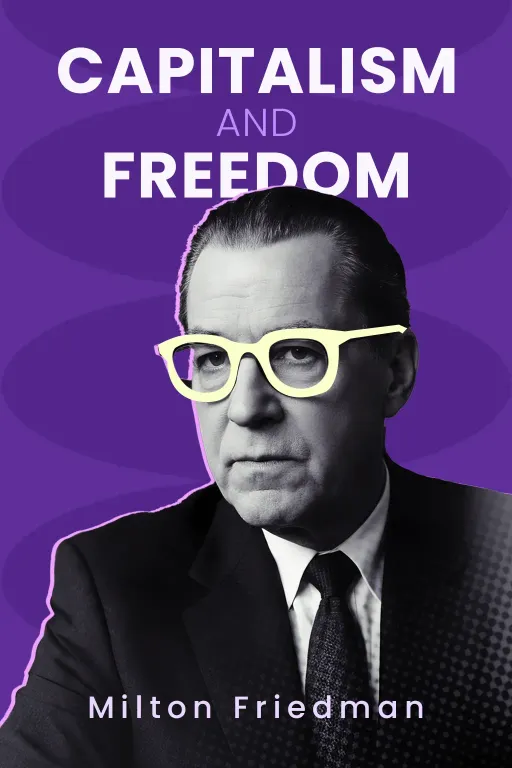
Nova: Exactly. And to unpack this, we are looking at two very different, yet deeply complementary works. Today we are diving into Milton Friedman’s seminal 1962 classic, Capitalism and Freedom, and contrasting it with the modern, analytical perspective found in The Evolution of Money by David Orrell and Roman Chlupatý.
Atlas: Friedman is a titan of economic thought, obviously. His ideas on how economic freedom underpins political liberty shaped the entire twentieth century. But pairing that with Orrell and Chlupatý feels like a strategic move. They take the history of currency—from ancient clay tablets to digital tokens—and argue that money has always been a ledger, not a physical object. It is a fascinating tension to hold in one conversation.
Nova: It is. Friedman gives us the philosophical why, and Orrell and Chlupatý give us the structural how. When you combine them, you stop looking at wealth as something you hoard and start looking at it as a system you navigate.
The Philosophy of Economic Freedom
SECTION
Atlas: Let’s start with the why. Friedman’s thesis in Capitalism and Freedom is incredibly bold. He claims that without economic freedom, political liberty is essentially impossible. When I read that, I hear a lot of people pushing back. They argue that freedom is about rights, speech, and voting, not about markets or deregulation. Why is he so insistent that the wallet is more important than the ballot box?
Nova: Friedman’s argument is that the wallet and the ballot box are not separate entities. He posits that if the state controls your economic means—your job, your housing, your ability to trade—it inevitably controls your political voice. Think about it this way. If you rely on a central authority for your livelihood, your ability to dissent, to criticize, or to vote against that authority becomes a massive, personal risk. Economic freedom provides a buffer. It creates a space where you can exist independently of the state’s approval.
Atlas: That makes sense. It is the idea that independence is not a theoretical concept; it is a practical, logistical reality. If I have the resources to feed myself and my family without begging for government permission, I have the leverage to be a free thinker.
Nova: Precisely. Friedman was looking at this during a time of massive centralized growth, and he saw the danger of equating efficiency with government control. He argued that the free market is not just about making money; it is about decentralized decision-making. When millions of people make millions of small, individual economic choices, you get a system that is far more responsive and efficient than any central planner could ever design.
Atlas: I am curious about the pushback, though. When he says efficiency, he is talking about the aggregate. But for the individual, the market can feel chaotic, sometimes brutal. If I am a high-performance optimizer, I love the idea of autonomy. But is there a point where that economic freedom starts to cannibalize the very societal stability it is supposed to protect?
Nova: That is the perennial question. Friedman would argue that the chaos you see is actually the system correcting itself. When a business fails, it is a signal that resources are being misallocated. When a price changes, it is a signal of scarcity or abundance. The problem arises when we try to shield ourselves from those signals. But let’s bridge this to the modern listener. If you are building a legacy, you have to realize that your strategy cannot rely on the expectation of a perfectly stable, state-supported environment. You need to build your own economic autonomy.
Atlas: So, the takeaway from Friedman isn't just about voting for a specific economic policy. It is about personal responsibility. If I want to be free, I need to curate my own economic ecosystem. I need to ensure my livelihood is not tethered to a single point of failure.
Nova: Exactly. And that leads us to the second, more technical part of the puzzle. Once you have that desire for autonomy, you have to understand the medium you are using to express it. That is where Orrell and Chlupatý’s work on money comes in.
Money as an Information System
SECTION
Atlas: Right, because Friedman talks about the freedom to trade, but he is operating on the assumption that money is a standard, stable unit. Orrell and Chlupatý seem to argue that money has never actually been stable.
Nova: They do. Their central thesis is that money is not a static commodity. It is not gold, and it is not just paper. It is an information system. Think about the history of money. We started with credit systems, long before we had coins. Ancient Mesopotamians used clay tablets to track debts. The money was not the clay; the money was the record of the relationship between two people.
Atlas: That is such a vivid image. We tend to think of money as this physical thing that has intrinsic value, like a gold bar. But you are saying the gold bar is just a proxy for the information about who owes what to whom.
Nova: That is the shift. When you treat money as a commodity, you get obsessed with scarcity. You think, I need to hoard this physical stuff. But when you treat money as information, you realize it is about flow, trust, and the speed at which that trust moves through a network. In the digital age, money has essentially become pure information. It is data moving across global ledgers.
Atlas: If it is just data, then it is vulnerable to the same things that make any information system vulnerable. It can be manipulated, it can be censored, and it can be devalued if the network loses trust. This makes sense of why we see so much volatility in modern markets. It is not just supply and demand of goods; it is the supply and demand of trust in the information itself.
Nova: You hit the nail on the head. When the information—the ledger—is perceived as corrupted or untrustworthy, the value of the currency drops. This is why decentralized systems are becoming so relevant. They are attempts to create a ledger that does not rely on a central authority to verify the truth.
Atlas: I can see how this would worry someone who is trying to build long-term wealth. If the information system is volatile, how do I plan for the future? I cannot just put money in a vault and hope it stays valuable. I have to understand the integrity of the ledger I am using.
Nova: You have to become a student of the system. In the past, you could just work hard, save in a bank, and trust that the purchasing power would remain relatively stable. Today, that assumption is dangerous. You have to look at the macroeconomic shifts—the printing of money, the changes in interest rates, the rise of digital assets—and realize these are all updates to the software of our global economy.
Atlas: It sounds like we are shifting from a game of "how much do I have" to "how well do I understand the rules of the ledger."
Nova: That is the perfect way to frame it. You are not just a participant; you are an analyst of the system.
Synthesis & Strategy for the Strategic Architect
SECTION
Atlas: So, let’s synthesize this for the listener. We have Friedman saying that economic freedom is the bedrock of your personal liberty, and we have Orrell and Chlupatý showing us that money is a fluid, information-based system that is constantly evolving. How does the "Strategic Architect"—the person listening to this—actually use these two insights to build a better life?
Nova: The first step is to recognize that your personal wealth strategy is also a political act. When you diversify your assets, when you move into decentralized platforms, when you optimize for mobility, you are exercising that economic freedom Friedman talked about. You are building a life that is not dependent on a single, fragile, centralized system.
Atlas: I like that. It moves the conversation away from just "investing to get rich" to "investing to be resilient." It is about structural independence.
Nova: Exactly. And the second step is to stop treating your net worth like a static pile of cash. Start treating your portfolio like a diversified information network. You want to hold assets that are robust against failures in the central ledger. That means looking beyond traditional classes and understanding how technology is decentralizing value.
Atlas: This feels very practical. It is the difference between someone who just puts money in a savings account and someone who actively manages their exposure to different types of risk. The passive saver is betting on the status quo. The active strategist is betting on their ability to adapt to a changing ledger.
Nova: And that requires a specific mindset. It requires the willingness to read the signals rather than just following the crowd. It requires deep work. You cannot understand these complex systems if you are constantly distracted by surface-level headlines. You need those first sixty minutes of your day to study, to think, and to analyze.
Atlas: It comes back to that "Strategic Architect" profile. You cannot build a legacy if you are just following the blueprints drawn by someone else. You have to understand the materials you are working with. And in this case, the material is the very nature of value itself.
Nova: That is the core of it. We are in a unique moment in history where the definition of value is being rewritten. We have the philosophical framework from people like Friedman to guide our values—our commitment to freedom and autonomy—and we have the analytical framework from people like Orrell and Chlupatý to guide our tactics.
Atlas: It is a powerful combination. It turns the anxiety of economic uncertainty into a challenge of intellectual growth. Instead of worrying about what the market will do, you focus on how you can position yourself to be robust regardless of what the market does.
Nova: That is the ultimate goal of the high-performance optimizer. It is not about predicting the future; it is about building a system that benefits from the future, whatever it looks like.
Atlas: I think that is a perfect place to land. We have gone from the high-level philosophy of liberty to the granular reality of how money functions as an information network. It is a lot to digest, but it provides a much clearer roadmap than just "save more and hope for the best."
Nova: Growth is rarely comfortable, but it is always necessary. And understanding these systems is the first step toward true, lasting independence.
Atlas: I agree. It has been a pleasure to break this down. For all our listeners, take that hour of deep work, look at your strategy, and ask yourself: am I holding onto a static commodity, or am I building a resilient information network?
Nova: And remember, your wealth is more than just a number. It is the foundation of your freedom. This is Aibrary. Congratulations on your growth!