

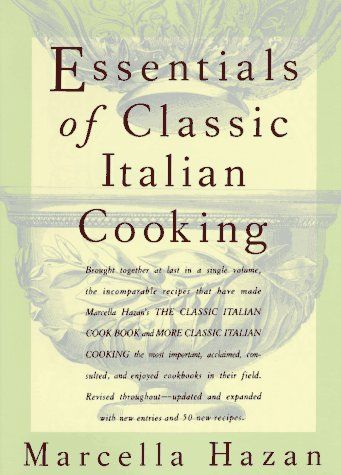
The Essentials of Classic Italian Cooking
Introduction
Nova: If you walk into the kitchen of almost any serious home cook or professional chef in America, there is one book you are almost guaranteed to find on the shelf. It usually has a simple white cover, maybe some flour dust on the spine, and it is titled The Essentials of Classic Italian Cooking. It was written by a woman named Marcella Hazan, and it is often called the bible of Italian cuisine.
Nova: It is the definitive guide because Marcella Hazan did not just give us recipes. She gave us a new way of thinking about food. Before this book, and the two earlier volumes it combined, most Americans thought Italian food was just heavy red sauce, spaghetti with giant meatballs, and maybe some checkered tablecloths. Marcella arrived and basically said, no, that is not what we eat in Italy. She introduced the idea of regionality, the importance of simplicity, and the scientific precision of a biologist to the kitchen.
Nova: That is the most fascinating part of her story. She was not a trained chef. She had a PhD in biology and natural sciences. And that scientific mind is exactly why her recipes work so perfectly every single time. Today, we are going to dive into her masterpiece and look at how a woman who did not even know how to cook when she got married ended up teaching the entire world how to make the perfect tomato sauce.
Key Insight 1
The Accidental Icon
Nova: To understand the book, you have to understand Marcella herself. She was born in the Emilia-Romagna region of Italy, which many consider the culinary heart of the country. But she did not spend her youth in the kitchen. She was a scientist. She moved to New York in 1955 after marrying her husband, Victor Hazan, and she suddenly found herself in a country where she could not find the flavors she grew up with.
Nova: Exactly. She literally did not know how to cook when she arrived. She had to remember the tastes of her childhood and use her scientific training to reverse-engineer them. She would go to the markets in New York, look at the ingredients, and figure out how to make them taste like Italy. Her husband Victor was a huge part of this too. He was a wonderful writer and a wine expert, and he became her translator and collaborator. She wrote in Italian, and he turned it into the elegant, direct English we read in the book.
Nova: It was a total accident. She signed up for a Chinese cooking class in New York because she loved the flavors. On the very first day, the teacher told the class she was taking a sabbatical and could not teach. The other students were disappointed, but they knew Marcella was a great cook because she had talked about it. They basically cornered her and said, well, you know how to cook Italian food, why don't you teach us?
Nova: She did. She started teaching in her own apartment. Eventually, a food critic for the New York Times, Craig Claiborne, heard about this Italian woman teaching these incredible classes. He went to visit her, tried her food, and wrote a massive feature on her. That was the spark. From there, she published her first book in 1973, and eventually, in 1992, she combined her best work into The Essentials of Classic Italian Cooking.
Nova: Precisely. She did not care about what was trendy. She cared about what was correct. She was famously exacting. If you were in her class and you chopped an onion the wrong way, she would let you know. She believed there was a right way to do things because the chemistry of the ingredients demanded it.
Key Insight 2
The Power of Three Ingredients
Nova: If there is one recipe that defines this book and Marcella's entire philosophy, it is her Tomato Sauce with Onion and Butter. It is legendary. If you search for it online, you will find thousands of blog posts calling it the best sauce in the world.
Nova: No garlic. No chopping. You put the tomatoes in a pot, add five tablespoons of butter and a medium onion peeled and cut in half. You let it simmer for 45 minutes, and then you throw the onion away. That is it.
Nova: This is where her biology background shines. She understood that the onion is there to provide sweetness and aroma to balance the acidity of the tomatoes, but she did not want the texture of the onion to distract from the silkiness of the sauce. By cooking it whole, you extract the essence without the bulk. And the butter? That was her secret weapon. Most people think Italian food is all olive oil, but in Northern Italy, where she was from, butter is king. It rounds out the sharp edges of the tomato in a way olive oil just cannot.
Nova: It is transcendent. It is the ultimate example of her philosophy that Italian cooking is about subtraction, not addition. She believed that if you have high-quality ingredients, your job as a cook is to get out of the way and let them speak. She famously said that Italian cooking is not about the hand of the cook, but about the ingredients themselves.
Nova: Marcella hated that. She had no time for fusion or what she called creative cooking. To her, classic Italian cooking was a perfected system. You do not improve on a system that has been refined over centuries; you just learn to execute it properly. This sauce is the gateway drug for her book because once you taste it, you realize that you have been overcomplicating your life for years.
Key Insight 3
The Science of the Roast Chicken
Nova: Another pillar of the book is her Roast Chicken with Two Lemons. It is another recipe that seems almost suspiciously simple, but it changed the way people roast poultry.
Nova: You do not even put oil on the skin. You just salt and pepper it. But there is a very specific technique. You take two small lemons, you roll them on the counter to soften them up, and then you prick them at least twenty times each with a toothpick or a skewer. You put them inside the cavity, sew it shut or close it with toothpicks, and put it in the oven breast-side down first.
Nova: The pricking allows the lemon juice to slowly leak out and turn into steam inside the chicken. It essentially flavors the meat from the inside out while keeping it incredibly moist. And starting it breast-side down allows the fat from the back to render and baste the breast meat, which is the part that usually dries out. Halfway through, you flip it to crisp up the skin.
Nova: Exactly. She understood the physics of heat and moisture. She also had very strict rules about vegetables. In the book, she has a massive section on how to choose and prepare them. She was one of the first people to tell Americans that they were overcooking their vegetables or buying the wrong ones. She insisted that you should never use a food processor to chop vegetables for a soffritto, which is the base of many Italian dishes.
Nova: She argued that a food processor tears and mashes the vegetables, releasing their juices too quickly and making them stew in their own liquid. A sharp knife cuts them cleanly, allowing them to sauté and develop flavor properly. She believed the texture of the hand-cut vegetable changed the entire structure of the sauce. She was a stickler for those tiny details because she knew they added up to a massive difference in the final dish.
Nova: She really was. Her writing style is very direct. She will tell you exactly what kind of pot to use, why you should use a certain shape of pasta for a certain sauce, and she will tell you if you are doing something that she considers a mistake. She was not trying to be mean; she just had a very high standard for what qualified as classic Italian food.
Key Insight 4
The Rules of the Table
Nova: One of the most important parts of Essentials of Classic Italian Cooking is the section on pasta. Marcella was very firm about the relationship between the shape of the pasta and the sauce it carries. This was a revelation for many American cooks who just used whatever box was in the pantry.
Nova: Her rule was based on how the sauce clings to the pasta. For example, she insisted that seafood sauces should never, ever be served with cheese. She thought the strong flavor of the cheese overwhelmed the delicate taste of the sea. And she was very specific about which sauces go with long pasta versus short pasta. A chunky vegetable sauce needs a short, sturdy pasta like rigatoni so the pieces can get caught in the tubes. A smooth, buttery sauce needs the long, thin strands of spaghetti or linguine to coat every inch.
Nova: That is a common misconception that she worked hard to correct. She explained that they are actually two different ingredients for different purposes. Fresh pasta, usually made with eggs, is soft and porous, perfect for rich, creamy sauces or meat sauces like Bolognese. Dried pasta, made from durum wheat and water, is firmer and has more bite, which makes it better for olive oil-based sauces or spicy tomato sauces. She did not see one as superior to the other; she saw them as tools in a kit.
Nova: You mean the milk? Yes, Marcella's Bolognese is a labor of love. It takes about five or six hours to cook properly. And the key step is adding milk to the meat and letting it simmer until it evaporates before you add the wine and tomatoes.
Nova: It does not curdle if you do it right. The milk actually protects the meat from the acidic bite of the wine and tomatoes. It makes the meat incredibly tender and gives the final sauce a creamy, mellow depth that you just cannot get any other way. It is another example of her scientific approach. She was looking for a specific chemical reaction to achieve a specific texture.
Nova: It really is. She was teaching a culture that was obsessed with fast food and convenience that some things simply cannot be rushed. You cannot make a great Bolognese in thirty minutes. You cannot rush the softening of an onion in butter. She was teaching us to slow down and respect the process.
Conclusion
Nova: Marcella Hazan passed away in 2013, but her influence is arguably stronger today than it was when she was alive. The Essentials of Classic Italian Cooking remains a bestseller because it is more than just a collection of recipes. It is a masterclass in culinary integrity. She taught us that you do not need a hundred ingredients to make a great meal; you just need three or four, and you need to treat them with respect.
Nova: That is a perfect way to put it. Marcella's legacy is that she gave us the confidence to be simple. She stripped away the pretension and the unnecessary garnishes and showed us the soul of the Italian kitchen. Whether you are a beginner who has never boiled an egg or a seasoned pro, there is something in this book that will make you a better cook. It is about the joy of a perfectly ripe tomato, the aroma of a lemon roasting inside a chicken, and the satisfaction of a meal made with care.
Nova: Five tablespoons. Do not skimp on it, Leo. Marcella would know. If you want to truly understand the heart of Italian cooking, pick up a copy of Essentials. It is a journey that starts in the market and ends with a perfect plate of pasta. This is Aibrary. Congratulations on your growth!