

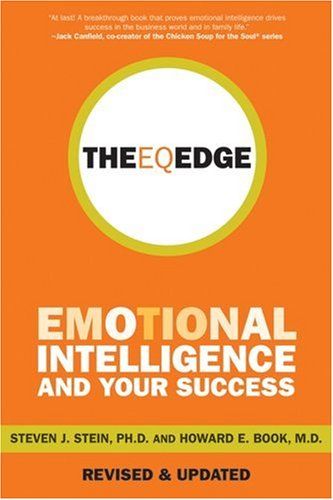
The EQ edge
Emotional Intelligence and Your Success
Introduction
Nova: Picture this. You're at the airport. Your flight just got canceled. The person ahead of you storms up to the counter, slams their fist down, and screams at the ticket agent: "Don't you know who I am?" They get nowhere. Then you walk up, take a breath, and say: "It must be really hard dealing with people like that all day." The agent looks at you, exhales, and suddenly finds you a seat on a flight that gets you home by midnight. Same situation. Radically different outcome. That's emotional intelligence in action, and that story opens one of the most influential books on EQ ever written: The EQ Edge by Dr. Steven J. Stein and Dr. Howard E. Book.
Nova: That is exactly the question The EQ Edge sets out to answer, and the answer is a resounding yes, EQ can be developed. Unlike IQ, which stays pretty stable throughout your life, emotional intelligence is a set of skills you can practice, measure, and improve. Stein and Book built their entire framework around this idea, using one of the first scientifically validated EQ assessment tools ever created: the Bar-On Emotional Quotient Inventory, or EQ-i.
Nova: Far from it. This book breaks emotional intelligence down into 15 specific, measurable skills organized into five major categories. It's grounded in decades of research, packed with case studies from CEOs to law enforcement officers to students, and every chapter ends with self-assessments so you can actually track your growth. Today we're diving deep into The EQ Edge: what it teaches, why it matters, and how you can use its insights to transform your relationships, your career, and your life.
The EQ-i Model and Its 15 Building Blocks
The Architecture of Emotional Intelligence
Nova: Let's start with the big picture. The EQ Edge is built around the EQ-i model, which organizes emotional intelligence into five composite scales and fifteen subscales. Think of it like a house with five rooms, and each room has three pieces of furniture you need to arrange.
Nova: Room one is Self-Perception. This is about how you see yourself, and it includes self-regard, which is basically how much you like and accept yourself; self-actualization, your drive to pursue meaningful goals; and emotional self-awareness, which is recognizing what you're feeling and why.
Nova: Exactly. Room two is Self-Expression, which covers how you show up in the world. This includes emotional expression, being able to communicate your feelings openly; assertiveness, standing up for yourself calmly and respectfully; and independence, thinking and acting on your own even under pressure.
Nova: It's crucial. The book even has a great exercise where you track every time you ask someone for help over a week, and then note whether you were genuinely seeking input or just trying to hand off the problem entirely. It reveals a lot about your independence muscle.
Nova: Interpersonal skills, the heart of connection. This includes interpersonal relationships, building trust and rapport; empathy, genuinely seeing things from another person's perspective; and social responsibility, caring about your community and contributing positively.
Nova: Decision-Making. This is where The EQ Edge really distinguishes itself from other EQ frameworks. Most models focus on self-awareness and relationships, but Stein and Book argue that how you make decisions is a core part of emotional intelligence. The three subscales here are problem-solving, managing emotions to find clear solutions; reality testing, staying grounded and separating feelings from facts; and impulse control, thinking before you act.
Nova: You and millions of others. And finally, room five is Stress Management: flexibility, adapting to change without losing your center; stress tolerance, staying cool under pressure; and optimism, seeing challenges as opportunities rather than roadblocks.
Nova: That's the beauty of the EQ-i assessment. You take it, get a baseline, and identify your specific strengths and gaps. The book then helps you build a targeted development plan. You don't have to fix everything at once. You focus on the areas that will make the biggest difference for you.
Nova: Every single chapter ends with practical self-assessments and actionable strategies. It's not a book you just read. It's a book you do.
The Research Behind Emotional Intelligence and Success
Why IQ Isn't Enough
Nova: Here's a provocative question: what actually predicts success in your career and your life? Most people would say intelligence, right? Being smart, having a high IQ.
Nova: And here's what The EQ Edge reveals: IQ can predict things like academic achievement, sure. But when it comes to real-world success, leading teams, navigating conflict, building relationships, staying resilient under pressure, IQ alone falls dramatically short. The book cites research showing that while IQ might get you hired, EQ is what gets you promoted.
Nova: And it's backed by data. Stein and his colleagues at Multi-Health Systems have collected assessments from thousands of people across dozens of professions. They've studied what separates top-performing law enforcement officers, lawyers, school principals, doctors, CEOs, and customer service representatives from their average counterparts. The common thread isn't raw intelligence. It's emotional intelligence.
Nova: Take a CEO. You might assume the top EQ factor for a chief executive would be something like assertiveness or stress tolerance. But the research actually shows that the most critical EQ skill for CEOs is reality testing, the ability to see situations objectively, separate emotions from facts, and avoid getting caught up in wishful thinking or catastrophic fears.
Nova: Precisely. And here's another fascinating finding: the top EQ factors vary dramatically by profession. For customer service representatives, empathy and stress tolerance are paramount. For lawyers, assertiveness and problem-solving lead the pack. For school principals, interpersonal relationships and optimism make the biggest difference. The book walks through these profession-specific profiles, which is incredibly useful whether you're hiring, managing, or choosing a career path.
Nova: Exactly. And that's empowering because it means you can develop the specific EQ skills that matter most for your context. You don't need to be perfect at all fifteen. You need to be strong in the ones your role demands.
Nova: Absolutely. Low EQ shows up as people who can't handle feedback, who explode under pressure, who burn bridges without realizing it, who make impulsive decisions they later regret. The book is full of cautionary tales. But the hopeful message is that these patterns aren't permanent. EQ is developable at any age, at any stage of your career.
Leadership, Relationships, and the Workplace
EQ in the Trenches
Nova: Let's talk about where the rubber meets the road. The EQ Edge devotes entire chapters to leadership, personal relationships, and workplace dynamics. And the insights are remarkably practical.
Nova: Stein and Book argue that leaders with high EQ foster positive, productive workplaces. They build trust, handle conflict effectively, and create cultures where people want to contribute. The key EQ skills for leaders are empathy, assertiveness, and impulse control. An empathetic leader understands what their team is experiencing. An assertive leader communicates clearly without aggression. And a leader with impulse control doesn't fire off angry emails at 2 a. m.
Nova: Most people have. And the research shows it's not just about feelings, it's about results. Teams led by high-EQ leaders consistently outperform teams led by low-EQ leaders, even when the low-EQ leaders have higher IQs or more technical expertise.
Nova: The book explores how EQ skills enhance communication, conflict resolution, and emotional intimacy. Think about empathy in a marriage. When your partner comes home frustrated, a low-EQ response is to immediately offer solutions or dismiss their feelings. A high-EQ response is to listen, validate, and ask what they need. Same situation, completely different outcome, just like the airport story.
Nova: Most of us are. The book emphasizes that interpersonal EQ factors like empathy, emotional expression, and interpersonal relationships are the foundation of healthy, fulfilling personal connections. And the exercises help you practice these skills in real time.
Nova: The book covers how EQ affects team collaboration, customer service, project management, and even hiring. One of the most practical applications is using EQ profiles to determine which personnel are the right fit for specific roles. If you're hiring for a high-stress customer-facing position, you want someone with strong stress tolerance and empathy, regardless of their technical qualifications.
Nova: They don't, and that's the problem. Most hiring focuses on resumes and technical skills while ignoring emotional intelligence entirely. The EQ Edge makes a compelling case that this is a massive blind spot, and it gives managers concrete tools to fix it.
Nova: Yes. It says: "Never has it been more important to focus on problem-solving. In workplaces everywhere, supervisors are asking their employees to come to them not with difficulties as they arise, but with solutions in hand, ready to be implemented. A competitive economy demands we be problem solvers, not problem collectors or reporters." That's from the Decision-Making chapter, and it captures how EQ translates directly into workplace value.
How to Actually Develop Your Emotional Intelligence
The Growth Mindset of EQ
Nova: So we've covered what EQ is and why it matters. But the million-dollar question is: how do you actually get better at it?
Nova: The EQ Edge takes this head-on. The authors emphasize that EQ development is a lifelong process, not a weekend workshop. They recommend starting with the EQ-i assessment to get a clear baseline. You can't improve what you can't measure.
Nova: Yes, and that's actually one of the criticisms of the book. Some reviewers point out that self-reported assessments can be misleading because we're not always accurate judges of our own behavior. You might think you have low optimism because you always prepare for the worst, but others might see your preparedness as a genuine strength.
Nova: The book acknowledges this limitation, and many practitioners recommend supplementing the EQ-i with a 360-degree assessment, where you get feedback from colleagues, friends, and mentors. But even the self-assessment is a valuable starting point. The key is to combine it with honest self-reflection and a willingness to seek feedback from others.
Nova: They vary by skill. For empathy, you might practice active listening, where you paraphrase what someone said before responding, to make sure you truly understood. For impulse control, you might implement a twenty-four-hour rule before sending any emotionally charged communication. For assertiveness, you might practice stating your needs clearly in low-stakes situations before tackling harder conversations.
Nova: And relationships. The book also emphasizes the importance of a growth mindset. Stein and Book remind readers repeatedly that EQ is malleable. It's not like your height or your eye color. Every interaction is an opportunity to practice. Every difficult conversation is a chance to build your emotional intelligence muscles.
Nova: The book doesn't promise overnight transformation. But with consistent practice, self-reflection, and feedback, people can see significant growth over months and years. The key is to set specific goals, track your progress, and stay patient. The authors are clear that this is a marathon, not a sprint.
Nova: The final chapter of the book addresses the broader impact of EQ on overall wellbeing. People with high EQ tend to experience lower stress levels, greater optimism, and higher life satisfaction. They're more resilient in the face of setbacks. They have stronger relationships. They're more effective at work. In short, EQ isn't just a career skill. It's foundational for a balanced, satisfying life.
Conclusion
Nova: So let's bring it all together. The EQ Edge by Steven J. Stein and Howard E. Book offers a comprehensive, research-backed framework for understanding and developing emotional intelligence. It breaks EQ down into five domains: Self-Perception, Self-Expression, Interpersonal skills, Decision-Making, and Stress Management, with fifteen specific, measurable subscales underneath them.
Nova: Exactly. The book is packed with real-world case studies, from CEOs to law enforcement officers to students. It shows that the specific EQ skills that matter most vary by profession and context, which means development can be targeted and strategic. And every chapter ends with practical exercises and self-assessments, so you're not just reading about EQ, you're actively building it.
Nova: And that applies far beyond the workplace. EQ shapes your marriage, your parenting, your friendships, your ability to handle stress and bounce back from setbacks. The airport story that opens the book isn't just a clever anecdote. It's a metaphor for life. Same situation, different emotional response, completely different outcome.
Nova: Start with self-awareness. For the next week, pay attention to your emotional reactions. When you feel anger, frustration, or anxiety bubbling up, pause and name the emotion. Ask yourself: what triggered this? Is my reaction proportional to the situation? Am I about to say or do something I'll regret? That simple practice of pausing and naming is the foundation of emotional intelligence, and you can start doing it right now.
Nova: And if you want to go deeper, The EQ Edge is waiting for you. It's in its third edition, revised and updated with new research, and it remains one of the most practical, evidence-based guides to emotional intelligence ever written.