The Energy Blueprint: Engineering a High-Performance Mindset
Golden Hook & Introduction
SECTION
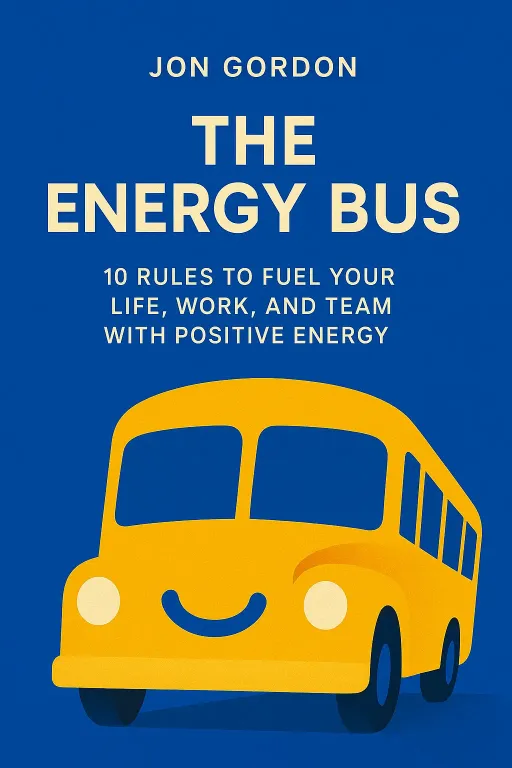
Nova: Imagine this: It’s Monday morning. You have a critical meeting, but you walk out to a flat tire. Your spare is also flat. Your wife can't help, and a tense argument erupts. You feel your entire week, maybe your entire career, spiraling out of control. This isn't just a bad day; it's a system failure. And according to Jon Gordon's 'The Energy Bus,' you might be the one driving it straight into the ground. But what if you could learn to steer it differently?
Usmanshah: That’s a scenario that feels a little too real for a Monday morning. It’s that cascading failure feeling, where one small problem triggers a chain reaction.
Nova: Exactly. And that's what we're diving into today. We're so thrilled to have Usmanshah, an engineer and analytical leader, here with us to unpack this. We're going to explore how to engineer a high-performance mindset using the blueprint from this incredible book. First, we'll explore the principle of radical ownership—what it means to truly be the driver of your own bus.
Usmanshah: Looking forward to it. It's about identifying the root cause.
Nova: Then, we'll get tactical and discuss the 'energy equation' for managing your team and dealing with negativity. And finally, we'll zoom out to the highest level of leadership, redefining what it means to be a CEO—a Chief Energy Officer. Usmanshah, welcome. It’s great to have your perspective on this.
Usmanshah: Thanks for having me, Nova. This book frames these "soft skills" in a way that really appeals to a structured, analytical mindset. It's less about feelings and more about physics—the physics of energy.
Deep Dive into Core Topic 1: The Driver's Mandate
SECTION
Nova: I love that, the physics of energy. So, Usmanshah, let's start with that chaotic morning. The book's hero, George, is just drowning in negativity. It feels like the world is against him. But the first rule he learns on this unexpected bus ride is brutally simple: 'You're the Driver of Your Bus.'
Usmanshah: It’s the foundational principle. Everything else builds on that.
Nova: It really does. And the book paints such a vivid picture of someone who has given up the wheel. George gets to his car, sees the flat tire, and his first thought is just dread. Then he remembers his spare is also flat, and he recalls his wife telling him weeks ago, "You should get that fixed, George." He knew it was a problem but did nothing. He tries to get a ride, fails, then gets into a bitter argument with his wife. He feels completely powerless.
Usmanshah: You know, it's a perfect metaphor for how small, unaddressed issues—technical debt, if you will—can cascade and bring an entire system to a halt. That flat spare tire wasn't a surprise; it was a known vulnerability he ignored. So when the inevitable happens, the system collapses. George's life isn't a series of random misfortunes; it's a system operating with known, unaddressed flaws. He's not a passenger in a crash; he's the driver who ignored the warning lights.
Nova: That is such a sharp way to put it. He's the driver ignoring the warnings. And in his moment of despair, he's forced to take the city bus, where he meets this incredibly cheerful driver, Joy. She takes one look at his grumpy face and tells him, "Everything happens for a reason." Now, how does that land with an analytical mind? Does it sound too 'woo-woo' or is there a practical truth there?
Usmanshah: I think it's incredibly practical. It's about reframing a problem as a data point. The flat tire wasn't a curse; it was a forced diagnostic test. It immediately revealed the deeper issues in his life's system: his broken communication with his wife, his lack of a personal support network—he had no one to call for a ride—and his own pattern of procrastination. The 'reason' it happened was to force him to confront the system's instability. In fact, later in the book, he finds out the mechanic discovered his brakes were completely worn out. The flat tire literally saved his life. The 'problem' was actually the solution in disguise.
Nova: Wow. The problem was the solution. That’s powerful. So being the driver isn't just about steering, it's about running those diagnostics, about seeing the data in the disasters.
Usmanshah: Exactly. It's about taking ownership of the entire system, not just reacting to the outputs. You have to own the inputs, the processes, and the maintenance. That’s what being the driver means.
Deep Dive into Core Topic 2: The Energy Equation
SECTION
Nova: I love that framing—a 'forced diagnostic test.' And once George is on this bus, the diagnostics get even more intense, moving from his personal life to his professional team. This brings us perfectly to our second point: the 'energy equation.' It's not just about your own energy, but how you manage the energy of your team.
Usmanshah: This is where it gets really interesting for anyone in a leadership role. It moves from self-management to system management.
Nova: It does! Joy introduces him to this simple but profound formula: E + P = O. Events + Perception = Outcome. We can't control the events, but we can control our perception, and that determines the outcome. And a huge part of that is managing the energy you allow around you. The book introduces this brilliant concept of "Energy Vampires."
Usmanshah: A very memorable term.
Nova: Isn't it? And it's a real phenomenon. The book cites a Gallup Poll estimating that negative workers cost the U. S. economy around $300 billion a year in lost productivity. These are the people who suck the life out of a team. And George has them. He's launching a new product, the NRG-2000, and he decides to apply the bus metaphor. He gives his team members "bus tickets" and asks them to get on his bus.
Usmanshah: A symbolic act of commitment. I like it.
Nova: But it backfires. Three of his key people—Michael, Jamie, and José—come to his office without their tickets and say, point-blank, "We think your bus is going to crash and we don’t want to be on it when it does." Meanwhile, the two guys he expected to be troublemakers, Larry and Tom, hand in their tickets with a smirk. George is completely thrown.
Usmanshah: That's a leader's nightmare. In a high-stakes engineering project, that kind of open dissent and negativity can be absolutely catastrophic. It's not just about morale; it's about project integrity.
Nova: So how do you handle that? What does an engineer do when the system is actively working against itself?
Usmanshah: This is where the 'Energy Vampire' concept is so powerful from a systems perspective. They're not just disgruntled people; they're energy sinks. They create drag on the entire system. George's initial mistake was focusing his emotional energy on the three who said no. A good leader has to triage. You have to allocate your resources—your energy—to the people who are on the bus, even the difficult ones, and you have to make a hard decision about the vampires. The book's rule, 'Don't waste your energy on those who don't get on,' is fundamentally about efficient resource allocation. You can't power the whole system if you're plugging all your energy into a black hole.
Nova: And George has to do just that. He realizes he has to deal with the negativity head-on. He confronts Tom, who is highly talented but incredibly toxic. Tom actually admits he wants to see George fail. It's a tense moment, and George, remembering Joy's advice to be strong, fires him on the spot. A tough call to fire a talented person.
Usmanshah: A necessary one. It's like removing a faulty, high-performance component that's sending bad data and threatening the integrity of the whole machine. It might be a powerful component, but if it's corrupting the system, it has to go. Sometimes, addition by subtraction is the best engineering solution. You improve the whole by removing the part that's causing the most drain.
Deep Dive into Core Topic 3: The CEO's True Role
SECTION
Nova: Addition by subtraction... I love that. It’s so counterintuitive but so true. And after cleaning house, George has to rebuild. He has to become a different kind of leader. This leads to the ultimate rule of leadership in the book, our final point today: The true role of a CEO is to be a Chief Energy Officer.
Usmanshah: Shifting the definition of the job itself. That’s a big idea.
Nova: It's huge! The book tells the story of another passenger, Jack, a high-flying executive who was running his division into the ground with a fear-based culture. He was about to quit his job and life when he stumbled onto Joy's bus. She taught him to lead with heart, and he went on to build a thriving company. He tells George, "CEO doesn't stand for Chief Executive Officer anymore. It stands for Chief Energy Officer."
Usmanshah: So the primary role of a leader isn't just to direct tasks, but to manage the collective energy of the group.
Nova: Precisely. It's about broadcasting positive energy. And to do that, you have to lead with purpose. The book shares that wonderful, classic story of the NASA janitor. When President Johnson asked him what he was doing, he didn't say "I'm sweeping the floor." He said, "Mr. President, I'm helping put a man on the moon."
Usmanshah: He was connected to the mission. He understood his role in the larger system. That's purpose.
Nova: Exactly. And the book also brings up Abraham Lincoln, a figure you're interested in, Usmanshah. In a moment of deep despair, George finds inspiration in a quote from Lincoln: "I am not bound to win, I am bound to be true." How does that idea of 'being true' connect to being a 'Chief Energy Officer' in a demanding field like engineering?
Usmanshah: I think it's the absolute core of it. 'Being true' is about integrity and purpose. In engineering, you can't fake the physics. The bridge either stands or it falls. The code either runs or it crashes. Your 'truth' is the design principle, the core mission, the laws of science you're working with. A leader's job is to constantly broadcast that purpose, that 'truth.' When the NASA janitor said he was helping put a man on the moon, he was connected to the mission's 'truth.' That's what a Chief Energy Officer does. They don't just manage tasks on a spreadsheet; they manage the behind the tasks. That's what creates genuine, sustainable energy, not just a sugar rush of motivation. It's the difference between compliance and commitment.
Nova: Wow. Managing the meaning. That's what it's all about. It’s not just about getting people on the bus, but making sure everyone knows and believes in the destination.
Synthesis & Takeaways
SECTION
Nova: This has been so insightful. So, if we boil it down, it really feels like a three-step blueprint for any leader. First, you have to drive your own bus with radical ownership.
Usmanshah: Own the whole system, maintenance included.
Nova: Then, you have to manage the team's energy by focusing on the positive, allocating your resources wisely, and being willing to remove the drains.
Usmanshah: The energy equation. Addition by subtraction.
Nova: And finally, you lead not just as an executive, but as a Chief Energy Officer, managing the meaning and broadcasting a purpose that is true and heartfelt.
Usmanshah: Absolutely. It’s a complete system for leadership.
Nova: So, for our listeners who are inspired by this and want to start applying it tomorrow, what's one simple, actionable first step they can take?
Usmanshah: I think the most elegant and practical takeaway from the book is a simple habit called the 'One Great Golf Shot' theory. The idea is that most golfers, after a terrible round, don't obsess over their 50 bad shots. They remember that one perfect drive, that one great chip. And that's what brings them back. We can apply that to our work and life. At the end of each day, instead of dwelling on the 99 things that went wrong, consciously identify the one great thing that happened—one successful conversation, one problem solved, one moment of connection. It's a small shift in focus, but as any engineer knows, changing the initial conditions, even slightly, can lead to a completely different outcome over time.
Nova: Focus on the one great shot. I love that. It’s a perfect, actionable way to start fueling your own bus. Usmanshah, thank you for these incredible insights and for helping us engineer a whole new perspective on leadership.
Usmanshah: My pleasure, Nova. It was great to be on the bus with you.