The End of Globalization, The Beginning of Your Strategy: An AI Founder's Guide to a Fractured World
Golden Hook & Introduction
SECTION
Nova: Frank, you're the cofounder of Aibrary, an incredible Agentic AI for personal growth. You're building a global-first company. So let me ask you a question. What if I told you that the entire system enabling that—secure shipping for servers, global finance, even the stability of the internet itself—was a historical accident, and that accident is now over?
Frank Wu: That's... a deeply unsettling thought. And honestly, it's the kind of macro-risk that keeps founders up at night, whether they admit it or not. We build on a foundation of assumptions about how the world works, and the idea that the whole foundation could crack is, well, terrifying. But it’s a question we have to ask.
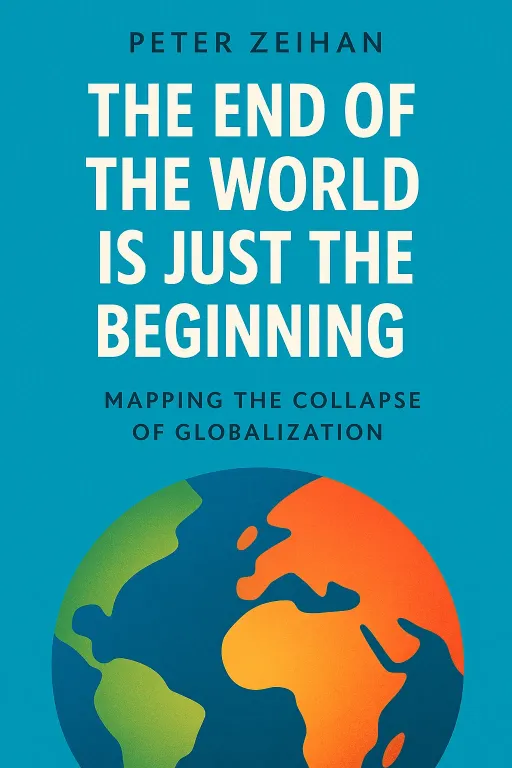
Nova: It’s the terrifying, central premise of Peter Zeihan’s book, "The End of the World Is Just the Beginning." He argues that the last 75 years of relative peace and prosperity weren't the norm; they were a perfect, fleeting moment. And it's ending. So today, we're going to stress-test our assumptions and tackle this from three perspectives. First, we'll explore why the era of easy globalization is over. Then, we'll discuss the demographic time bomb that's set to reshape global markets. And finally, and most importantly for you and everyone listening, we'll focus on where the new opportunities lie for innovators in this fractured world.
Frank Wu: I'm ready. It sounds like essential, if bracing, listening for anyone trying to build for the future.
Deep Dive into Core Topic 1: The Great Unraveling
SECTION
Nova: Alright, let's dive into that first, huge idea: the end of the 'perfect moment.' Zeihan's argument is that what we call 'globalization' didn't just happen. It was created. After World War II, the United States made a strategic decision. Instead of building an empire, they built an alliance to contain the Soviets. And the way they did it was, essentially, a bribe.
Frank Wu: A bribe? How so?
Nova: They used the US Navy, the most powerful in history, to patrol all the world's oceans and guarantee safe passage for everyone's cargo. For the first time in history, any country—Germany, Japan, later South Korea and China—could trade with anyone else without needing a massive, expensive navy to protect their shipping. This security blanket was the bribe. It allowed these countries to focus on manufacturing and exports, get rich, and align with the US against the Soviets. It created the integrated global economy we know today.
Frank Wu: So it was an artificial system, maintained for a specific geopolitical purpose.
Nova: Exactly! But now, Zeihan says, the strategic reason is gone. The Cold War ended thirty years ago. And his stark conclusion is, and I'm quoting here, "Thirty years on from the Cold War’s end, the Americans have gone home." The US is no longer willing to pay the cost in blood and treasure to police the world for everyone else's benefit. They're withdrawing. And without that global security guard, the whole system of free, open trade begins to fray.
Frank Wu: You know, this framework explains so much about the political shifts we've seen recently. The "America First" rhetoric we saw under Trump, for example. It wasn't necessarily an aberration, but maybe an acceleration of a trend Zeihan identifies was already underway. It’s a bipartisan shift towards focusing inward.
Nova: That's his point entirely. It's bigger than any one president. So what does that mean for you, as a founder of Aibrary?
Frank Wu: It means the core assumption that we can seamlessly serve a user in Berlin or Tokyo from our base in the US is now a strategic risk, not a given. It forces us to ask some hard questions. What happens if data localization laws become the norm because countries can no longer trust the global system? What if international financial transactions become more difficult? It fundamentally changes how you think about market entry and global architecture. The "world is flat" idea is suddenly looking very bumpy.
Deep Dive into Core Topic 2: The Demographic Time Bomb
SECTION
Nova: Exactly. And that political fragmentation is happening at the exact same time as another, even more unstoppable force: what Zeihan calls the demographic winter. This is where it gets really personal. It's not about politics anymore; it's about biology.
Frank Wu: Okay, lay it on me.
Nova: For the past 75 years, the world has been getting younger and more populous. But that trend has slammed into reverse. Zeihan points out that because of industrialization and urbanization, people everywhere started having fewer kids. Now, the bill is coming due. He gives some shocking numbers: Japan's median age is over 48. Many European countries are over 40. And China, thanks to its one-child policy, is facing the fastest, most catastrophic aging crisis in human history.
Frank Wu: And the consequence of that is...
Nova: A death spiral for consumption-led economies. You have fewer young workers to produce goods and provide services, which drives up labor costs. And you have a massive, aging population that consumes less and requires more social spending on pensions and healthcare. It's a double-whammy. There's a collapse in consumption, production, and investment all at once. And Zeihan's chilling point is that for most of the world, this is already baked in. The people who would be having kids today... weren't born 30 years ago.
Frank Wu: Wow. That is terrifyingly practical. As a founder, when we think about our Total Addressable Market, or TAM, we usually just look at population size. Zeihan's framework forces us to look at demographic. A huge market of 60-year-olds is not the primary target for a personal growth app like Aibrary. This completely reframes how we should prioritize international expansion.
Nova: How so?
Frank Wu: Well, it suggests that the war for young, skilled talent is about to get incredibly intense in places like Europe and East Asia. It might actually become easier and, paradoxically, cheaper to hire top-tier talent within North America than to compete for the shrinking pool in, say, Germany or South Korea. And on the customer side, it means we should be looking for markets with a healthy demographic pyramid, not just a large population number.
Nova: And the US is one of the few developed countries that has a relatively healthier demographic profile, thanks to its Millennial generation being a large cohort and a history of immigration.
Frank Wu: Right. And as a dad... it makes you think about the world my 3-year-old daughter will inherit. The idea of "more" and "faster" and "cheaper" that we all grew up with as a given... that might not be her reality at all. It's a profound shift in perspective.
Deep Dive into Core Topic 3: The New Geography of Success
SECTION
Nova: You've just hit on the crucial pivot point of the book. Because while most of the world faces this grim demographic and geopolitical picture, Zeihan argues there's a clear winner emerging from the chaos. So let's talk about this 'New Geography of Success.'
Frank Wu: Okay, after all that doom, I'm ready for some good news. Where is it?
Nova: It's right here. North America, and the United States in particular. Zeihan argues the US is uniquely positioned to not just survive, but thrive in a deglobalized world. First, geography. It's insulated by two massive oceans. It's self-sufficient in energy and is a food superpower. And critically, it has the Mississippi River network, the largest system of navigable waterways on the planet, which allows it to move goods internally for a fraction of the cost of anywhere else.
Frank Wu: So our internal logistics are a massive, underappreciated strategic asset.
Nova: A game-changing one. He contrasts this with a country like China, which is completely dependent on imported energy and food. All of that has to travel thousands of miles on sea lanes that, as we discussed, the US Navy may not be interested in protecting anymore. He uses the historical story of Spain to make his point. Spain was a superpower in the age of sail, but when the Industrial Revolution came, it lacked the coal and navigable rivers that Britain and Germany had, and it became a backwater. The geography of success changed. Zeihan says it's changing again, this time in North America's favor.
Frank Wu: Okay, so the actionable insight here for founders is 'Go North America.' It's a powerful and simple directive. It means we need to seriously re-evaluate our supply chains. Maybe things like 3D printing and localized manufacturing aren't just a cool trend; they're a strategic necessity for building a resilient business for the coming decades.
Nova: And for your AI company?
Frank Wu: For Aibrary, it suggests our primary, most stable, and most profitable growth markets for the next 20 years are likely the US, Canada, and Mexico. The demographic profiles are stronger, the consumer base is there, and the political and economic system is more self-contained. It also means that as an AI company, being physically located close to the centers of chip design and fabrication—which are increasingly being re-shored to the US through policies like the CHIPS Act—is a massive long-term competitive advantage.
Nova: So the book's title is quite literal.
Frank Wu: Exactly. "The End of the World" is really just the end of of doing things. And for US-based innovators, if Zeihan is right, this collapse could be the beginning of a new kind of golden age, one built on local resilience rather than global fragility.
Synthesis & Takeaways
SECTION
Nova: What a journey. So, to recap: the American-led global order that powered globalization is fragmenting, the demographic cliff is about to decimate most major economies, but North America is uniquely positioned to become a resilient, self-contained powerhouse. Frank, what's the one thing a founder or leader listening should take away from this?
Frank Wu: The question Zeihan leaves us with is this: Is your strategy built for the world of the last 30 years, or for the world of the next 30? Because they are not the same. It's time to pull out the map—a real map—and re-assess every single assumption you have. From where your customers are, to where your talent will come from, to where your servers are physically located. The future will belong to those who understand this new geography of success.
Nova: A powerful and urgent call to action. Frank Wu, cofounder of Aibrary, thank you for helping us map this new world.
Frank Wu: Thanks for having me, Nova. It was a fascinating discussion.