

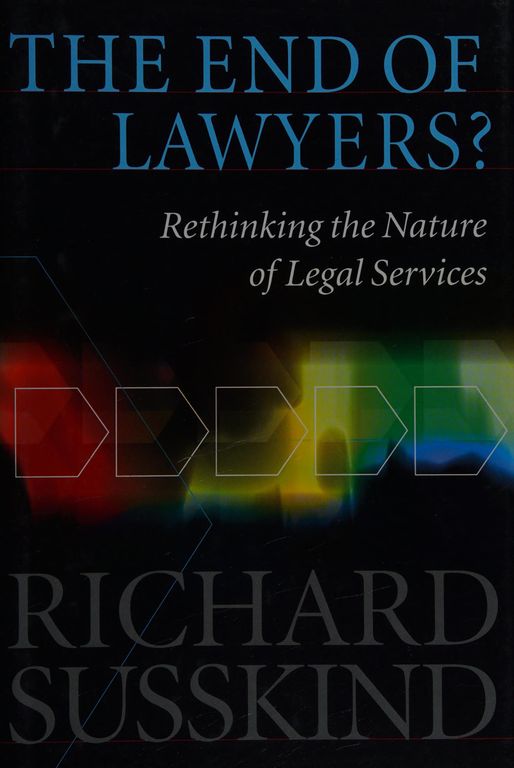
The end of lawyers?
Introduction
The Sword of Damocles Over the Bar
Nova: Welcome back to the show. Today, we are tackling a book that landed in the legal world like a tactical nuclear strike back in 2010: Richard Susskind's 'The End of Lawyers?'. Imagine a profession that has existed, largely unchanged, for centuries—a bastion of tradition, precedent, and high fees—and then someone declares its impending doom.
Nova: It was absolutely the evidence, Alex, wrapped in a title that was pure provocation. Susskind, a highly respected academic and lawyer himself, didn't just suggest lawyers needed to be more efficient; he argued that the entire of legal service delivery was fundamentally broken and unsustainable in the internet age. He saw the profession as a guild clinging to an outdated model.
Nova: It was everything. The cost, the structure, the resistance to change. He identified four main pressures: the demand to charge less, the need to work differently, the imperative to embrace technology—which at the time was still seen as just an IT expense—and the push for deregulation. He essentially said, 'If you don't radically change, the market will replace you with something cheaper and better.'
Nova: Because the legal system underpins everything in our society—business, property, rights. If the system becomes inaccessible because it’s too expensive or too slow, society suffers. Susskind argued that vast swathes of unmet legal need exist because the traditional lawyer model can't serve the middle and lower classes efficiently. This book is about democratizing justice, whether the lawyers like it or not.
Key Insight 1: Commoditization and Inefficiency
The Death of the Billable Hour and the Artisan Model
Nova: The first casualty, Alex, was the sacred cow itself: the billable hour. Susskind argued that the billable hour is not a law of nature; it’s an artifact, a relic from a time when legal work was bespoke, artisanal, and impossible to standardize. When you charge by the hour, you are incentivized to be efficient.
Nova: Precisely. Susskind pointed out that as technology advanced in other fields—manufacturing, accounting—those industries embraced standardization and automation, leading to lower costs and wider access. The legal profession, however, remained stubbornly artisanal. He used the analogy of the hand-loom weavers being replaced by the power loom. Lawyers are the hand-loom weavers of the information age.
Nova: That’s the critical structural problem he highlighted. The traditional pyramid structure relies on junior lawyers subsidizing the senior partners by performing low-value, high-volume work at high rates. If technology automates that work, the bottom of the pyramid vanishes. Susskind suggested that the work that remains for humans will be the truly complex, bespoke, high-stakes strategy—the stuff that be commoditized.
Nova: It forces a complete re-evaluation of value. If a client can get 80% of the legal outcome through a tech-enabled service for 20% of the cost, the traditional firm offering 100% for 100% of the price becomes uncompetitive for that 80% of the work. Susskind wasn't saying lawyers would disappear overnight, but that the of what they do, and who they serve, would shrink dramatically unless they adapted.
Nova: Absolutely. Even back then, he pointed to early forms of e-discovery and basic document automation. He saw that once a task becomes predictable, it becomes susceptible to technological replication. He urged firms to stop viewing technology as a tool to make their existing processes slightly faster, and start viewing it as a tool to the entire service offering.
Nova: Exactly. The mindset shift is the hardest part. It requires lawyers to stop thinking like lawyers—defending the status quo—and start thinking like entrepreneurs or engineers, focused purely on solving the client's problem in the most efficient way possible, even if that means not billing for the solution.
Key Insight 2: The Power of Information Technology
From IT to AI: The Technological Tsunami
Nova: When Susskind wrote 'The End of Lawyers?' in 2010, the term AI wasn't as ubiquitous as it is today, but his focus was already on the transformative power of Information Technology. He saw IT not just as an aid, but as a fundamental disruptor that would lead to the 'unbundling' of legal services.
Nova: He envisioned legal work being broken down into tasks that could be automated, tasks that could be outsourced to non-lawyers, and tasks that required high-level human judgment. The key was that technology would handle the first category, which was previously the bread and butter of junior lawyers. Think about contract review—that used to take weeks of associate time.
Nova: It has, dramatically. In later works, like 'Tomorrow's Lawyers,' he emphasized that AI’s biggest impact isn't just productivity—making lawyers faster—but. He stated that the most impactful gains from AI will be in creating entirely new systems that prevent disputes before they even happen.
Nova: Certainly. Consider regulatory compliance. Instead of a company hiring lawyers annually to audit their operations against complex, ever-changing regulations, an AI system could be embedded directly into their operational software, providing real-time compliance checks and flagging potential violations they become actionable legal problems. The need for reactive legal advice shrinks.
Nova: That’s right. Susskind argued that technology would become so embedded that legal expertise without technological fluency would be obsolete. It’s not about coding; it’s about understanding the capabilities and limitations of the tools that are now doing the heavy lifting. If you don't understand how the AI reached its conclusion, you can't ethically advise your client on it.
Nova: Exactly. The lawyer’s value proposition moves up the chain. It becomes about framing the narrative, understanding the human element, negotiating the settlement based on predicted outcomes, and handling the truly novel legal questions that the algorithms haven't been trained on yet. The routine advocacy becomes automated.
Nova: That brings us to the next major prediction: the rise of entirely new players who are not constrained by the traditional law firm structure.
Key Insight 3: New Providers and New Roles
The Rise of the 'Un-Lawyer' and New Legal Ecosystems
Nova: Susskind’s vision wasn't just about traditional firms becoming more efficient; it was about the emergence of entirely new entities that could deliver legal services without the baggage of the traditional partnership model. He predicted the rise of what we might call the 'un-lawyer' or alternative legal service providers, or ALSPs.
Nova: Precisely. These entities are built around process, technology, and fixed-fee or subscription models. They focus relentlessly on delivering that 'more for less.' They don't see the law as a sacred craft; they see it as a set of solvable, repeatable problems. Think about large corporations bringing legal work in-house and using specialized tech teams, or dedicated legal process outsourcing firms.
Nova: It’s a complete inversion of the service delivery model. Furthermore, Susskind predicted new emerging within the legal ecosystem that aren't traditional lawyers. We’re seeing legal project managers, legal technologists, legal process engineers, and legal data scientists. These roles focus on optimizing the of legal expertise, rather than just possessing the expertise itself.
Nova: That’s an excellent summary of the segmentation. The danger for traditional firms is getting stuck in the middle—trying to compete on price with the ALSPs while not having the specialized, unique expertise to justify their high rates against the elite firms. Susskind warned that the middle ground would be hollowed out.
Nova: That’s the million-dollar question, and it leads us directly into the critical reception of his work. Because while the vision is compelling, the reality of professional inertia is incredibly strong.
Key Insight 4: Critiques and Current Adoption
The Reality Check: Resistance and Resilience
Nova: So, we have this powerful, technologically driven prophecy. But when we look around, are we seeing the mass extinction of the traditional law firm? Not exactly. The profession has shown remarkable resilience, which brings us to the critiques of Susskind’s thesis.
Nova: That’s a huge factor. Critics argue that Susskind was perhaps too enamored with the technology and too dismissive of the political and economic barriers. The guild mentality is strong. Furthermore, many firms have adopted technology, but often in a way that the billable hour, rather than replacing it. They use AI for efficiency gains, but they don't necessarily pass those savings on to the client; they just pocket the extra margin.
Nova: Exactly. Some reviewers noted that while the book is an inspiration for change, the market reality is slower. The clients who afford the top-tier firms—large corporations, wealthy individuals—are often happy with the status quo, as long as the service is excellent, regardless of the cost structure.
Nova: There’s evidence that it has, particularly in specific, high-volume areas like immigration forms, simple wills, or consumer debt resolution. The technology serving the underserved, but perhaps not as broadly or as quickly as Susskind hoped. He himself has acknowledged that the transition is slower than his initial predictions, often pointing out that the market is showing 'no loyalty to the traditional way of working,' but that loyalty takes time to erode.
Nova: The most important takeaway is that the of value has changed. Value is no longer synonymous with time spent. It is synonymous with the achieved efficiently. If you are a lawyer today, you must be able to articulate how you use technology to deliver a better, faster, or cheaper result than the system that existed before. If you can’t, you risk becoming one of those artisans whose specialized skill set is no longer required by the modern world.
Synthesis: The Lawyer of Tomorrow
Synthesis: The Lawyer of Tomorrow
Nova: We’ve covered a lot of ground today, Alex, tracing Richard Susskind’s provocative journey from the 'End of Lawyers?' to the 'Future of Law.' The core message remains: the legal profession as we know it is unsustainable due to market pressures and technological capability.
Nova: For listeners who are lawyers, the actionable takeaway is to stop defending the past and start designing the future. Identify the 30% of your work that is routine, find the technology to automate it, and then focus your human capital on the 70% that requires true strategic insight, empathy, and novel thinking.
Nova: Susskind’s work was a necessary shock to the system. It forced a conversation that was long overdue. Whether the profession fully transforms or merely adapts around the edges, the pressure for efficiency and accessibility will only increase.
Nova: Indeed. The end of the lawyer as we know them might not be a sudden collapse, but a slow, inevitable evolution into something far more integrated with technology and far more focused on delivering real-world value.
Nova: This is Aibrary. Congratulations on your growth!