

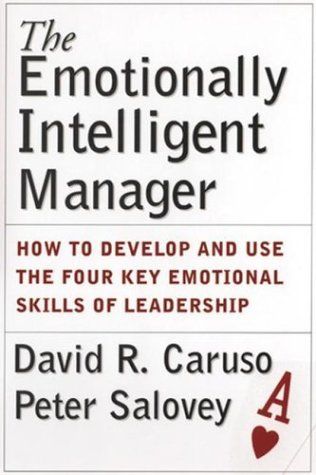
The emotionally intelligent manager
Introduction: Beyond IQ - The Emotional Manager
Introduction: Beyond IQ - The Emotional Manager
Nova: Welcome back to the show! Today, we're diving into a book that fundamentally reframes what it means to be a successful leader: David R. Caruso’s "The Emotionally Intelligent Manager." We often hear about IQ, strategy, and technical skill, but what if the real secret weapon in management is something far more primal?
Nova: Exactly! But Caruso, along with his collaborator Peter Salovey, argues that emotions aren't just irrational impulses to be suppressed. They are, in fact, absolutely necessary for intelligent thinking and making good decisions. That’s the radical premise here.
Nova: Because this isn't just about being 'nice.' Caruso presents an ability-based model. It’s not about personality traits; it’s about measurable, learnable skills. And the stakes are high. Research suggests that employees whose managers have high emotional intelligence are four times less likely to leave the company. Four times, Alex!
Nova: We start by understanding that Caruso’s work is built on a hierarchy. It’s a ladder you climb, skill by skill, to true emotional mastery in leadership. Let's break down the first rung, which is often the hardest for analytical thinkers: simply noticing what’s happening inside the room.
Key Insight 1: The Hierarchy of Emotional Skills
The Four Pillars: An Ability-Based Framework
Nova: The core of Caruso’s framework is a four-part hierarchy. Think of it like building a house; you can't put up the roof until the foundation is solid. The base level is.
Nova: Precisely. Identifying means accurately perceiving emotions in yourself and others—reading facial expressions, tone of voice, body language. It's about moving from 'something feels off' to 'I see tension in Sarah's shoulders and John's clipped responses suggest frustration, not disagreement.' Caruso emphasizes that if you can't accurately name the emotion, you can't manage it.
Nova: That brings us to the second skill:. This is where the book really separates itself from the pack. It argues that emotions aren't obstacles to logic; they are inputs logic.
Nova: That’s the common misconception. Caruso suggests that different emotional states prime us for different types of thinking. For instance, a moderate level of positive emotion can foster creativity and open-minded problem-solving. Fear, when understood, can highlight potential risks that logic alone might overlook. It’s about leveraging the emotional data to guide your cognitive focus.
Nova: Exactly! You’re using the feeling to prioritize what needs your analytical attention. It’s emotional data informing your strategic focus. This is a massive departure from the 'stiff upper lip' management style.
Nova: Yes,. This is about grasping the causes, consequences, and transitions of emotions. Why is Sarah anxious? What will happen if this anxiety isn't addressed? It involves understanding emotional sequences.
Nova: Precisely. And this level is crucial for empathy and forecasting team dynamics. If you understand that frustration often follows a period of high effort without recognition, you can preemptively schedule that recognition.
Nova: The capstone skill. This isn't about faking happiness or suppressing sadness. It’s about regulating emotions—your own and others’—to achieve a goal. For a manager, this means knowing when to dial down team panic, when to encourage productive tension, and how to de-escalate conflict effectively.
Key Insight 2: Measuring and Developing EI
From Theory to Practice: Developing Managerial Muscle
Nova: One of the most powerful aspects of Caruso’s work is its grounding in measurement. He and his colleagues developed the Mayer-Salovey-Caruso Emotional Intelligence Test, or MSCEIT. This test treats EI as an ability, like verbal reasoning, which you can score on.
Nova: It gives you a baseline. If your score is low on the 'Understanding Emotions' branch, you know exactly where to focus your development efforts. Caruso suggests practical exercises for each level. For instance, to improve identification, you might practice labeling emotions in movies or reading short stories without sound.
Nova: For management, the practice often involves scenario planning. Imagine a high-stakes negotiation where you feel defensive. The exercise is to mentally walk through the four steps: 1. Identify the defensiveness. 2. Use that feeling to recognize the perceived threat to your position. 3. Understand that defensiveness might shut down collaboration. 4. Choose a regulation strategy—perhaps taking a planned five-second pause before responding, or reframing the other person’s critique as valuable data rather than an attack.
Nova: That statistic is staggering, isn't it? It explains so much organizational friction. If only one in five managers is truly adept at this, it creates a massive competitive advantage for those who master Caruso’s model. It’s a skill gap that organizations are desperate to fill.
Nova: Absolutely. Think about feedback. A low-EI manager might deliver critical feedback bluntly because they’ve suppressed their own discomfort about giving it. A high-EI manager, using the model, identifies their own discomfort, uses that awareness to realize the delivery needs to be more structured and supportive, understands the employee’s likely reaction, and then manages the delivery to ensure the message lands constructively.
Key Insight 3: Quantifiable Returns on Emotional Investment
The Bottom Line: EI as a Business Imperative
Nova: Let’s talk about the ROI, because ultimately, managers need to justify their time investment. We mentioned the 4x lower turnover rate for teams with high-EI managers. What other business metrics does Caruso’s framework directly impact?
Nova: That’s right. And it ties directly into decision quality. Remember, Caruso argues emotion is necessary for good decisions. When managers suppress emotion, they often default to analysis paralysis or rely on outdated heuristics. Emotionally intelligent managers integrate that 'gut feeling' data point, leading to faster, more robust choices.
Nova: That’s a perfect illustration. The outcome is vastly different. The high-EI manager fosters resilience, while the low-EI manager fosters learned helplessness. Furthermore, studies show that EI accounts for up to 70% of what determines success in life and work. That’s a massive lever for any leader to pull.
Nova: It’s the 'soft skill' that’s actually the hardest skill. It requires vulnerability and constant self-monitoring. But Caruso makes it clear: this isn't about being overly sensitive; it’s about being and with your emotional data. It’s about building strong teams that can weather storms because the leader knows how to manage the internal weather system.
Conclusion: Your First Step to Emotional Mastery
Conclusion: Your First Step to Emotional Mastery
Nova: We’ve covered a lot of ground today, Alex. David R. Caruso’s "The Emotionally Intelligent Manager" forces us to stop viewing emotions as noise and start treating them as valuable, actionable data.
Nova: Absolutely. If you can’t name it, you can’t tame it, or leverage it. For our listeners looking to apply this tomorrow, start by simply observing your own reactions during a stressful meeting. Don't judge the anger or the frustration; just label it. Is it frustration? Is it fear of failure? That simple act of labeling is the first step up Caruso’s ladder.
Nova: It’s about integrating the human element into the intelligence equation. It’s about being a manager who leads with both head and heart, but always with a clear, measurable strategy for both.
Nova: My pleasure, Alex. The journey to mastery is continuous, and understanding the science behind our feelings is the best place to start.
Nova: This is Aibrary. Congratulations on your growth!