

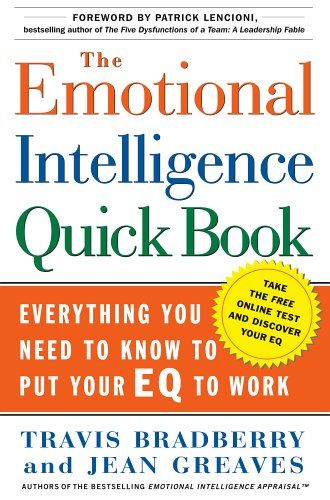
The emotional intelligence quick book
The Secret Ingredient of Success
The Secret Ingredient of Success
Nova: Welcome to the show. Today we are diving into a book that basically rewritten the rules of the workplace and personal growth. We are talking about The Emotional Intelligence Quick Book by Travis Bradberry and Jean Greaves. If you have ever wondered why some incredibly smart people fail miserably at leadership, while others who might not have the highest IQ seem to glide through life with everyone on their side, this is the answer.
Nova: Exactly. And it is not just a hunch. Bradberry and Greaves are the founders of TalentSmart, and they have tested more than half a million people. Their data shows that EQ is responsible for fifty eight percent of performance in all types of jobs. It is the foundation for a whole host of critical skills like decision-making, time management, and even productivity.
Nova: In many cases, yes. The book argues that while your IQ and your technical expertise might get you through the door, your EQ is what determines how far you go once you are inside. And the best part? Unlike your IQ, which is pretty much set by the time you are a teenager, your EQ is flexible. You can actually train your brain to be more emotionally intelligent.
Nova: Not at all. It is about how you handle yourself and how you handle others. The Quick Book breaks it down into four distinct skills, and today we are going to peel back the layers on each of them. We will look at why our brains are hardwired to react emotionally before we think rationally, and how we can use that knowledge to our advantage.
Key Insight 1
The Biological Hijack
Nova: To really understand EQ, we have to start with biology. Bradberry explains that every single thing you experience—everything you see, hear, or smell—travels through your body in a very specific way. It starts at the base of your brain, right where your spinal cord enters.
Nova: This is the critical part. Before that signal reaches the frontal lobe, which is the rational, thinking part of your brain where you solve math problems and plan your day, it has to pass through the limbic system. That is the emotional center of your brain.
Nova: It is a physical fact. You have an emotional reaction to an event before your rational brain even knows the event has happened. This is what Bradberry calls the biological journey of an emotion. The problem is, for many of us, the communication between the emotional and rational centers is more like a narrow dirt road than a high-speed highway.
Nova: Precisely. When you are in the middle of a high-stakes meeting or a heated argument at home, your limbic system can take over. It floods your system with chemicals that prepare you for fight or flight. Your rational brain gets sidelined, and you end up saying or doing something that you regret ten minutes later when the signal finally makes it to the frontal lobe.
Nova: Actually, you can. That is the concept of neuroplasticity. The book explains that by practicing emotional intelligence skills, you are effectively building a bridge between those two parts of the brain. The more you practice, the more neurons grow in that direction. You are turning that dirt road into a superhighway of communication.
Nova: Exactly. And Bradberry is very clear that EQ is not about suppressing emotions or turning into a robot. It is about understanding the emotion and then choosing how to respond to it. He makes a clear distinction between EQ, IQ, and personality. Your IQ is your ability to learn. Your personality is the style that defines you, like being an introvert or an extrovert. Neither of those change much over time. But EQ is the one part of your make-up that is completely under your control to improve.
Key Insight 2
The Four Pillars of EQ
Nova: The map consists of four quadrants. On one side, you have Personal Competence, which is about you. On the other side, you have Social Competence, which is about your interactions with others. Each side is then split into an awareness skill and an action skill.
Nova: Right. That is Self-Awareness. It is the ability to accurately perceive your own emotions in the moment and understand your tendencies across situations. People with high self-awareness know what they do well, what motivates them, and which people or situations push their buttons.
Nova: It is harder than it looks because emotions can be messy. Bradberry suggests that self-awareness is about staying on top of your reactions. For example, if a coworker critiques your work, do you immediately get defensive? Do you shut down? Self-awareness is the ability to see that reaction happening in real-time without judgment.
Nova: Yes, Self-Management. This is the action part of personal competence. It is your ability to use your awareness of your emotions to stay flexible and direct your behavior positively. This is where most people struggle. It is not about ignoring the anger or the frustration; it is about managing it so it doesn't manage you.
Nova: It is simple, but it is science! Remember the brain pathway? When you take deep, slow breaths, you are literally telling your nervous system to calm down. You are giving your rational brain those few extra seconds it needs to catch up with the emotional limbic system. Bradberry also suggests things like sleep hygiene and even just counting to ten. These are physical hacks to stop the emotional hijack.
Nova: Exactly. Social Awareness is your ability to accurately pick up on emotions in other people and understand what is really going on with them. This often means perceiving what other people are thinking and feeling even if you do not feel the same way. It is about being a world-class observer.
Nova: Precisely. It is about listening with your eyes as much as your ears. And the final pillar, Relationship Management, is the culmination of the first three. It is using your self-awareness, self-management, and social awareness to manage interactions successfully. This is where you build bonds, handle conflict, and influence others.
Case Study
The $29,000 Difference
Nova: Let is talk about the stakes for a second, because this is where the research gets really eye-opening. Bradberry and Greaves found that people with high EQ make an average of twenty nine thousand dollars more per year than people with low EQ.
Nova: Across every industry they tested. In fact, they found that for every point you increase your EQ, it adds about thirteen hundred dollars to your annual salary. These findings held true regardless of the person's job title, their location, or their level of education.
Nova: It is much deeper than that. Think about what high-EQ looks like in a workplace. These are the people who stay calm during a crisis, so they make fewer expensive mistakes. They are the ones who can navigate office politics without getting bogged down in drama. They lead teams that are more productive because people actually want to work for them.
Nova: Exactly. Bradberry points out that when researchers looked at top performers, they found that ninety percent of them have high emotional intelligence. On the flip side, only twenty percent of bottom performers have high EQ. You can be a top performer with low EQ, but the odds are heavily against you.
Nova: And that ceiling usually appears when you move into management. That is when your technical skills matter less and your ability to lead people matters more. The book shares stories of brilliant engineers or financial analysts who were promoted because they were great at their craft, but then they failed as managers because they couldn't handle the emotional complexity of leading a team.
Nova: That is the unique thing about this book. When it was released, it came with a passcode for an online test called the Emotional Intelligence Appraisal. It was designed to give you a baseline score in all four quadrants so you know exactly which dirt roads in your brain need the most paving.
Deep Dive
Training the Emotional Brain
Nova: Once you have your baseline, the book provides very specific strategies for each quadrant. And I want to highlight some of these because they are surprisingly practical. For example, in the Self-Management section, one of the strategies is to Make Your Goals Public.
Nova: Because it creates external accountability. When you tell people you are working on a specific behavior, like not interrupting in meetings, the social pressure helps your rational brain stay engaged. You are less likely to let your limbic system take over if you know everyone in the room is watching to see if you will slip up.
Nova: One of my favorites is Greeting People by Name. It sounds so basic, but Bradberry explains that it is a powerful way to force yourself to focus on the other person immediately. It breaks your internal monologue and forces you to acknowledge the human being in front of you. Another one is Watching Body Language, but with a twist: you have to look for the baseline. If someone is normally very fidgety, their fidgeting doesn't mean they are nervous now. You have to look for what is different from their normal state.
Nova: That is huge for building trust. When people understand the why, even if they don't like the decision, their emotional brain is less likely to feel threatened. It prevents that feeling of being treated like a cog in a machine. Bradberry also emphasizes the importance of Acknowledging Other People's Feelings. You don't have to agree with them, but simply saying, I can see that you are frustrated by this, can de-escalate a situation almost instantly.
Nova: Exactly. And the key to all of this, according to the book, is consistency. You can't just do this once. You have to pick one or two strategies and practice them every single day. Bradberry suggests that it takes about three to six months of consistent practice to see a permanent shift in your EQ scores. You are literally building new neural pathways, and that takes time.
Nova: It really is. The book argues that emotional intelligence is not a luxury; it is a necessity for the modern world. We are more connected than ever, yet our brains are still operating on hardware that is thousands of years old. EQ is the software update we all need to navigate this environment successfully.
Mastering the Human Connection
Mastering the Human Connection
Nova: We have covered a lot today. From the way our brain processes emotions before logic, to the four pillars of EQ, and the massive impact these skills have on our bank accounts and our careers. The Emotional Intelligence Quick Book really is a manual for the human side of life.
Nova: If there is one takeaway for our listeners, it is this: your EQ is not fixed. You have the power to change how you react to the world. Start small. Pick one strategy, like taking three deep breaths before you respond to a frustrating email, or making a point to use people's names in conversation. These small changes, repeated over time, build the neural pathways for a more successful and fulfilling life.
Nova: That is the first step toward mastery. Travis Bradberry and Jean Greaves have given us the tools; now it is up to us to do the work. Thank you for joining us on this journey into the heart of emotional intelligence.
Nova: Good luck with that, Leo! And to everyone listening, remember that growth is a process, not an event.
Nova: This is Aibrary. Congratulations on your growth!