

The Elements of Statistical Learning
Introduction
Nova: Picture this: it's 2001. The term "data science" barely exists. Machine learning is still largely an academic curiosity. And three Stanford statisticians — Trevor Hastie, Robert Tibshirani, and Jerome Friedman — quietly publish a 533-page book with an unassuming title: The Elements of Statistical Learning. Fast forward two decades, and that book has been cited over 80,000 times, downloaded millions of times, and is widely considered one of the most influential texts in the history of data science. Welcome to Aibrary, where we explore the books that shaped how we think. I'm Nova.
Nova: : And I'm Orion. So Nova, I have to ask — what makes a statistics textbook from 2001 still relevant in 2025? I mean, the field has exploded. We have deep learning, transformers, large language models. Why are people still reading this book?
Nova: That's the million-dollar question, Orion. And the answer is fascinating. ESL — as it's affectionately known — isn't just a textbook. It's a framework for thinking. It bridges classical statistics and modern machine learning in a way that no other book has quite managed. It gives you the mathematical foundations that make everything else — including deep learning — actually make sense.
Nova: : So it's like learning music theory instead of just memorizing songs?
Nova: Exactly! You can learn to play specific songs on the piano, but if you understand chord progressions and scales, you can play anything. ESL gives you the chord progressions of data science. And here's the wild part: the authors made the entire PDF freely available on Stanford's website. No paywall. No subscription. Just pure knowledge, accessible to anyone with an internet connection.
Nova: : That's remarkable. And I know the authors went on to write a more accessible companion book — An Introduction to Statistical Learning — but ESL remains the definitive deep dive. So what are we going to unpack today?
Nova: We're going to explore what makes this book a masterpiece: its origins and the legendary trio behind it, the core ideas that changed how we think about learning from data, why its mathematical rigor is a feature not a bug, and how it continues to shape machine learning today. Let's dive in.
Origins and Authorship
The Stanford Trio
Nova: Let's start with the people behind the book, because the story of ESL is really the story of three extraordinary statisticians who happened to be in the same place at the same time. Trevor Hastie, Robert Tibshirani, and Jerome Friedman — all professors in Stanford's Statistics Department — had been collaborating for years before the book came together.
Nova: : What's their background? Were they always working on machine learning?
Nova: Great question. Hastie and Tibshirani actually grew up together in South Africa and both ended up at Stanford. Hastie is known for his work on generalized additive models and principal curves. Tibshirani invented the lasso — one of the most important methods in modern statistics, which we'll talk about later. And Friedman, who's a bit older, was a pioneer in nonparametric regression and came up with some of the earliest practical implementations of gradient boosting.
Nova: : So they weren't just textbook writers — they were actively inventing the methods they were writing about.
Nova: Exactly! That's what gives ESL its unique authority. These aren't people summarizing other people's work. Friedman literally invented MARS — multivariate adaptive regression splines. Hastie developed entire classes of smoothing methods. Tibshirani's lasso paper from 1996 is one of the most cited papers in all of statistics. When they explain a method, they're often explaining something they created or deeply contributed to.
Nova: : That's like getting a guitar lesson from Jimi Hendrix.
Nova: Pretty much! And the book emerged from a course they co-taught at Stanford. The first edition came out in 2001, and it was immediately recognized as something special. But here's what's interesting: the second edition in 2009 was a massive expansion — they added chapters on random forests, boosting, graphical models, and more. It grew from 533 pages to 745 pages. The field was moving fast, and they kept pace.
Nova: : I've heard the book described as "the bible of machine learning." Is that fair?
Nova: It's one of two books that get that label — the other being Christopher Bishop's Pattern Recognition and Machine Learning. But ESL has a distinct flavor. It's deeply rooted in the statistical tradition. It cares about inference, about understanding why methods work, not just that they work. And it's written with a clarity that's rare in technical books. The prose is precise but never needlessly opaque.
Nova: : And they made it free. I still can't get over that.
Nova: It's genuinely remarkable. In an era where textbooks routinely cost hundreds of dollars, Hastie, Tibshirani, and Friedman put the entire PDF on Hastie's Stanford faculty page. They've said in interviews that they wanted the knowledge to be accessible, especially to students and researchers in developing countries. That decision alone has probably done more to democratize machine learning education than almost anything else.
Bias, Variance, and the Art of Generalization
The Core Philosophy
Nova: If there's one idea that runs through every chapter of ESL like a golden thread, it's the bias-variance tradeoff. This is the central organizing principle of the entire book, and honestly, of statistical learning itself.
Nova: : Okay, break that down for me. Bias versus variance — what does that actually mean in practice?
Nova: Imagine you're trying to hit a target with a bow and arrow. High bias means your arrows consistently land in the wrong spot — you're systematically off. High variance means your arrows scatter all over the place — no consistency. In machine learning, a model with high bias is too simple to capture the patterns in the data — it underfits. A model with high variance is so complex that it memorizes the noise in the training data — it overfits.
Nova: : So the whole game is finding the sweet spot between too simple and too complex?
Nova: That's it. And ESL doesn't just state this — it builds an entire mathematical framework around it. Chapter 7, on model assessment and selection, is one of the most important chapters in the book. It introduces concepts like the expected prediction error, the bias-variance decomposition, and cross-validation. These aren't just theoretical curiosities — they're the practical tools you use every day as a data scientist.
Nova: : I've used cross-validation countless times without really understanding where it came from.
Nova: And that's exactly why ESL is so valuable. It gives you the why, not just the how. The book shows you that k-fold cross-validation isn't just a heuristic — it's an approximately unbiased estimator of the expected prediction error. When you understand that, you make better decisions about how to use it.
Nova: : What about the bias-variance tradeoff in the age of deep learning? I've heard people say it breaks down with very large models.
Nova: That's one of the most fascinating developments. ESL's framework predicts that as models get more complex, test error should eventually go up due to increased variance. But with deep neural networks, we've observed something surprising: after a certain point, making the model even bigger can actually reduce test error. This is the "double descent" phenomenon, and it's sparked intense debate about whether the classical bias-variance framework needs updating.
Nova: : So ESL might be... wrong about some things?
Nova: Or at least incomplete! And that's actually a sign of a great book — it gives you a framework solid enough that you can identify where it breaks down. The authors themselves have engaged with these new findings. The book isn't a static monument; it's a living document that continues to generate productive questions.
Lasso, Boosting, and Random Forests
The Methods That Changed Everything
Nova: Let's talk about some of the specific methods that ESL covers — and in many cases, helped popularize. Chapter 3 is on linear methods for regression, and it includes a section on the lasso that's absolutely foundational.
Nova: : The lasso — that's Tibshirani's invention, right?
Nova: Yes! And it's a perfect example of a simple idea with profound consequences. The lasso adds a penalty to linear regression that shrinks some coefficients exactly to zero. This does two things simultaneously: it prevents overfitting and it performs variable selection. Before the lasso, people used stepwise selection methods that were computationally expensive and statistically unstable. The lasso made regularization mainstream.
Nova: : And now it's everywhere — in genomics, in finance, in any field with high-dimensional data.
Nova: Exactly. And ESL doesn't just present the lasso as a recipe. It walks you through the geometry of why the l1 penalty produces sparsity while the l2 ridge penalty doesn't. There's a famous figure in the book showing the constraint regions — a diamond for the lasso, a circle for ridge regression — and it makes the intuition crystal clear.
Nova: : What about boosting? I know that was a huge deal.
Nova: Boosting is one of the great success stories in machine learning, and ESL devotes an entire chapter to it. The basic idea is almost absurdly simple: combine many weak learners — models that are barely better than random guessing — into a single strong learner. But the statistical theory behind why this works is deep and beautiful.
Nova: : And Friedman himself developed one of the most popular boosting algorithms, right?
Nova: Yes — gradient boosting, which Friedman introduced in a series of papers around 1999 to 2001. He showed that boosting could be understood as a form of gradient descent in function space. That connection between boosting and numerical optimization was a genuine intellectual breakthrough. And of course, gradient boosting went on to dominate Kaggle competitions and power some of the most successful machine learning systems in industry.
Nova: : And random forests?
Nova: Random forests, covered in Chapter 15, are another ensemble method that ESL helped codify. Leo Breiman developed them, and the book gives a clear, rigorous treatment. The key insight is that by introducing randomness — both in the data samples and in the features considered at each split — you decorrelate the trees and dramatically reduce variance. Random forests are remarkably robust, require almost no tuning, and remain competitive with much fancier methods decades later.
Nova: : It's striking how many of these methods from the early 2000s are still workhorses today.
Nova: That's the mark of deep understanding. ESL doesn't chase fads. It focuses on methods with solid statistical foundations, and those tend to have staying power.
Why the Math Matters
The Rigor Question
Nova: Let's address the elephant in the room. ESL is hard. It assumes you're comfortable with linear algebra, probability theory, and some measure theory. The exercises are challenging. People joke that "ESL" stands for "Extremely Stressful Learning."
Nova: : I was going to ask about that. Who is this book actually for? If I'm a practicing data scientist who just wants to use scikit-learn, do I really need to work through ESL?
Nova: That's a fair question, and the honest answer is: it depends on your goals. If you just need to run XGBoost on a tabular dataset and get a reasonable result, you probably don't need ESL. But if you want to understand why XGBoost works, when it might fail, and how to diagnose and fix problems — that's where ESL becomes invaluable.
Nova: : So it's the difference between being a technician and being an engineer?
Nova: I'd say it's the difference between being a practitioner and being an expert. There's a famous quote — I think it's from the authors themselves — that the book is for "statisticians and researchers in data mining and machine learning who want to understand the statistical basis of their methods." It's not a cookbook. It's a deep exploration of principles.
Nova: : But isn't there a risk that the mathematical rigor makes the book inaccessible to a lot of people who could benefit from it?
Nova: Absolutely, and the authors recognized this. That's exactly why they wrote An Introduction to Statistical Learning, or ISLR, with Gareth James and Daniela Witten. ISLR covers many of the same topics but with less math and more R code. It's the friendly, accessible sibling. And the two books work beautifully together — you can start with ISLR and then go deeper with ESL on the topics that matter most to you.
Nova: : That's a smart approach. But I want to push back a little — in 2025, with AutoML tools and foundation models, do we really need to understand the math at this level?
Nova: I'd argue we need it more than ever. When models are black boxes, understanding their statistical properties becomes crucial for safety, fairness, and reliability. ESL teaches you to think about generalization error, about the assumptions underlying your methods, about when and why things can go wrong. Those skills don't become obsolete — they become more important as the models get more complex.
Nova: : That's a compelling argument. It's like how understanding aerodynamics matters more, not less, when you're flying a faster plane.
Nova: Perfect analogy. The faster and more powerful your tools, the more you need to understand the principles that keep you from crashing.
ESL in the Age of Deep Learning
The Living Legacy
Nova: One of the most interesting things about ESL is how it's aged. The second edition came out in 2009 — before AlexNet, before the deep learning revolution really took off. The book has one chapter on neural networks, and it's focused on the single-hidden-layer networks that were state of the art at the time.
Nova: : So is it outdated?
Nova: In some specific ways, yes. You won't find convolutional neural networks, recurrent networks, transformers, or generative adversarial networks in ESL. But here's the thing: the statistical principles that ESL teaches — regularization, bias-variance tradeoff, model selection, ensemble methods — are exactly the principles that explain why deep learning works.
Nova: : Can you give me an example?
Nova: Sure. Dropout, one of the key regularization techniques in deep learning, is essentially a form of model averaging — it's training an ensemble of subnetworks and averaging their predictions. ESL's chapters on model averaging and regularization give you the conceptual tools to understand why dropout works. Batch normalization? It's about stabilizing the optimization landscape, which connects to ESL's discussions of numerical stability and preconditioning.
Nova: : So ESL provides the conceptual foundation even for techniques it doesn't explicitly cover.
Nova: Exactly. And the authors have continued to contribute to the field. Hastie has done important work on post-selection inference and on understanding the double descent phenomenon. Tibshirani has been working on selective inference and the replication crisis. Friedman continues to develop gradient boosting methods. They're not resting on their laurels.
Nova: : What about the book's influence on education?
Nova: It's hard to overstate. ESL has been the primary textbook for graduate-level statistical learning courses at Stanford, Berkeley, CMU, and countless other institutions. It's shaped how an entire generation of data scientists and machine learning researchers think about their craft. When you read papers at NeurIPS or ICML, you can often trace the statistical reasoning back to concepts from ESL.
Nova: : And the free PDF — has that influenced the broader open science movement?
Nova: I think it has. ESL was one of the first major technical textbooks to be made freely available by its authors, and it set a precedent. It showed that you could give away the PDF and still sell physical copies — the book has been a commercial success despite being free. That model has been emulated by many others, including the authors' own ISLR.
Nova: : It's a remarkable legacy for what started as course notes at Stanford.
Conclusion
Nova: So where does that leave us? The Elements of Statistical Learning is more than a textbook. It's a monument to a particular way of thinking about data — rigorous, principled, and deeply curious about why things work. It's the product of three extraordinary minds who not only advanced the field through their research but took the time to codify that knowledge for everyone else.
Nova: : What I'm taking away is that ESL matters not because it has all the answers, but because it teaches you how to ask the right questions. The bias-variance tradeoff, regularization, model assessment — these aren't just techniques, they're lenses for understanding any learning problem.
Nova: Beautifully said. And I think there's a broader lesson here about the relationship between theory and practice. In a field that moves as fast as machine learning, it's tempting to chase the latest architecture or the newest framework. But the methods that endure — lasso, random forests, gradient boosting — are the ones built on solid statistical foundations. ESL gives you those foundations.
Nova: : So for someone listening who's intrigued — where should they start?
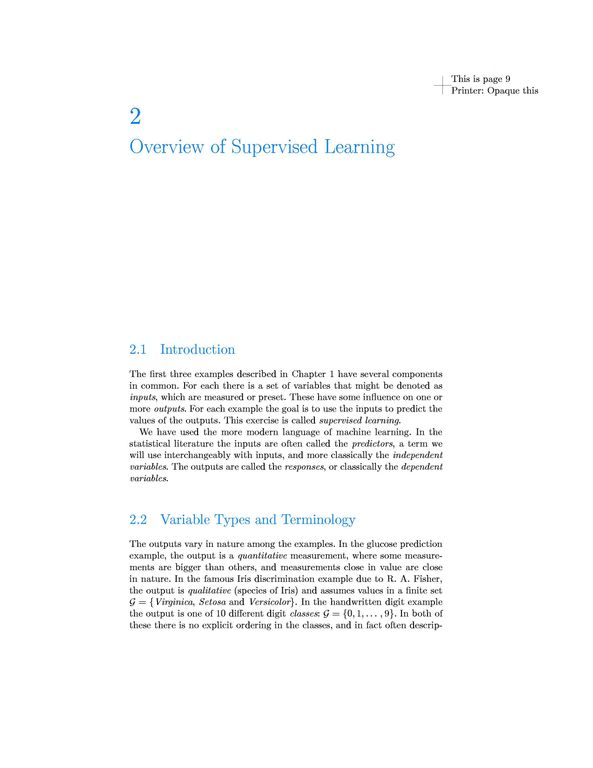
Nova: If you have a strong math background, dive into ESL directly. The PDF is free on Trevor Hastie's Stanford website. Start with Chapter 2, which gives an overview of supervised learning, then work through the chapters that interest you most. If the math feels daunting, begin with An Introduction to Statistical Learning — it covers much of the same ground more gently, with code examples. Then come back to ESL when you're ready to go deeper.
Nova: : And for those who just want to appreciate the book's ideas without working through the equations?
Nova: Even skimming ESL is valuable. The conceptual discussions, the figures, the chapter summaries — they give you a map of the territory. You might not understand every detail, but you'll know what you don't know, and that's the beginning of wisdom.
Nova: : The Elements of Statistical Learning — a book that proves some knowledge is truly timeless. Nova, this has been a fascinating journey through one of the great texts of our field.
Nova: It really has. From the Stanford trio's collaboration to the bias-variance tradeoff, from the lasso to gradient boosting, from mathematical rigor to open access — ESL is a book that changed how we think about learning from data. And in a world awash in data, that might be one of the most important skills there is.
Nova: : This is Aibrary. Congratulations on your growth!