

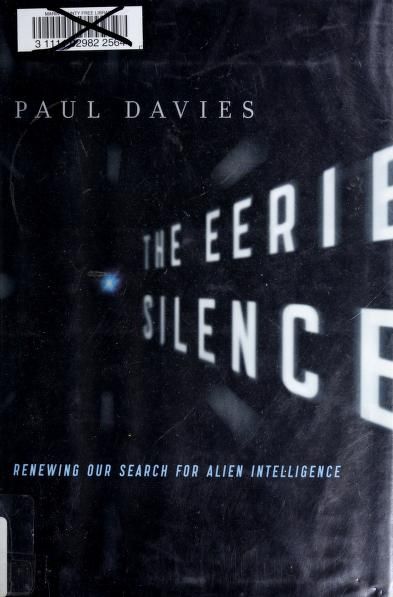
The Fermi Paradox is a Trap: Why You Need 'The Eerie Silence'.
Golden Hook & Introduction
SECTION
Nova: What if the reason we haven't found aliens isn't because they don't exist, but because our search itself is fundamentally flawed, trapped by our own human-centric assumptions?
Atlas: Whoa, that's a bold claim, Nova. Are you saying the entire scientific community has been looking for ET in all the wrong places? That's going to resonate with anyone who's ever felt like they're missing something obvious.
Nova: Absolutely, Atlas. Today, we're flipping the script on one of the greatest cosmic mysteries, the Fermi Paradox, inspired by two pivotal works: "The Eerie Silence" by theoretical physicist and astrobiologist Paul Davies, and "If the Universe Is Teeming with Aliens... WHERE IS EVERYBODY?" by physicist and author Stephen Webb.
Atlas: Two heavy hitters right there.
Nova: Exactly. Davies, a groundbreaking thinker on the origin of life and the nature of time, challenges us to reconsider how we're even looking for life, while Webb meticulously catalogs and critiques the myriad of proposed answers to the Fermi Paradox, revealing just how many biases we carry into the cosmic search. This isn't just about aliens; it's about our own blind spots.
Atlas: So, you're suggesting the "eerie silence" might not be a cosmic void, but rather a reflection of our own limited perception? That makes me wonder, how deep do these blind spots go?
Nova: They go right to the core of our assumptions, Atlas.
The Human-Centric Blind Spot: Why Our Search for ET Might Be Flawed
SECTION
Nova: Paul Davies, in "The Eerie Silence," really makes us confront this. He argues that our current search for extraterrestrial intelligence, or SETI, is fundamentally anthropocentric. We're looking for things that would do, or signals that would send.
Atlas: So, we're essentially looking for a cosmic version of ourselves? Like, if they don't use radio waves or build Dyson spheres, they don't count?
Nova: Precisely. Davies suggests alien communication might be incredibly subtle, non-technological, or even biological, completely unlike what we're looking for. Imagine trying to find a specific radio signal, perfectly tuned to what you understand, while the aliens are communicating via quantum entanglement, or manipulating cosmic background radiation, or even altering the very fabric of spacetime in ways we can't yet conceive.
Atlas: That's a bit out there, but I get the point. If we're only looking for a cosmic mirror of ourselves, we're going to miss a lot. But isn't it logical to look for signals we understand? How else would we find them?
Nova: That's the trap. It’s logical. Davies posits that our 'technology equals intelligence' assumption is a major limiting factor. What if intelligence doesn't manifest in big, energy-hungry technological signatures? What if it's something microscopic, or distributed, or even something that doesn't "communicate" in a way we recognize as communication? Davies, with his deep understanding of astrobiology and the potential for life's diverse forms, pushes us to consider life that might not even be carbon-based, let alone signal-based.
Atlas: That's incredible. So it’s not just about looking for different of radio signals, but entirely different of existence or interaction. For our listeners who are constantly seeking new ways to innovate and solve complex problems, this idea of fundamentally rethinking our search parameters has huge implications. It's like trying to find a fish by looking for a bird. How does this kind of human-centric bias play out in other areas of our cosmic perspective?
Nova: It means we're constantly limiting our cosmic imagination. We assume intelligence means a drive for expansion, or resource consumption, or even just curiosity in the same way we define it. Davies' work essentially tells us: "You think you know what intelligence looks like, but you really don't." His insights challenge us to expand our definition of 'life' and 'mind' far beyond our biological and technological comfort zones.
Beyond the Empty Sky: Re-evaluating the Fermi Paradox's 'Solutions'
SECTION
Nova: And this idea of our blind spots becomes even more stark when we look at how we've tried to 'solve' the Fermi Paradox, which is exactly what Stephen Webb meticulously deconstructs in his book.
Atlas: Okay, so if Davies is telling us we're looking in the wrong direction, Webb is telling us that our explanations for we haven't found anything are also flawed?
Nova: Exactly. Webb's "If the Universe Is Teeming with Aliens... WHERE IS EVERYBODY?" systematically examines over 75 proposed solutions to the paradox. And what he reveals is that many of these 'solutions' are built on incredibly shaky, often unexamined, assumptions about alien life, intelligence, and even their motivations.
Atlas: So, are we trying to fit square pegs into round holes with these explanations? Give me an example.
Nova: Well, take the classic "they're too far away" solution. Webb points out that with billions of galaxies and an immense timeline, even if interstellar travel is slow, statistically, someone should have reached us by now if they're out there and they to expand. The underlying assumption is that all advanced civilizations would to expand in a physical way, like us.
Atlas: But wait, what if they've evolved beyond physical expansion? What if they've gone digital, or philosophical, or simply found contentment without needing to colonize every planet? That makes me wonder what ethical implications arise if we assume aliens behave like us, or that their purpose would mirror ours.
Nova: Precisely. Or consider the "zoo hypothesis"—that they're intentionally hiding from us, observing us like animals in a cosmic zoo. Webb dissects this, asking: how could such a vast, diverse civilization maintain perfect secrecy across billions of years and unimaginable distances? And again, it assumes their ethical frameworks, their curiosity, their internal politics, would allow for such a unified, long-term deception, mirroring human concepts of observation and non-interference.
Atlas: That’s a great way to put it. It seems like many of these solutions are less about what aliens doing, and more about what them to be doing, or what do. It's almost like we're projecting our own fears and desires onto the cosmic canvas.
Nova: You've hit on it. Webb’s comprehensive approach forces us to confront our own intellectual comfort zones. He makes us realize that most of our "solutions" are really just reflections of our own limited definitions of life, intelligence, and motivation. He shows us that the absence of evidence is not always evidence of absence; our search methods and assumptions may be the true limitation.
Atlas: So, the "eerie silence" isn't necessarily a statement about the universe's emptiness, but rather a profound mirror reflecting our own intellectual biases back at us. It’s less about a cosmic mystery and more about a human mystery.
Synthesis & Takeaways
SECTION
Nova: Exactly, Atlas. The Fermi Paradox, when viewed through the lenses of Davies and Webb, becomes less about the presence or absence of others, and more about the presence or absence of. It’s a trap that makes us believe intelligent life is either extremely rare or intentionally hiding, when in reality, our narrow view limits our imagination about the universe and our place within it. We need to expand our thinking beyond simplistic answers.
Atlas: That gives me chills. This isn't just an academic debate about alien life; it's a profound challenge to our cosmic perspective, urging us to question everything we assume about intelligence and purpose. For visionary storytellers and ethical explorers, this is a call to imagine radically different futures for humanity, and to consider what it truly means to be intelligent, both on Earth and beyond.
Nova: It truly is. The "eerie silence" might be less about the universe being empty, and more about us being deaf to frequencies we haven't even conceived of yet. It’s a powerful reminder that the biggest discoveries often come from questioning our most deeply held assumptions.
Atlas: So, the deep question for our listeners, the cosmic philosophers and ethical explorers out there, is this: What unexamined assumptions are making about the nature of intelligence, both on Earth and beyond, that might be limiting your cosmic perspective and your vision for humanity's future?
Nova: Something to ponder as you look up at the stars tonight.
Atlas: This is Aibrary. Congratulations on your growth!