Beyond the Degree: Crafting Your Own Success Pathway
Golden Hook & Introduction
SECTION
Nova: For decades, we’ve been told a college degree is the golden ticket to success, the guaranteed path to a stable, prosperous future. But what if that ticket is actually leading you down a path of missed opportunities, subtly obscuring the real keys to wealth and independence?
Atlas: Whoa, Nova, that’s a bold claim right out of the gate! Are you saying my years of studying and those student loan payments might have been… a distraction? Because I imagine a lot of our listeners, especially those driven by mastery and impact, have poured their lives into their education.
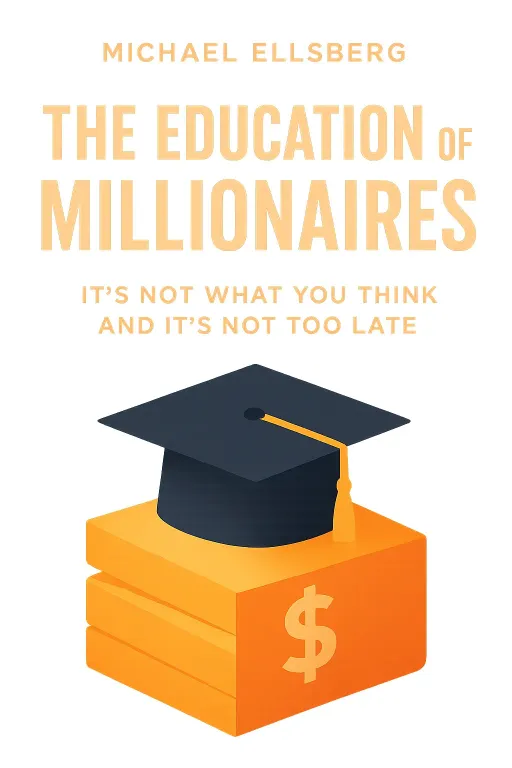
Nova: Absolutely, Atlas. And it’s not to diminish the value of learning, but to challenge the that a degree automatically guarantees the of success most people envision. Today, we’re diving into a fascinating exploration of this very idea, drawing insights from two pivotal books: Michael Ellsberg’s "The Education of Millionaires" and Robert T. Kiyosaki’s "Why "A" Students Work for "C" Students."
Atlas: Ah, Ellsberg, the entrepreneur who saw firsthand how academic achievement didn't always translate to real-world wealth. And Kiyosaki, of course, a name synonymous with challenging conventional financial wisdom, whose work has been both celebrated and, let’s be honest, quite polarizing for its radical stance on education.
Nova: Precisely. Ellsberg, with his background in tech and entrepreneurship, wrote "The Education of Millionaires" after observing a stark disconnect: many highly educated individuals struggled financially, while others, often without traditional credentials, built immense wealth. His book became a highly influential work, sparking significant debate about what truly constitutes valuable skills. And Kiyosaki, building on his "Rich Dad Poor Dad" legacy, dives even deeper into the systemic issues, arguing that our schools are fundamentally structured to produce employees, not financially independent entrepreneurs.
Atlas: That makes me wonder, if the traditional path isn't the only way, what the alternative? What are these elusive "real keys" you mentioned?
The "Degree Delusion" & Unconventional Skills for Wealth
SECTION
Nova: Well, that leads us directly into our first core idea, which is Ellsberg’s powerful argument against what we might call the "degree delusion." He contends that while degrees provide valuable knowledge, they often fail to cultivate the that are truly vital for wealth creation and professional independence. Think about it: when was the last time your university offered a course on "Advanced Sales Techniques" or "Mastering Negotiation in Real-World Scenarios"?
Atlas: Honestly, not in my curriculum. My degree was all about theoretical frameworks and analytical rigor. I can see how that would be a gap. What specific skills are we talking about here? Because for someone who's a focused learner, understanding the is key.
Nova: He highlights what he calls "the seven essential skills": sales, negotiation, entrepreneurship, marketing, financial literacy, communication, and self-promotion. Consider a brilliant engineer, fresh out of a top university, who designs an incredible piece of software. Without sales skills, that software might never reach its users. Without negotiation skills, they might be drastically underpaid for their innovation. Without an entrepreneurial mindset, they might remain an employee rather than building their own empire.
Atlas: That’s a great way to put it. It’s like having a supercar but no driving lessons. You have the horsepower, but you can’t navigate the road. So you’re saying these are learned through practice, not lectures?
Nova: Exactly. Ellsberg's core message is that these skills are acquired not in lecture halls, but in the trenches of real-world experience. He gives examples of individuals who, despite lacking traditional academic backgrounds, excelled by relentlessly honing these practical abilities. Take the story of a young man who started a small online business. He didn't have an MBA, but he learned to write compelling sales copy through trial and error, negotiated favorable terms with suppliers, and networked tirelessly to promote his product. His business thrived, not because of a diploma, but because he mastered these "unconventional" skills.
Atlas: I can definitely relate to the idea of learning by doing. For our listeners who are ambitious builders, constantly looking to expand their capabilities, this flips the script on how they might view their own skill development. But wait, isn’t there still a certain level of credibility that comes with a degree, especially in high-stakes fields like tech?
Nova: There absolutely can be, Atlas. A degree can open doors and signal a baseline level of competence. The point is not to dismiss formal education entirely, but to recognize its limitations and proactively supplement it. The engineer with the top degree exceptional sales and negotiation skills is a formidable force. The problem arises when we fall into the trap of believing the degree is sufficient, or that these essential life skills will somehow magically materialize after graduation.
Atlas: So, the challenge is to bridge that gap. To understand that academic excellence is one pillar, but real-world acumen is another, equally crucial one.
Nova: Precisely. And this leads us to our second core idea, which further explains this gap exists in the first place, and what the consequences are.
Beyond Academic Knowledge: Financial Literacy & Entrepreneurial Mindset
SECTION
Nova: And that naturally leads us to Kiyosaki’s powerful critique in "Why "A" Students Work for "C" Students." He argues that the traditional school system, by its very design, often prioritizes academic knowledge and the pursuit of good grades over practical financial literacy and entrepreneurial thinking. It trains us to be excellent employees, not necessarily independent wealth creators.
Atlas: That sounds rough, but I can see how that would be true. We're taught to follow instructions, pass tests, and secure a stable job. Not necessarily how to invest, manage debt, or identify market opportunities.
Nova: Exactly. Kiyosaki draws a stark contrast between what he calls "academic intelligence" and "financial intelligence." You can have a PhD in theoretical physics, but if you don't understand how money works, how to make it work for you, or how to identify and mitigate financial risks, you might still struggle. He often uses the metaphor of "running in the rat race," where even high-earning professionals can find themselves trapped by consumer debt and a lack of assets.
Atlas: He’s really saying that the system conditions us to be good cogs in a larger machine, rather than teaching us how to build our own machines. That makes me wonder, what does he mean by "C students" then? Is it about intelligence or something else?
Nova: It’s not about intelligence at all, but about mindset and priorities. Kiyosaki argues that many "C students" – those who might not have excelled in traditional academics – often developed strong entrepreneurial instincts, risk tolerance, and a practical understanding of money because they to. They learned by doing, by taking initiative, by failing and adapting. They weren't waiting for a syllabus; they were creating their own curriculum in the real world.
Atlas: That’s a bit like the story of someone working a part-time job through college, learning sales and customer service on the fly, while their straight-A classmate is solely focused on their textbooks. Both are learning, but fundamentally different skill sets. So what does this mean for our listeners who are excelling in their studies, but also want to build that financial independence and secure their future freedom, as our strategic navigators often do?
Nova: It means adopting a dual approach. It’s about recognizing that your formal education is one tool, but you need to actively seek out and cultivate other tools. It’s understanding the difference between an asset and a liability, not just in accounting terms, but in how you spend your time and energy. It's developing a mindset of ownership and problem-solving, rather than just task completion. Kiyosaki emphasizes that financial literacy isn't about being rich; it's about being free. It's about understanding the rules of money so you can play the game effectively, rather than being a pawn.
Atlas: That gives me chills. The idea of learning the rules of the game, rather than just playing by someone else’s rules, is incredibly empowering. It really resonates with the desire for independence and impact.
Nova: And that’s the profound insight here. It’s about being proactive in your own education, realizing that the most valuable lessons might not be found in a classroom, but in the messy, unpredictable, and often lucrative, landscape of the real world.
Synthesis & Takeaways
SECTION
Nova: So, bringing Ellsberg and Kiyosaki together, the common thread is clear: true professional and financial independence isn't solely a byproduct of academic achievement. It's forged through the deliberate cultivation of skills and mindsets that traditional education often overlooks. It's about being an active architect of your own learning, not just a passive recipient of knowledge.
Atlas: That’s a powerful synthesis. It challenges us to look beyond the diploma and ask: how can you proactively acquire these 'unconventional' skills that lead to true professional and financial independence, even while excelling in your studies? Because for the focused learner, it’s not about choosing one path over the other, but integrating both.
Nova: Precisely. And the tiny step we can all take, right now, is incredibly simple but profoundly impactful. Identify one non-academic skill – maybe it’s networking, maybe it’s learning the basics of coding, or perhaps it’s honing your negotiation tactics – and dedicate just 60 minutes to learning it daily, outside of your formal curriculum.
Atlas: Sixty minutes a day. That’s an hour that could easily be spent scrolling or multitasking. But protecting that time, as our growth recommendations often suggest, for focused learning, could fundamentally alter your trajectory towards mastering tech skills, achieving financial independence, or unlocking leadership potential.
Nova: It’s about embracing the journey, Atlas. Every small step builds momentum. It’s not about abandoning your studies, but about enriching your personal curriculum with the skills that truly matter in the arena of life. The world rewards those who can create, connect, and negotiate, often far more than those who can simply recall facts.
Atlas: That’s such a hopeful way to look at it. It’s a call to action for anyone who feels that itch for more agency, more impact, and more freedom. It’s about building your own pathway, brick by brick.
Nova: Absolutely. And that, my friends, is a journey worth embarking on.
Atlas: This is Aibrary. Congratulations on your growth!