The Future of Intelligence and Wealth
Golden Hook & Introduction
SECTION
Nova: The average person today is working with a mental map of the future that is roughly fifteen years out of date. We are operating as if the world moves in straight lines, but the reality is that we are currently navigating a curve that is bending upward at a rate our brains were never wired to comprehend.
Atlas: That sounds like a polite way of saying we are all driving toward a cliff while looking in the rearview mirror. I have to be honest, when I hear about exponential technology, my first instinct isn't excitement. It’s a deep, sinking feeling that my current skill set is about to become a historical artifact.
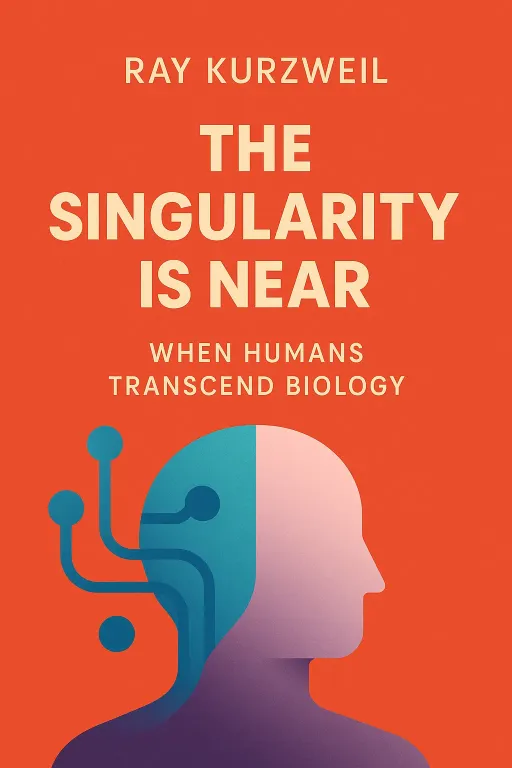
Nova: That reaction is completely natural. It is the friction between our biological evolution and our technological acceleration. Today, we are going to bridge that gap. We are diving into two seminal works that define this new reality. First, we have Ray Kurzweil’s The Singularity Is Near, which laid the groundwork for understanding the law of accelerating returns. Then, we are going to pair that with Calum Chace’s The Economic Singularity, which takes those technological predictions and forces us to look at the cold, hard math of the job market.
Atlas: Right. Kurzweil gives us the "what is coming," and Chace gives us the "how do I pay my mortgage when it arrives." That is a combination I can get behind. I am curious, though—Kurzweil has been talking about these timelines for decades. Is he still relevant, or are we just reading a history book about the future?
Nova: That is the beauty of it. Kurzweil’s track record is startlingly accurate. He isn't just throwing darts at a board. His background as a prolific inventor and his role at the forefront of AI research gives his predictions a foundation in hard engineering. He understood early on that technological progress doesn't add up; it multiplies. And Calum Chace, writing with a more modern, economic lens, provides the necessary cautionary tale. His work is widely regarded as one of the most sobering, yet essential, analyses of what happens to the human labor market when machines stop being just tools and start being replacements.
Atlas: Okay, so we have the visionary and the economist. Let’s get into the mechanics of this because I think most people—myself included—struggle to actually feel the speed of this change until it hits us.
The Law of Accelerating Returns
SECTION
Nova: To understand why this is happening, we have to talk about the Law of Accelerating Returns. Most people view progress as linear. You take one step, then another, then another. If you take thirty linear steps, you end up thirty meters away. But technological progress is exponential. One step becomes two, two becomes four, four becomes eight, and so on.
Atlas: That is the old "lily pad in a pond" math problem, right? The one where the lily pad doubles every day, and on the last day, it covers the whole pond.
Nova: Exactly. And the most dangerous part of that analogy is that on the second-to-last day, the pond is only half covered. It looks like there is plenty of room left. You feel safe. You think you have time. Then, overnight, everything changes.
Atlas: That is exactly the feeling I get when I look at the current state of AI. One month, it is struggling to write a coherent email; the next month, it is passing professional exams. The psychological hurdle here is that we keep waiting for a plateau that never comes. We keep expecting technology to slow down so we can catch our breath, but the Law of Accelerating Returns says that’s not how the game is played.
Nova: Precisely. Kurzweil points out that as technology improves, it gains the ability to improve itself. This creates a feedback loop. We are not just building better tools; we are building tools that build better tools. And that cycle time is shrinking. This means your career is no longer a ladder. It is a series of distinct, often disconnected, chapters.
Atlas: So, the idea of a thirty-year career in one field is essentially dead. But let’s play devil's advocate here. People have been saying that since the Industrial Revolution. We moved from farms to factories, and from factories to offices. Why is this time different? Why should we think that this specific wave of technology is going to break the structure of our entire economy?
Nova: That is a fair question, and it brings us to the core of why this moment is unique. In previous revolutions, technology replaced human muscle. We had machines that could lift heavier loads or weave faster than a hand loom. But those machines still needed humans to operate them, maintain them, and direct them. We were the cognitive layer on top of the physical labor.
Atlas: Right, we were the supervisors. We provided the judgment.
Nova: Exactly. But now, we are witnessing the automation of the cognitive layer itself. AI is not just lifting the heavy boxes; it is making the decisions about which boxes to lift, how to pack them, and how to optimize the delivery route. When you automate the decision-making process, you are not just replacing a worker; you are replacing the need for the role entirely.
Atlas: That makes the hair on the back of my neck stand up. Because if you are in a knowledge-based role—whether you are a programmer, a copywriter, or a middle manager—you are essentially in the business of making decisions. If the machine can make those decisions faster and cheaper, the economic value of your specific role starts to erode.
Nova: It does. And this is where Chace’s The Economic Singularity enters the conversation. He argues that we are heading toward a point where the traditional link between labor and income might be permanently severed. He doesn't say this to induce panic, but to force us to look at the structural changes in the job market.
Atlas: Okay, let's unpack that. If the link between labor and income is severed, what does that actually mean for the average person? Are we talking about a world where nobody works, or a world where we all work for pennies?
Nova: It means we have to rethink the concept of wealth. If your primary asset is your ability to trade your time and cognitive effort for money, you are vulnerable. Because time is finite, and your cognitive effort is increasingly being commoditized by software.
Structural Market Changes and Financial Planning
SECTION
Atlas: This is the part that keeps me up at night. If I am listening to this, and I am in a professional field that feels secure, how do I actually interpret this? Am I supposed to just start investing everything I have and hope for the best? Or is there a way to pivot my actual career?
Nova: It is about changing your relationship with your labor. Chace emphasizes that we need to stop viewing our careers as the primary source of our long-term security. That is a massive shift. It means we have to become proactive about asset diversification in a way that goes beyond just buying stocks. You have to diversify your skills, your income streams, and your exposure to these technological shifts.
Atlas: So, how do we actually do that? If I am a mid-career professional, I can't just quit my job and become an AI researcher overnight. That is not practical. What is the bridge between where I am now and where I need to be?
Nova: You start by mapping your own obsolescence. It sounds harsh, but it is the most strategic thing you can do. You look at your current responsibilities—the things you do every day that make you valuable—and you ask which of those tasks are currently being performed by AI or automation, or will be in the next three to five years.
Atlas: That is a brutal exercise. I am thinking about my own workflow. I spend a lot of time synthesizing information from different reports to create a summary for my team. If I am being honest, an AI can do that in seconds. So, if I stop doing that, what does that leave me with?
Nova: It leaves you with the "human-in-the-loop" value. It leaves you with the ability to interpret that summary, to understand the cultural and human nuances of your team, and to make the final judgment call on how to act. The machine provides the data; you provide the strategy. You move from being the person who does the work to the person who directs the machine doing the work.
Atlas: That makes sense. It is moving up the value chain. But what about the financial side? If I know my role is going to be impacted, how does that change my financial planning?
Nova: Chace is very clear on this: you need to prioritize financial independence as an insurance policy. In a world where career paths are volatile, having a capital base—investments, assets, passive income—is the only way to have true autonomy. You cannot rely on your employer to provide long-term stability in an exponential economy. Your financial safety net has to be external to your employer.
Atlas: That is a tough pill to swallow. It essentially means we are all entrepreneurs now, even if we are employees. We have to manage our own "company of one."
Nova: Exactly. And that is why the mindset shift is so important. You are the architect of your own legacy. You have to treat your life like a portfolio that needs to be optimized for resilience, not just for a steady paycheck.
Atlas: I like the phrase "optimized for resilience." It feels more proactive than just "prepare for disaster." But tell me, is there a risk of over-optimizing? Is there a risk that we become so obsessed with productivity and future-proofing that we lose the human element of what we are doing?
Nova: That is the danger. If you focus only on efficiency, you become a robot, and robots are the first things to get replaced. The irony is that the more you try to mimic the machine, the more vulnerable you become. The more you lean into your human capacity—your creativity, your empathy, your ability to handle ambiguity—the more valuable you become.
Atlas: That is a fascinating paradox. To survive the machine age, we have to become more human.
Synthesis & Takeaways
SECTION
Nova: It is the ultimate irony, isn't it? As the machines get better at being machines, we have to get better at being human. We have to leverage the technology to handle the repetitive, the analytical, and the data-heavy, so that we can spend our energy on the creative, the relational, and the strategic.
Atlas: I think that is a really hopeful way to frame it. It is not about fighting the tide; it is about learning how to surf. But let’s bring this down to earth for our listeners. We have talked about the Law of Accelerating Returns, we have talked about the structural shifts in the economy, and we have talked about the need for financial and professional resilience. If someone is listening to this and feeling a bit overwhelmed, what is the one thing they should do this week?
Nova: Start with that 15-minute mapping exercise. It is simple, it is focused, and it is immediate. Take 15 minutes this week to look at your professional field. Don’t look at the whole world; look at your specific desk. Ask yourself: what is one emerging technology in my field that is currently automating or enhancing the core tasks of my role? And then, map out how that technology is likely to evolve over the next five years.
Atlas: I love that because it takes the abstract, terrifying concept of "The Singularity" and turns it into a concrete, manageable task. It is not about predicting the future; it is about preparing for the next iteration of your current reality.
Nova: Exactly. And once you have that map, you can start identifying where your unique value lies. You can start asking, "If this part of my job is automated, what new skills do I need to develop to stay ahead of the curve?" It is about active navigation rather than passive reaction.
Atlas: It’s the difference between being a passenger on the train and being the conductor. And honestly, I would much rather be the conductor.
Nova: That is the goal. We are all living through a period of unprecedented change. But change doesn't have to be something that happens to us. It can be something we harness. By understanding the forces at play—the exponential growth, the economic shifts—we can make better decisions for our careers, our wealth, and our lives.
Atlas: That is a great note to end on. I think we have covered a lot of ground today, from the high-level math of Kurzweil to the practical, sometimes uncomfortable, economic reality described by Chace. It has been a lot to process, but it feels like the kind of processing we all need to be doing.
Nova: It is the most important processing we can do. The future is coming, whether we are ready for it or not. The best way to face it is with clear eyes and a strategic plan.
Atlas: I couldn't agree more. And for everyone listening, I hope this sparked some reflection on how you are positioning yourself for the next chapter. Don't wait for the future to happen to you. Go out and start mapping it.
Nova: Thank you for joining us on this deep dive. Remember, the goal isn't just to survive the change, but to find the opportunities hidden within it. This is Aibrary. Congratulations on your growth!