Surviving the Technological Singularity
Golden Hook & Introduction
SECTION
Atlas: The average shelf life of a professional skill is now less than five years. That means by the time you master a new technology, the market has already moved on to the next iteration. It is a treadmill that is constantly accelerating.
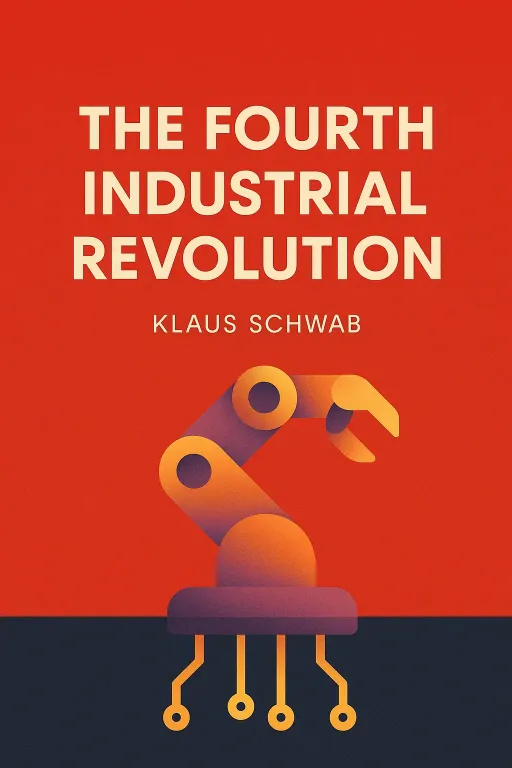
Nova: That is the reality of our current era. We are living through what Klaus Schwab, the founder of the World Economic Forum, famously called the Fourth Industrial Revolution. It is not just a technological upgrade; it is a fundamental shift in how we live, work, and relate to one another.
Atlas: I have been looking at the work of Calum Chace, specifically his book The Economic Singularity. He takes the ideas Schwab lays out and pushes them into the economic reality we are facing. He argues that we are approaching a point where artificial intelligence will automate not just manual labor, but cognitive labor.
Nova: That distinction is crucial. When we talk about the Fourth Industrial Revolution, we are discussing the convergence of physical, digital, and biological technologies. When we layer Chace’s insights about the Economic Singularity on top of that, we see a world where the very definition of a valuable employee is being rewritten in real-time.
Atlas: And that is exactly what I want to dig into today. For the builders, the strategists, and the visionaries listening to this, the question isn't how to keep up with the machines. It is how to build a career or a team that remains relevant when the machines are doing the heavy lifting.
The Convergence of Systems
SECTION
Nova: To understand why this feels so different from previous industrial shifts, we have to look at the concept of convergence. Schwab’s analysis is powerful because he identifies that we are no longer dealing with isolated silos. In the past, you had digital technology, then you had biological research, and then you had physical infrastructure. They were separate lanes.
Atlas: That makes sense. I remember when the internet was just a tool you used on a desktop computer. It was a destination you traveled to.
Nova: Exactly. Now, the internet is an environment you live in. The digital world is embedded in our physical infrastructure, and it is increasingly interacting with our biological selves through wearables, gene editing, and neural interfaces. This is what Schwab means by a systemic shift. It is not just that we have better computers; it is that the boundaries between these three domains have dissolved.
Atlas: That sounds like a massive architectural challenge. If you are a strategist, you are not just managing a product roadmap anymore. You are managing an ecosystem where the biological, the digital, and the physical are constantly bleeding into each other.
Nova: That is the core of the challenge. Think about a smart city project. It is digital sensors managing physical traffic flow, which impacts the biological health of the citizens by reducing pollution. A decision in one domain triggers an effect in all the others. This is why the old governance models—the old way of managing teams and projects—are failing. They were designed for linear, siloed problems. We are now facing non-linear, systemic problems.
Atlas: I can see how that would be overwhelming. It feels like trying to steer a ship while the ocean itself is changing its chemical composition. If I am a team leader, how do I even begin to map this out?
Nova: You start by shifting your perspective from resource management to system design. You stop asking how to optimize the current workflow. Instead, you ask what the system is trying to accomplish at a fundamental level. You look for the points where the digital, physical, and biological converge and you identify the value that humans can provide at those specific intersections.
The Automation of Cognitive Labor
SECTION
Atlas: That brings me to the point Calum Chace makes in The Economic Singularity. If we are building these complex systems, we assume we need a massive team of experts to handle the cognitive load. But Chace suggests that we are approaching a threshold where the machines will handle the cognitive load better, faster, and more cheaply than any human team.
Nova: This is the part that makes people uncomfortable. We have spent centuries valuing human intelligence as the ultimate asset. Chace argues that we are moving toward a world where cognitive labor—the kind of work that happens behind a desk, the analysis, the coding, the strategic planning—is becoming a commodity.
Atlas: I have been thinking about this in the context of my own work. If I am a strategist, I spend hours analyzing data, looking for patterns, and building business cases. If an AI can do that analysis in milliseconds, what am I actually doing?
Nova: You are doing something that the AI cannot do. You are defining the strategic intent. The AI can process the data, it can identify the patterns, and it can even suggest the most probable outcomes. But the AI cannot choose the direction based on a set of values or a vision for the future. It lacks agency.
Atlas: That is a comforting thought, but I wonder if it is enough. If I spend 90 percent of my time on the processing—the data gathering, the formatting, the initial drafting—and the AI takes that over, I am left with that final 10 percent of decision-making. Does that mean the team of the future is much smaller?
Nova: It means the team of the future is much more focused. In the past, we measured value by output. How many reports did you write? How many lines of code did you ship? How many meetings did you attend? In the world Chace describes, value is not measured by output. It is measured by the quality of the questions you ask and the clarity of the strategic architecture you design.
Atlas: So, the role shifts from being a creator of the work to being the architect of the process.
Nova: Precisely. Think of it like the difference between a master builder who lays every brick and an architect who designs the structure and oversees the construction. The master builder is essential, but the architect determines the purpose and the integrity of the building. The machines are the master builders now. They are incredibly good at laying bricks. You need to be the architect.
The Human-Centric Strategic Pivot
SECTION
Atlas: That implies we need to change how we hire and how we train our teams. If I am building a team, I should not be looking for people who are just good at the mechanics of the job. I should be looking for people who can handle that architectural, strategic layer.
Nova: That is the most important insight. We have been optimizing our teams for technical proficiency. We want the best coder, the best analyst, the best marketer. But if technical proficiency is being automated, that is no longer your primary competitive advantage. Your competitive advantage is your team’s ability to synthesize information across domains and make high-stakes, human-centric decisions.
Atlas: I can see that playing out in a team meeting. Instead of everyone coming to the table with a spreadsheet they spent all week building, they come to the table with a synthesis of insights they’ve gathered from the automated systems. They spend the meeting debating the implications, not the data.
Nova: And that changes the energy of the room. It becomes a place of debate, of vision, of moral and ethical deliberation. That is human-centric value. The machine can tell you how to maximize profit for the next quarter. It cannot tell you if that profit maximization aligns with the long-term mission of the company or the well-being of the community you serve.
Atlas: I am curious about the practical application of this. For the listeners who are currently in the middle of this transition, how do they protect their time and their team’s energy to focus on this high-level work?
Nova: You have to schedule deep work. This is not just a productivity hack; it is a survival strategy. You must carve out time where you are not reactive. You are not responding to the emails, the messages, or the alerts that the automated systems are constantly generating. You are using that time to think about the architecture of your strategy.
Atlas: That sounds like it requires a massive amount of discipline. I see so many teams drowning in the "urgent" because they have lost sight of the "important."
Nova: That is the trap. The Fourth Industrial Revolution is designed to keep you in a state of constant reaction. It is designed to feed you information faster than you can process it. If you want to provide human-centric value, you must deliberately step out of that loop. You have to be the one who says, "I am going to ignore the noise for two hours so I can focus on the signal."
Atlas: What does that look like for a team leader? How do you create that culture?
Nova: You start by changing your meeting structures. Stop asking for updates on tasks; the dashboard already provides that. Start asking for insights on the strategy. Ask your team, "Given the data we have, what is the most important question we should be asking right now?" You shift the focus from "what are we doing" to "why are we doing it."
Synthesis & Takeaways
SECTION
Atlas: It sounds like we are talking about a transition from being operators to being curators of meaning.
Nova: That is a beautiful way to put it. We are moving from an era where human value was defined by our utility—by what we could produce—to an era where human value is defined by our agency—by what we choose to pursue.
Atlas: So, if I am a strategist or a builder, my goal is to build a team that isn't just efficient, but is deeply connected to the "why" of our mission. Because the "how" is increasingly going to be handled by the algorithms.
Nova: Exactly. And the most interesting part is that this makes your work more human, not less. It forces you to confront the values that drive your decisions. It forces you to be more deliberate about the impact you want to have on the world.
Atlas: That is a compelling vision. It makes the threat of automation feel less like a cliff we are falling off and more like a bridge we are crossing.
Nova: It is a bridge, but it requires you to change the way you walk. You cannot carry the same baggage of old habits and old ways of thinking across that bridge. You have to travel lighter, but with more focus.
Atlas: This has been a fascinating look at the intersection of these two books. Schwab gives us the landscape of the revolution, and Chace gives us the economic reality of the transition.
Nova: And the takeaway for our listeners is clear. In a world where technical skills are becoming commodities, your strategic architecture—your ability to define, to curate, and to lead with intention—is the only sustainable competitive advantage.
Atlas: If you are listening to this, I want you to take one action today. Look at your calendar for the next week. Find two blocks of time, thirty minutes each, and protect them fiercely. Use that time not to work on a task, but to think about the direction of your team. Ask yourself: if the machine could do all the work we are doing right now, what would we actually be doing instead?
Nova: That is a question that will change your career. Thank you for joining us in this exploration of the future. We hope this has given you the clarity to build something meaningful in a rapidly changing world.
Atlas: This is Aibrary. Congratulations on your growth!