Navigating the Economic Singularity
Golden Hook & Introduction
SECTION
Nova: Here is a five-second challenge for you. Look at the device you are using to listen to this podcast right now. Now, think about the last time you had to manually calculate a route to a destination, remember a phone number, or physically walk into a library to answer a question.
Atlas: That is actually a terrifying thought. I haven't memorized a phone number in a decade. Everything is just offloaded to the cloud.
Nova: Exactly. And that shift is not just about convenience. It is the quiet, invisible evidence that we are already living through a fundamental transformation of human existence. We are not just using tools anymore; we are merging with them.
Atlas: I can see that. It feels like the ground is shifting beneath our feet, but we are so busy walking that we barely notice the quake.
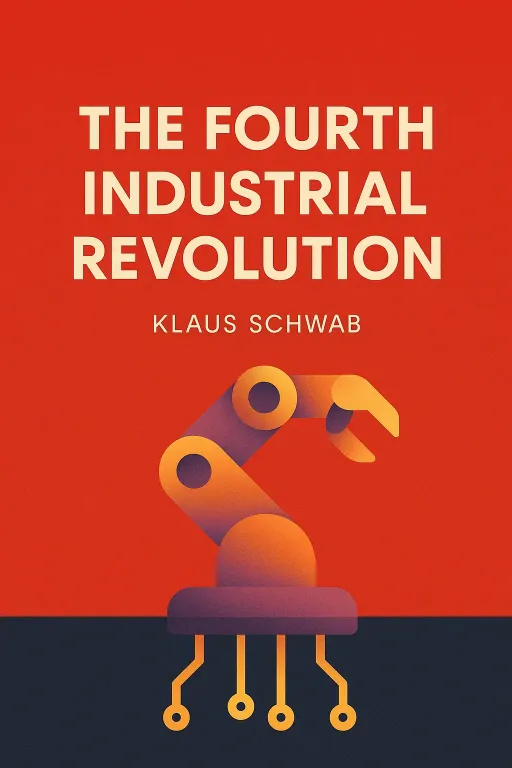
Nova: That is the perfect way to put it. Today, we are going to look at that ground shift directly. We are diving into two essential texts that act as blueprints for this new reality. First, we have The Fourth Industrial Revolution by Klaus Schwab, the founder of the World Economic Forum. He provides the macro view of how our physical, digital, and biological worlds are colliding.
Atlas: And to balance that out, we are pairing it with The Economic Singularity by Calum Chace. Chace takes that macro view and zooms in on the terrifying, yet fascinating, reality of artificial general intelligence and what that actually means for our careers and our bank accounts.
Nova: It is a powerhouse combination. Schwab gives us the landscape, and Chace gives us the survival guide. The goal for today is to move past the anxiety of "robots taking over" and instead talk about how you can become the architect of your own professional future in a world that is automating everything else.
The Great Convergence
SECTION
Atlas: I want to start with the landscape. When people hear "Fourth Industrial Revolution," they usually imagine factory robots or self-driving cars. But Schwab is talking about something much more systemic, right?
Nova: He is. Most of us think of industrial revolutions as mechanical upgrades. The first was steam, the second was electricity, the third was computing. But the Fourth is different. It is defined by the fusion of technologies. It is not just that we have better computers; it is that the computer is now inside the biology. We are seeing the blurring of lines between the physical, the digital, and the biological.
Atlas: That sounds like science fiction. Give me a concrete example of that blurring.
Nova: Think about wearable health tech. It is a digital device that lives on your biological skin, measuring your physical heart rate, and then it feeds that data into an algorithm—the digital layer—which then influences your physical behavior. You are no longer just a human; you are a data-generating node in a massive, interconnected system.
Atlas: That puts it in a different light. I used to think of my smartwatch as a gadget, but you are describing it as a piece of an infrastructure.
Nova: That is the key shift. Schwab argues that this revolution is happening at an exponential pace, not a linear one. In previous eras, you had time to adjust to a new technology. Now, the technology evolves faster than our social or regulatory systems can keep up. This creates a state of permanent turbulence.
Atlas: Turbulence is a great word for it. It explains why everyone feels constantly behind. If the pace of change is exponential, then our traditional ways of learning—like spending four years on a degree—might be fundamentally misaligned with the speed of the market.
Nova: You hit the nail on the head. The traditional model of "learn for twenty years, work for forty" is collapsing. The Fourth Industrial Revolution demands a model of "learn, unlearn, and relearn" on a cycle that never stops. This is why the aspiring architect—the person who wants to build a legacy—has to shift their focus from static knowledge to structural adaptability.
The Automation Paradox
SECTION
Atlas: Let’s pivot to the second piece of this, which is the economic side. Calum Chace’s work on the Economic Singularity feels like the logical follow-up to Schwab’s landscape. If everything is merging and accelerating, what happens to the human worker?
Nova: Chace makes a very bold argument. He posits that we are heading toward a point where artificial general intelligence—or AGI—will be able to perform almost any cognitive task that a human can do, and it will do it cheaper, faster, and more reliably.
Atlas: That is the part that keeps people up at night. The idea that my job, or my neighbor’s job, could be rendered obsolete by a server rack.
Nova: It is a valid concern, but Chace suggests we should reframe the fear. The goal is to identify which parts of our work are "routine" and which parts are "high-value." Routine is anything that follows a predictable pattern. If your work relies on repeatable processes, data processing, or standard decision-making, you are essentially competing against a machine that never sleeps and never makes a calculation error.
Atlas: I can see how that would be a losing battle. But what is left for us? If the machines take the routine, are we just left with nothing?
Nova: We are left with the architecture. This is where the "high-value human skill" comes in. The machine can execute the task, but it struggles to define the system. It can solve the puzzle, but it cannot decide which puzzle is worth solving. The future belongs to the humans who can understand the systemic connections.
Atlas: That feels like a massive shift in mindset. It is moving from being a "doer" to being an "orchestrator."
Nova: Exactly. Think about a construction site. You have the people laying bricks, and you have the architect who designed the building. The robot is going to be the master bricklayer. It will lay bricks faster and more accurately than any human ever could. But the robot does not understand the of the building, the aesthetic needs of the client, or the environmental context of the neighborhood. The architect does.
Atlas: So, the advice isn't to learn how to lay bricks faster. The advice is to learn how to design better buildings.
Nova: Precisely. And this applies to every industry. In marketing, the machine can generate the copy and the ad creative. The human architect decides the brand strategy and the emotional resonance of the campaign. In law, the machine can research case law. The human architect builds the legal strategy and navigates the nuance of negotiation.
The Toolkit for the Strategic Architect
SECTION
Atlas: I like this "Architect" metaphor. It feels empowering. But let’s get into the weeds of execution. If I am an aspiring architect of my own career, and I want to survive this shift, what does my daily toolkit look like?
Nova: You need to cultivate three specific capacities. The first is systemic understanding. This is the ability to see how your specific task connects to the larger business ecosystem. You have to ask yourself, "Why does this task exist, and what does it feed into?"
Atlas: That sounds like systems thinking. Most people just focus on their own silo.
Nova: That is exactly the trap. If you stay in your silo, you are replaceable. If you understand the pipes, the wiring, and the structural integrity of the entire building, you become an essential operator. You start to see opportunities for efficiency or innovation that no algorithm would spot because the algorithm is only looking at its own dataset.
Atlas: Okay, that’s the first capacity. What is the second?
Nova: Strategic adaptability. This is the ability to pivot your methodology without losing sight of your objective. Think of it like a GPS. The destination—your goal—stays the same, but the route changes constantly based on traffic. If you are too attached to the route, you get stuck. If you are attached to the destination, you find a way around the roadblock.
Atlas: That resonates with me. I see so many people get attached to the "how." They love their specific workflow. But if the tech changes, their workflow breaks, and they panic.
Nova: They do. They view the workflow as the identity. But your identity should be the you produce. The workflow is just a tool. If a better tool comes along, you should be the first one to adopt it, not the one fighting to keep the old way alive.
Atlas: And the third capacity?
Nova: Creative problem-solving. This is the uniquely human ability to handle ambiguity. Machines thrive on data. They struggle when the data is missing, conflicting, or nonexistent. When you encounter a situation where the answer isn't in the manual, that is where your value is highest.
Atlas: I have had those moments. Where everyone is looking at the screen, waiting for the software to tell them the answer, and I just have to look at the situation and say, "Well, the data is useless here, so let's try this instead."
Nova: That is the moment of high-value contribution. That is you being the architect. When you embrace ambiguity, you are not just solving a problem; you are defining the new path forward.
Synthesis & Takeaways
SECTION
Atlas: It sounds like we are talking about moving from being a worker bee to being a gardener or an architect. It’s about cultivating the system rather than just performing the labor.
Nova: That is a beautiful way to put it. You are tending to the ecosystem. You are watching for the weeds, you are nourishing the soil, and you are deciding what gets planted. The machines are the irrigation system and the automated harvesters. They make the garden grow, but they don't decide what the garden.
Atlas: I think the biggest takeaway here for our listeners is to stop fearing the automation and start auditing their own work. If I look at my week, I should be able to color-code it. Everything that is routine, data-driven, or repetitive—that is the "robot" portion. Everything that requires strategy, empathy, systemic vision, or creative judgment—that is the "human architect" portion.
Nova: And then, your goal for the next quarter should be to shrink the robot portion and expand the architect portion. Not by working more hours, but by leveraging those very tools you fear. Use the AI to handle the data processing so you have more time to think about the strategy.
Atlas: It’s not about working harder. It’s about shifting the focus. If I spend less time on the labor, I have more time to design the future.
Nova: Exactly. It is about reclaiming your cognitive surplus. We are moving into an era where the most valuable resource is not labor, but insight. The insights that connect the dots between the digital, the physical, and the biological.
Atlas: This has been a massive reality check, but a hopeful one. It shifts the power dynamic back to the human.
Nova: That is the ultimate goal. The Fourth Industrial Revolution and the Economic Singularity are not forces that happen us; they are environments we live. Once you understand the rules of the environment, you stop being a victim of the landscape and start becoming the architect of your own legacy.
Atlas: I love that. For everyone listening, take that advice. Audit your week. Find the routine, automate it, and then double down on the creative, systemic, and strategic work that only you can do.
Nova: That is the blueprint for mastery. This is Aibrary. Congratulations on your growth!