Navigating the Automation Horizon
Golden Hook & Introduction
SECTION
Nova: The most dangerous thing a software team can do today is build a system that works perfectly for today. In a world of exponential automation, perfection is just another word for instant obsolescence.
Atlas: That sounds like a wake-up call for anyone trying to build anything that lasts. If we are optimizing for today, we are basically designing our own expiration date.
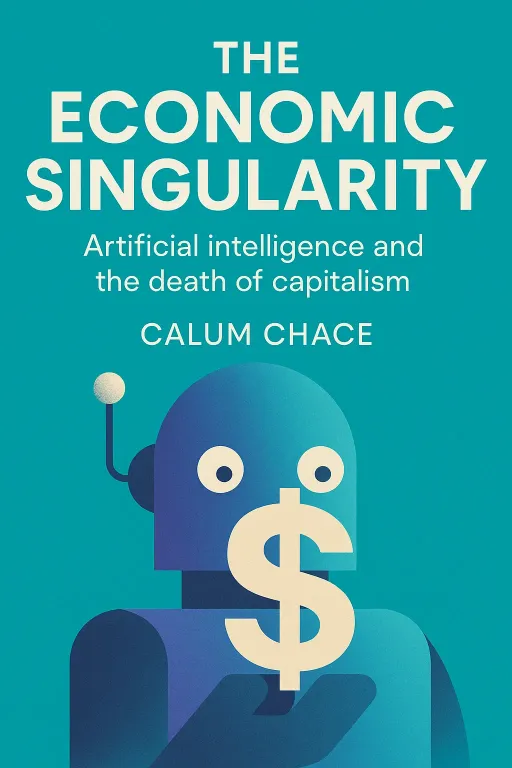
Nova: Exactly. Today we are diving into two massive frameworks that map out this exact challenge. We have Klaus Schwab's groundbreaking book, The Fourth Industrial Revolution, and Calum Chace's deeply provocative work, The Economic Singularity.
Atlas: Oh, those are heavy hitters. Klaus Schwab, of course, is the founder of the World Economic Forum, so he has spent decades watching global systems collide from a very unique vantage point. And Calum Chace brings this incredibly sharp, almost philosophical business strategy lens to the future of work.
Nova: Yes, and their insights together form a perfect guide for anyone trying to navigate where technology is heading. Schwab shows us how physical, digital, and biological systems are fusing together, which completely disrupts every existing industry. Meanwhile, Chace warns us about the rapid transformation of the labor market, pointing toward a future where cognitive labor itself is automated.
Atlas: That combination sounds incredibly intense, but also highly necessary to understand. If these massive structural shifts are coming, how do the builders, the strategists, and the leaders design systems right now that do not just crumble under the pressure of rapid AI integration?
Nova: The answer lies in shifting our entire approach to design. We have to move away from rigid, static systems and embrace highly modular software architectures that are built to adapt to constant change.
The Double Tsunami of Automation
SECTION
Nova: To understand why modularity is so critical, we first need to look at the sheer scale of the disruption Schwab and Chace describe. Schwab argues that the Fourth Industrial Revolution is fundamentally different from anything humanity has experienced before. The speed, scope, and systems impact are exponential rather than linear.
Atlas: I guess that makes sense, but we have had industrial revolutions before. We went from steam engines to electricity, then to early computers. Why is this fusion of physical, digital, and biological systems any different?
Nova: The key factor is the lack of boundaries. In previous revolutions, a new technology would emerge, like the steam engine, and industries would slowly adapt around it. Today, technologies are actively feeding into one another. Look at a modern smart prosthetic limb. It is a physical object, but it is powered by digital machine learning algorithms, and it directly interfaces with biological human nerves. The digital, physical, and biological are no longer separate categories. They are a single, continuous feedback loop.
Atlas: Wow, that is a wild way to look at it. It is like the technology is becoming a living, breathing ecosystem rather than just a set of tools we use.
Nova: That is the perfect way to describe it. And this ecosystem is evolving at a pace that traditional structures simply cannot handle. This is where Calum Chace's work on the economic singularity comes into play. Chace focuses heavily on the cognitive side of automation. He argues that we are rapidly approaching a point where artificial intelligence will be able to perform almost any cognitive task cheaper, faster, and better than a human.
Atlas: That sounds incredibly disruptive for the workforce. But historically, technology has always created more jobs than it destroyed. Are we sure this time is different?
Nova: Chace addresses that exact argument. He points out that during the Industrial Revolution, horses were replaced by tractors. The horses did not get new, higher-skilled jobs. They were simply phased out of the economy because their muscle power was no longer needed. In the economic singularity, the same thing could happen to human cognitive power. When the primary asset we offer is cognitive labor, and machines can do that cognitive labor better, the economic rules of the game change entirely.
Atlas: That is a chilling thought, but it also makes a lot of sense. If the brainpower itself is being automated, we cannot just tell everyone to go learn how to code, especially because the code itself might be written by AI.
Nova: Exactly. The shift is already happening. We are seeing AI systems write software, diagnose illnesses, and draft legal contracts. This is not a distant future scenario. It is a rapid, compounding reality. The traditional approach of building a software system to solve a specific, static problem is dead. If your system cannot easily absorb new AI capabilities next month, next week, or even tomorrow, it is already legacy code.
The Modular Shield
SECTION
Atlas: Okay, so if the ground is shifting beneath our feet at this kind of speed, how do we actually build anything stable? How do we design systems today that remain resilient against these massive structural shifts?
Nova: The breakthrough moment comes when we stop trying to build complete, monolithic solutions and start building highly modular architectures. Think of it like the transition from custom-built wooden ships to modern container shipping. In the old days, if you wanted to transport goods, you had to build a custom ship designed specifically for that cargo. If the cargo changed, you had to rebuild the ship.
Atlas: Right, whereas today, container ships do not care what is inside the boxes. They just carry standard containers. You can swap a container of electronics for a container of food in minutes, and the ship keeps moving.
Nova: That is precisely the mental model we need for software. A highly modular architecture treats different components of a system, including AI engines, as interchangeable containers. You decouple your core business logic from the specific technologies you use to execute it.
Atlas: Let me check if I got that right. If we build a system where the AI integration layer is completely separate from the database and the user interface, we can swap out the AI model whenever a better one comes along without breaking the rest of the application?
Nova: Yes, that is the goal. Let us look at a practical scenario. Imagine a logistics company that wants to use AI to optimize its delivery routes. If they build a monolithic system where the routing algorithm is tightly woven into their primary database and customer notification system, they are in trouble. When a new, vastly superior AI model is released, integrating it would require tearing apart the entire codebase. It would take months of work, cost a fortune, and introduce massive risks.
Atlas: Honestly, that sounds like a nightmare. By the time they finish the integration, that new AI model might already be obsolete.
Nova: Exactly. They are trapped in a cycle of constant, expensive rebuilding. Now, look at a company that designed a modular, API-first architecture from the start. Their core routing logic sits in its own module. The AI is treated as an external service accessed through a clean, well-defined interface. When a new AI model comes out, they simply update the connection point. The database and the user interface do not even realize a change occurred. They swap the container in a weekend.
Atlas: That is incredibly elegant. It turns a massive, high-risk engineering project into a simple plug-and-play upgrade. But I imagine building this way requires a lot of discipline up front. It is tempting to take shortcuts when you are trying to ship a product quickly.
Nova: The temptation is real, but the cost of technical debt has skyrocketed because of the speed of AI evolution. In the past, you might get away with a monolithic system for a few years before it became a problem. Today, that timeline has shrunk to months. Strategic thinking for innovation means recognizing that clean architecture is not a luxury. It is a survival mechanism.
Atlas: That makes complete sense. It is about optimizing for adaptability rather than just optimizing for the immediate feature list. But how do you get a team of developers, who are often under intense pressure to deliver immediate results, to prioritize this kind of modular design?
Nova: It starts with leadership. Leaders must establish clear architectural boundaries and treat modularity as a non-negotiable standard. This means investing in API-first development, robust microservices, and comprehensive testing frameworks that allow modules to be updated independently with total confidence. It also means changing how we measure progress. We cannot just celebrate shipping features. We have to celebrate the health and flexibility of the system itself.
Leading Through the Shift
SECTION
Atlas: I love that shift in perspective. But let us talk about the team itself. If Schwab and Chace are right, and the technological landscape is changing this fast, the cognitive load on developers must be immense. How do we lead a tech team through this kind of constant disruption without causing massive burnout?
Nova: This is where we have to look at the human element of technology. As the systems we build become more complex, the mindset of the people building them becomes our most valuable asset. The growth recommendation here is to embrace the power of focused learning. We have to realize that our time is incredibly precious, and we must make every minute count.
Atlas: That sounds great in theory, but in reality, developers are often stuck in endless meetings, firefighting production bugs, and trying to keep up with a mountain of daily tasks. Where do they find the time to learn these new skills?
Nova: The solution is to actively protect their time. Leaders must schedule and fiercely defend at least thirty minutes daily for deep work and focused learning. This is not optional time. It is a critical investment in the team's strategic capability.
Atlas: Oh, I know that feeling of never having enough time to actually think. If a team can block out thirty minutes of uninterrupted, deep focus every day, that adds up to two and a half hours a week, or over a hundred hours a year, of pure, high-leverage learning. That is massive.
Nova: It is life-changing for a technical professional. During this protected time, engineers should not be answering emails or fixing minor bugs. They should be researching emerging AI capabilities, experimenting with modular design patterns, or mastering new technical skills. This consistent, daily habit prevents cognitive overload because it replaces frantic, reactive learning with structured, proactive growth.
Atlas: That is a beautiful way to frame it. It is moving from a state of constant panic to a state of deliberate preparation. It also helps the team build a sense of agency. Instead of feeling like they are being swept away by the automation wave, they are actively learning how to ride it.
Nova: Yes, and that sense of agency is the ultimate antidote to burnout. When developers feel they are growing their skills and building systems that are elegant and resilient, their work becomes deeply meaningful. They are no longer just managing tasks. They are optimizing systems that will shape the future.
Atlas: But wait, looking at this from a strategic perspective, how does a leader justify this to the rest of the organization? To the executives who might only care about the quarterly roadmap and immediate deliverables?
Nova: You frame it in terms of risk mitigation and speed to market. A team that spends thirty minutes a day learning and building modular systems will ultimately deliver features faster and with fewer bugs. They avoid the catastrophic rewrite phases that paralyze monolithic organizations. You show the leadership that modularity is the fastest path to long-term business agility.
Synthesis & Takeaways
SECTION
Atlas: This has been an incredibly eye-opening conversation. We started with the massive, sweeping predictions of Klaus Schwab and Calum Chace, and we brought it all the way down to how we design code and manage our daily schedules.
Nova: The core of our discussion today is really an exploration of how we can build resilience in an age of exponential change. We cannot stop the wave of automation, but we can absolutely design systems and teams that thrive within it.
Atlas: Right. By focusing on highly modular software architectures, we ensure that our technology can adapt to rapid AI integration without constant, costly rebuilds. And by protecting thirty minutes of daily deep work, we give our teams the intellectual breathing room to master new skills and lead effectively.
Nova: It is about recognizing that the ultimate value we create is not the specific code we write, but the adaptability of the systems we design and the minds of the people who build them. Modularity is not just a software pattern. It is a philosophy of readiness for an uncertain future.
Atlas: That is a perfect note to end on. If you want to stay ahead in this rapidly evolving landscape, start by looking at your current systems. Where are the monoliths that are holding you back? And how can you start carving out that thirty minutes of daily deep work to build your own strategic capability?
Nova: This is Aibrary. Congratulations on your growth!