Deconstructing the Future of Labor and Value
Golden Hook & Introduction
SECTION
Nova: How many times have you been at a dinner party or a networking event, and the very first question someone asks is, What do you do?
Atlas: Oh, every single time. It is the default setting for human interaction, isn't it? It is as if our job title is our social security number for our personality.
Nova: Exactly. And that reflex reveals something profound about how we have structured our lives. We have tethered our self-worth, our identity, and even our moral standing to our professional output. Today, we are going to dismantle that connection. We are diving into two essential books that look at this from completely different, yet complementary angles.
Atlas: I am ready for this, because I feel like the modern professional landscape is a pressure cooker that never turns off.
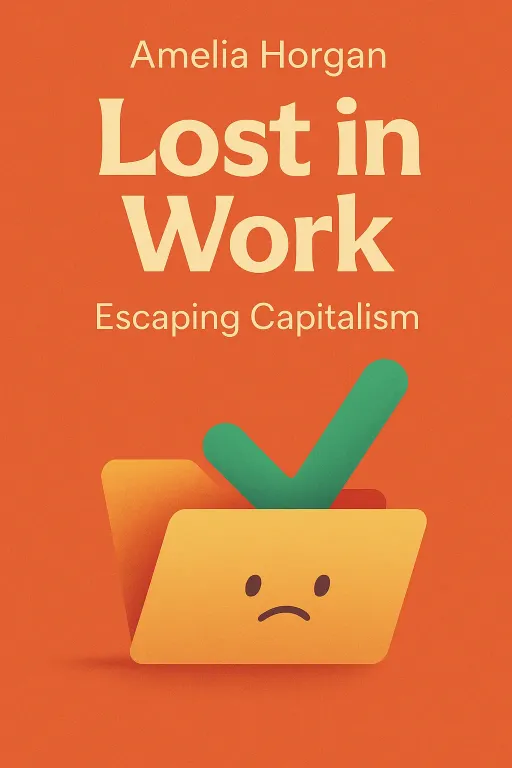
Nova: We are looking at Lost in Work by Amelia Horgan, who dissects how the modern workplace exploits our passion, and The Economic Singularity by Calum Chace, which explores how automation will soon force humanity to decouple income from traditional labor. Amelia Horgan, for context, is a writer and activist whose work is deeply rooted in the realities of the contemporary labor market. She wrote Lost in Work with a sharp, critical eye on how the promise of fulfilling work has actually become a mechanism for constant surveillance and burnout. Then you have Calum Chace, who is a technology writer and speaker. He approaches the future of work not as a distant sci-fi fantasy, but as a looming economic reality we are woefully unprepared for.
Atlas: It sounds like we are going to be talking about the past, the present, and a future where the Monday morning alarm clock might be an artifact of history. Let us start with the present. Why does it feel like our jobs are eating our lives?
The Passion Trap and Systemic Burnout
SECTION
Nova: That is the central question of Amelia Horgan’s work. She argues that we have been sold a bill of goods. We are told that if we find our passion, we will never work a day in our lives.
Atlas: That is one of those classic pieces of career advice that sounds beautiful on a coffee mug but feels like a trap when you are staring at a screen at 8:00 PM on a Tuesday.
Nova: Precisely. Horgan points out that the more we view work as an expression of our identity, the more vulnerable we become to exploitation. When you see your job as your passion, you are essentially giving your employer permission to exploit your values. If you are just a worker, you have a contract. You do the task, you get the pay, you go home. But if you are a passionate contributor, the boundaries dissolve.
Atlas: I see the logic there. If my work is my soul, then a critique of my work is a critique of my soul. That makes it incredibly difficult to say no to extra hours, or to push back on unreasonable demands. It turns every project into a personal test of character.
Nova: And that is the systemic design element Horgan highlights. Burnout is not a personal failure. It is not because you are not resilient enough or because you did not do enough yoga. It is the intended outcome of a system that relies on your emotional labor to function. Think about the way companies talk about themselves as families.
Atlas: Oh, I have heard that one. We are a family here.
Nova: Exactly. And families do not have punch clocks. Families do not ask for overtime pay. When a company uses that language, they are creating a framework where you feel guilty for setting boundaries. Horgan’s analysis is quite biting because she strips away the corporate veneer of well-being initiatives and shows them for what they often are: ways to keep the machine running without fixing the broken parts.
Atlas: So, if I am hearing you right, the burnout we feel is actually a rational response to an irrational environment. It is like the alarm going off in a house that is on fire. You do not blame the alarm for being loud.
Nova: That is a perfect analogy. The alarm is doing exactly what it was designed to do. When we try to solve burnout with personal habits, like breathing exercises or time-blocking, we are essentially trying to mute the alarm while the house is still burning. We need to look at the wiring of the house itself.
Atlas: This hits home, especially for the high-impact professionals who listen to us. They are often the ones who care the most. They are the ones who have bought into the passion narrative the hardest. If they stop caring, they feel like they are failing.
Nova: And that is the trap. The system relies on their high standards and their dedication. But Horgan suggests that reclaiming our autonomy starts with recognizing that our value as human beings is independent of our output.
The Economic Singularity and the Future of Purpose
SECTION
Atlas: Okay, so we have established that the current model of work is, for lack of a better term, a psychological hazard. But let us pivot to the future, because that is where Calum Chace comes in. If we move away from this model, what happens when the work itself starts disappearing?
Nova: That is where The Economic Singularity becomes essential. Calum Chace is looking at the rise of artificial intelligence and robotics. He argues that we are heading toward a point where machines will be able to do most of the jobs humans currently do, and they will do them more efficiently and more cheaply.
Atlas: I have read the headlines about AI replacing tasks, but it is always framed as a distant threat. Is Chace saying this is happening faster than we realize?
Nova: He is saying the transition is inevitable, and it is going to be profound. The core argument is that we need to prepare for a world where income is not tied to a job. This is the decoupling of labor and survival.
Atlas: This is the part that makes people nervous. If I do not have a job, I do not have an income. If I do not have an income, I do not have a life. How does he propose we bridge that gap?
Nova: He talks about universal basic income and other structural changes, but the more interesting part for our listeners is the psychological shift. We have spent centuries defining ourselves by what we produce. If machines produce everything, we are left with a massive existential crisis.
Atlas: That is the big one. If I am not an architect, or a strategist, or a healer, then who am I?
Nova: Chace suggests that we will need to find meaning outside of the traditional professional sphere. This is actually a massive opportunity. Think about how many people are stuck in soul-crushing roles just to pay the bills. If the necessity of that labor is removed, we are theoretically free to pursue things that are inherently valuable, rather than economically valuable.
Atlas: It sounds like a utopia, but it also sounds terrifying. We are talking about rewriting the social contract. How do we even begin to prepare for a transition that big?
Nova: It starts with intellectual and emotional preparation. Chace’s work serves as a wake-up call. He is urging us to look at our lives and ask, what would I do if I did not have to work for money? And more importantly, can I start building those foundations now?
Atlas: That is a challenging question. Most people would say they would travel, or paint, or spend time with family. But then, when they actually have a week off, they feel lost. They feel guilty for not being productive.
Nova: That is because we have been conditioned to view leisure as a reward for work, rather than a valid state of being. The transition Chace envisions requires us to move away from the idea that our worth is tied to our utility.
Atlas: This connects back to Horgan, doesn't it? If Horgan is telling us to stop letting our jobs define our identity, Chace is essentially saying the economy is going to force us to do that anyway.
Nova: Exactly. They are two sides of the same coin. Horgan is telling us to reclaim our identity from the current system, and Chace is telling us that the system is going to change anyway, so we better have an identity ready to go.
Synthesis and Practical Application
SECTION
Atlas: I like that. It feels like we are moving from defense to offense. Horgan gives us the armor to protect our identity today, and Chace gives us the map to navigate the landscape of tomorrow. But Nova, we have listeners who are in the thick of it. They have deadlines today. They have teams to manage. How do they take these big, structural, philosophical ideas and make them actionable?
Nova: The first step is to create a clear boundary between your role and your self. We often use our job title as a shorthand for our identity. When someone asks what you do, you say, I am a consultant, or I am a manager.
Atlas: And that is such a dangerous habit. It makes the job title the container for the entire self.
Nova: Right. So, here is the challenge. For the next week, I want our listeners to track their identity. Every time you feel a sense of pride or a sense of failure, ask yourself: is this coming from my work, or is this coming from my core values?
Atlas: That is a great exercise. It is essentially an identity audit.
Nova: It is. And then, the second part of the challenge is to write down three core personal values that have absolutely nothing to do with your career. These are values that would remain true even if you were on a deserted island. Maybe it is curiosity, or kindness, or a specific kind of creativity.
Atlas: I love that. It forces you to define yourself by your attributes, not your activities.
Nova: Precisely. Because if you know your values, you can bring them into your work, but you are not dependent on your work to validate them. You become a person who happens to be a strategist, rather than a strategist who happens to be a person.
Atlas: And that shift, even if it is subtle, changes everything. It changes how you handle stress. It changes how you view a setback. Because if you lose the job, you do not lose the values.
Nova: That is the core of it. We are moving toward a future where the old definitions of success are going to be obsolete. The people who are going to thrive, both now and in the future, are the ones who have cultivated an inner life that is robust enough to survive the fluctuations of the market.
Atlas: It is about building a life that is sustainable, not just profitable.
Nova: Yes. And that brings us to the deeper truth here. We are not just workers. We are human beings with a capacity for meaning that far exceeds any job description. The systems we work in might be designed to extract value from us, but they cannot extract our essence unless we give it away.
Atlas: This has been a heavy but necessary conversation. It is a reminder that we are the architects of our own meaning. We don't have to wait for the economic singularity to start living with intention.
Nova: We can start that work today. By decoupling our worth from our output, we are not just surviving the modern workplace; we are transcending it. That is the kind of professional standard that truly matters.
Atlas: I think I am going to go write down those three values right now.
Nova: That is the best possible use of your time. This is Aibrary. Congratulations on your growth!