Why Your Business Needs a System, Not Just More Effort
8 minGolden Hook & Introduction
SECTION
Nova: What if I told you that working harder, pouring every ounce of your passion into your business, and being the absolute best at what you do, might actually be the very thing holding you back from true growth and freedom?
Atlas: Whoa. Hold on, Nova. That's a pretty bold statement. I mean, isn't 'hard work and passion' the mantra for every successful entrepreneur we hear about? That feels almost counter-intuitive for anyone trying to build something great.
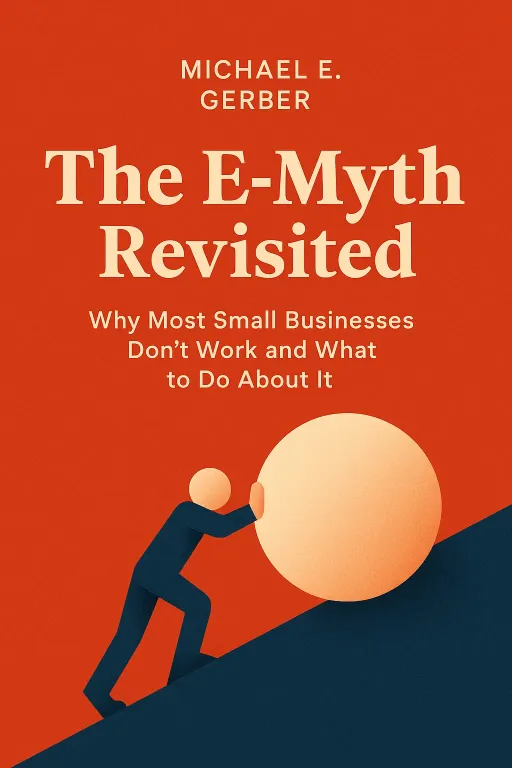
Nova: Absolutely, Atlas. It feels that way because it's what we've been conditioned to believe. But today, we're diving into a book that fundamentally challenges that notion, a book that has profoundly reshaped how millions of small business owners approach their ventures: by Michael E. Gerber. This isn't just another business book; it's a foundational text, a true classic that has sold millions of copies and defined the entrepreneurial journey for generations, pushing people to think beyond the daily grind.
Atlas: Millions, huh? That's serious impact. So, it's not about working harder, then. What's the real secret?
Nova: Well, Gerber argues that the real secret lies in understanding a fundamental trap that most entrepreneurs fall into, often unknowingly. It's what he calls the 'entrepreneurial seizure,' and it sets the stage for our first deep dive.
The Entrepreneurial Trap: From Passion to Burnout
SECTION
Nova: Think about it: most businesses aren't started by entrepreneurs in the traditional sense. They're started by technicians. Someone who loves baking decides to open a bakery. Someone who's great at graphic design starts a design studio. They have a passion, a skill, and a desire for independence.
Atlas: Yeah, that makes sense. You're good at something, you think, "I can do this for myself, be my own boss." It’s the dream, right?
Nova: Exactly. It's the dream, but it often quickly turns into a nightmare. This technician, who was brilliant at baking cakes, suddenly finds themselves drowning in paperwork, managing staff, marketing, sales, cleaning, and paying bills. They're working the business, doing all the technical work, instead of the business, designing how it operates.
Atlas: Oh, I know that feeling. I can totally imagine that baker, exhausted, covered in flour, thinking, "I just wanted to make beautiful cakes, now I'm a full-time problem solver and spreadsheet wizard." It sounds like passion becomes a blind spot.
Nova: Precisely. Gerber breaks it down into three personalities within every business owner: The Technician, who does the work; the Manager, who brings order; and the Entrepreneur, who envisions the future. The problem is, most small business owners are 70% Technician, 20% Manager, and maybe 10% Entrepreneur. They're stuck, not. They become indispensable, but also completely overwhelmed.
Atlas: So you're saying their very skill and dedication to the craft is what prevents them from growing? That's a brutal irony. For a curious learner, someone who loves mastering a skill, this is a crucial warning. How do you even begin to shift that mindset when you're the one who built it all from scratch?
Nova: It's incredibly difficult because the technician is often the best at the core service. They believe no one can do it as well as they can. And often, in the beginning, they're right! But that belief becomes a self-fulfilling prophecy, limiting growth to what one person can physically accomplish. The emotional cost is immense: burnout, frustration, and the slow death of that initial passion.
Atlas: That’s actually really sobering. It paints a vivid picture of the grind. So, if you're stuck making all the cakes yourself, metaphorically speaking, how do you free yourself from the kitchen?
Building the Unseen Engine: The Power of Systems
SECTION
Nova: That's where the idea of building comes in. It's the way out of the entrepreneurial trap. Think of it like this: instead of focusing on being the best cake-maker, you focus on building the best.
Atlas: Okay, so a "cake-making machine." That sounds like efficiency, which I get. But is this just about making things faster, or is there something deeper here?
Nova: It's profoundly deeper. It's about designing your business to run predictably and profitably your constant personal intervention. James Clear, in, talks about focusing on systems over goals. While he applies it to personal habits, the principle is identical for business. Small, consistent improvements in processes build powerful, lasting business habits.
Atlas: Ah, so it's not just about what you, but you do it, and making that 'how' repeatable. Can you give an example? Like, how does a struggling coffee shop owner apply this?
Nova: Absolutely. Take a classic example: a coffee shop owner, let's call her Sarah, who makes fantastic coffee but is swamped. She's the barista, the manager, the accountant, the marketer. Instead of just trying to pull more shots faster, she starts documenting. How to greet a customer, how to grind beans for each type of coffee, the exact recipe for a latte, how to clean the espresso machine, how to handle a complaint.
Atlas: So she's literally writing down every single step? That sounds meticulous.
Nova: It is. She's creating an 'operations manual' for her business. Each documented step becomes a system. This frees her up. When she hires a new barista, she doesn't just train them verbally; she hands them the system. The quality and consistency of the coffee no longer depend solely on Sarah's individual skill, but on the robustness of the system. This 'unseen engine' allows her to step back, train others, and eventually, open a second, then a third location, all delivering the same quality.
Atlas: Wow, that’s a perfect example. It's like she's productizing her business itself. And it makes sense why she could then focus on strategic growth, because the day-to-day is handled. But for our listeners, the curious learners who might be just starting or are in that "technician" phase, what's a tiny step they can take? Because "build a system" can sound a bit overwhelming.
Nova: That's a fantastic question, Atlas, and it directly relates to the essence of this idea. The "Tiny Step" is critical. Don't try to systemize your entire business tomorrow. Pick repetitive task you do regularly. Just one. It could be how you respond to customer emails, how you onboard a new client, or even how you organize your digital files.
Atlas: Like, literally write down the steps? As if you were explaining it to someone else who's never done it before?
Nova: Exactly that. Document the steps, make it a checklist, even record a quick video of yourself doing it. The goal isn't perfection, it's simply to externalize that process from your head. That single act is the first brick in building your unseen engine. It's the small, consistent improvement that Clear talks about, applied to your business processes.
Atlas: That makes it so much more approachable. It's not about losing the soul of your passion project, it's about giving it a framework so it can actually thrive beyond just your personal effort.
Synthesis & Takeaways
SECTION
Nova: That’s it, Atlas. The profound insight here is that you're not just building a product or offering a service; you're building a business that product or service. And the business itself needs to be designed as a product, a replicable, scalable entity. The shift in effort isn't from working hard to not working at all, it's from working the business to working the business.
Atlas: So, it's about moving from being the indispensable cog to being the ingenious architect. It’s about creating something that has its own life, its own momentum. That gives me chills, honestly, because it means your passion can truly scale without consuming you.
Nova: Precisely. It frees you not just from burnout, but for innovation, for strategic thinking, for pursuing new passions. It's about designing your business for freedom, not just for profit.
Atlas: And the first step, as we discussed, is simple: pick one repetitive task and document it. Get that process out of your head and onto paper or a screen. It’s a powerful, actionable insight for anyone who's ever felt trapped by their own success.
Nova: Absolutely. And when you do that, you're not just making your business more efficient; you're beginning to build a legacy. We'd love to hear what task you choose to systemize first. Share your insights with the Aibrary community!
Atlas: That’s a fantastic challenge. What a powerful way to redefine success.
Nova: This is Aibrary. Congratulations on your growth!