How to Build a Business That Thrives Without Constant Firefighting
8 minGolden Hook & Introduction
SECTION
Nova: Working harder may actually be the reason your business growing.
Atlas: Whoa, Nova. That's a bold statement right out of the gate! I think a lot of our listeners, especially the visionary architects and innovators out there, are probably thinking, "But I working hard, and I'm still feeling like I’m constantly putting out fires." How can working harder hinder growth?
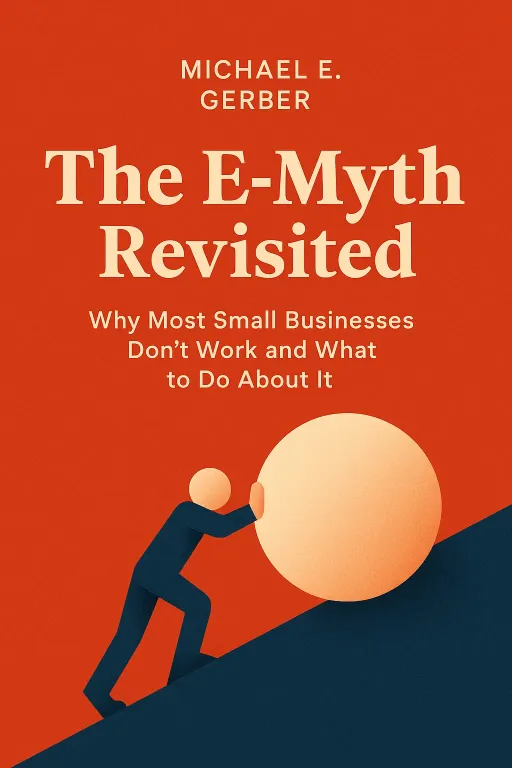
Nova: Exactly the paradox we’re diving into today, Atlas. It's about a fundamental misunderstanding of what it means to build a business. We're drawing inspiration from two foundational texts that really illuminate this: Michael E. Gerber's and John Warrillow's. Gerber, for instance, spent decades as a business consultant, observing thousands of small businesses. He saw a consistent, almost heartbreaking pattern: brilliant people, exceptional at their craft, starting businesses only to find themselves trapped, drowning in the day-to-day operations.
Atlas: And that resonates with so many of our listeners. They're amazing at what they do, whether it's designing ethical AI frameworks or building cross-cultural innovation ecosystems, but they often feel like they're stuck in the weeds, unable to truly scale their big picture vision. It's like they're building a magnificent cathedral brick by brick, but they're also mixing all the mortar themselves.
Nova: Precisely. They're working the business, not it. And that, my friend, is the founder's trap.
The E-Myth Fallacy & The Technician's Trap
SECTION
Nova: So, let's start with Gerber and this "E-Myth" – the entrepreneurial myth. The myth is that people who are brilliant at a technical skill will automatically be brilliant at running a business in that field. You're a fantastic baker, so you open a bakery. You're a genius software developer, so you start a tech company. Logical, right?
Atlas: It sounds incredibly logical! I mean, who better to lead a baking business than an incredible baker? Or a tech startup than a cutting-edge developer? It seems like a prerequisite, almost.
Nova: And that's where the myth bites you. Gerber argues that every business owner plays three distinct roles: the Technician, the Manager, and the Entrepreneur. The Technician is the doer, the one who bakes the bread or writes the code. The Manager is the organizer, the one who puts systems in place. And the Entrepreneur is the visionary, the one with the big picture, the future-oriented thinker.
Atlas: Okay, I can see that. But what's the problem? Shouldn't a good business owner be all three?
Nova: Ideally, yes, but what usually happens, especially with our visionary innovators, is that the Technician personality dominates. They're so good at the work itself, they can't let go. They get caught in an endless cycle of doing, doing, doing. They become the bottleneck. Imagine Sarah, a phenomenal architect. She starts her own design firm because she wants to build sustainable, impactful structures. She’s brilliant at design, but suddenly she's also managing invoices, hiring staff, dealing with client complaints, and trying to win new bids. She’s working 80 hours a week, and her passion for transformative design is slowly being choked out by administrative tasks.
Atlas: Oh, I know that feeling! For someone who thrives on creating and impacting humanity, the idea of stepping back from the hands-on work can feel counterintuitive, almost like abandoning their core passion. It's like, "If I'm not doing it, is it truly vision being executed?"
Nova: That's a critical point, Atlas. It's not about abandoning the craft. It's about systemizing it, designing the of the work rather than just doing every single piece of it yourself. Gerber’s radical idea is to think like a franchisor from day one. Even if you never plan to franchise, imagine you need to document every single process so clearly that someone with minimal experience could step in and execute it to your high standards.
Atlas: So, it's about seeing your business not just as "my thing," but as a blueprint for something bigger, something repeatable? A framework that allows your unique vision to scale beyond your personal capacity, without burning out the visionary architect. That makes total sense for our listeners who are expanding what's possible, but need the structure to support it.
Designing Freedom & Building a Business That Can Run Without You
SECTION
Nova: Exactly. And that blueprint thinking seamlessly leads us to our second powerful idea, from John Warrillow's. Warrillow takes Gerber's concept a step further, showing how to create a business that can genuinely run without you. His core premise is that if your business is too dependent on you, it has little value to anyone else, even if you never intend to sell it. The goal is to build a business that is an asset, not just a job you created for yourself.
Atlas: Okay, so this isn't just about selling your business; it's about creating a machine that runs itself, giving you the freedom to focus on the truly impactful, visionary parts of your role, not just the day-to-day grind.
Nova: Precisely. A key strategy Warrillow advocates is productizing your services. Instead of offering bespoke, custom-tailored solutions for every client—which ties you directly to every project—you turn your expertise into standardized, repeatable products or packages. Think of a marketing agency. One agency might offer completely custom campaigns for every client, meaning the founder is deeply involved in every strategy session. Another agency might offer three clearly defined packages: "Starter SEO," "Growth Content," and "Premium Social Media."
Atlas: I see. In the second scenario, the team can deliver those packages consistently because the process is documented, the deliverables are clear, and the founder isn't needed for every single decision. It streamlines everything. But Nova, for a "global synthesizer" who loves bespoke solutions and connecting disparate ideas across cultures, how do you productize that without losing the unique, nuanced value that makes them special? Isn't there a risk of becoming generic?
Nova: That's a brilliant question, and it's a common misconception. Productization isn't about becoming generic; it's about codifying the of delivering unique value. It frees the founder to innovate on bespoke solutions or higher-level strategy, rather than being bogged down in every detail of current delivery. It means you can offer a "Cross-Cultural Innovation Strategy Sprint" with a defined methodology, rather than starting from scratch with every client. You're still bringing your global synthesis, but you're doing it through a structured, repeatable framework.
Atlas: So it's about building the framework for innovation, not just doing the innovation yourself every single time. That's a huge mindset shift. It allows the nurturing innovator to scale their impact without personally having to be in every single meeting, every single project. It’s like building a reliable bridge so more people can cross, instead of personally ferrying each individual across the river.
Synthesis & Takeaways
SECTION
Nova: Exactly! Both Gerber and Warrillow fundamentally solve the problem of founder dependency by shifting focus from to. It’s about building a robust, resilient structure that can operate independently, allowing the visionary to truly be the architect, not just the master builder laying bricks. This is crucial for anyone driven by transformation and shaping a better future. You can’t lead with greater presence or build ethical AI frameworks if you’re constantly firefighting.
Atlas: Wow, that’s actually really inspiring. It sounds like both books are really pushing us to trust our instincts as innovators, but also to build the scaffolding so those innovations can scale without us being the bottleneck. For someone driven by transformation and shaping a better future, this is absolutely essential for wider impact. It's about creating the capacity to tackle those big, daunting challenges like conscious leadership and cross-cultural innovation ecosystems.
Nova: It is. So, for our tiny step this week, we want you to identify just one recurring task you do. It could be sending a specific email, preparing a report, or organizing your notes. Then, outline the steps for someone else to complete it. Just one task. Start building that first system.
Atlas: That's brilliant. Start small, build that muscle of designing, not just doing. It's about expanding what's possible, just like our listeners are always striving to do. It’s the first step to reclaiming your time and truly leading with greater presence.
Nova: Absolutely. Because when you design your business to thrive without constant firefighting, you're not just building a better business; you're building a better life, and ultimately, creating more space to truly shape the future.
Atlas: Incredible insights today, Nova. Thank you.
Nova: My pleasure, Atlas.
Nova: This is Aibrary. Congratulations on your growth!