

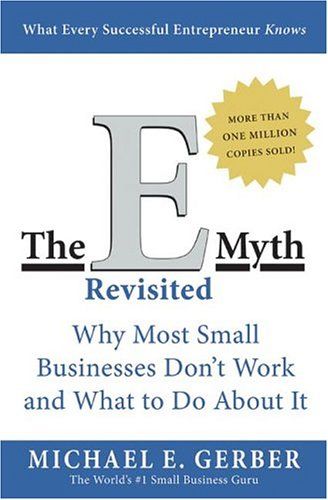
The E-myth revisited
why most small businesses don't work and what to do about it
Introduction
Nova: Did you know that about eighty percent of small businesses fail within their first five years? And of the twenty percent that survive, another eighty percent of those fail in the next five? It is a staggering statistic that keeps many aspiring entrepreneurs up at night.
Atlas: That is a brutal survival rate. It makes you wonder why anyone even tries. Is it just bad luck, or is there something fundamentally broken in how people start businesses?
Nova: According to Michael Gerber, the author of the business classic The E-Myth Revisited, it is not luck at all. It is a fundamental misunderstanding he calls the E-Myth, or the Entrepreneurial Myth. Most people who start a business are not actually entrepreneurs. They are what he calls technicians having an entrepreneurial seizure.
Atlas: An entrepreneurial seizure? That sounds painful. So, you are saying the person who opens a bakery because they love baking might be the very reason the bakery fails?
Nova: Exactly. That is the fatal assumption at the heart of the book. The belief that because you understand the technical work of a business, you understand a business that does that technical work. Today, we are diving deep into why most small businesses do not work and, more importantly, what you can do to make sure yours does.
Atlas: I am ready. If we can figure out how to beat those eighty percent odds, this is going to be a game-changer.
Key Insight 1
The Three Personalities
Nova: To understand why businesses fail, Gerber says we have to look inside the mind of the business owner. He argues that every person who goes into business is actually three people in one: The Entrepreneur, The Manager, and The Technician.
Atlas: Three people in one? That sounds like a recipe for a personality conflict. How do they differ?
Nova: They are constantly at war. The Entrepreneur is the visionary, the dreamer. They live in the future, wondering what if and how. They are the ones who see opportunities where others see problems. They crave change and control.
Atlas: Okay, so that is the person we usually think of when we hear the word entrepreneur. What about the Manager?
Nova: The Manager is the pragmatic one. They live in the past and crave order. If the Entrepreneur is the dreamer, the Manager is the one who builds the house and keeps it clean. They want to organize, plan, and create predictability. Without the Manager, there would be no planning, no order, and eventually, no business.
Atlas: And then there is the Technician. I am guessing this is the person actually doing the work?
Nova: Precisely. The Technician lives in the present. They love the feel of the tools and the satisfaction of getting things done. Their motto is if you want it done right, do it yourself. To the Technician, the Entrepreneur is a dreamer who gets in the way, and the Manager is a meddler who creates unnecessary paperwork.
Atlas: I can see the conflict. The Technician just wants to bake the pies, but the Entrepreneur wants to open ten more shops, and the Manager wants to track the cost of every ounce of flour.
Nova: You hit the nail on the head. The problem is that most small businesses are started by Technicians. They are great at the craft, so they think they should run the business. But they end up creating a job for themselves rather than a business. They become a slave to the work because they cannot let go of the technical tasks.
Atlas: So the business becomes a cage. Instead of working for a boss, they are working for a lunatic, which is themselves, trying to do all three roles at once and failing at the two they do not like.
Nova: That is exactly what happens. Gerber points out that a business run by a Technician is not a business; it is a place where the owner goes to work every day, often for less money and more stress than they had at their old job. To succeed, you have to balance all three personalities, but most importantly, you have to stop being just the Technician.
Key Insight 2
The Turn-Key Revolution
Nova: Once you realize you are trapped in the Technician role, the question is how to get out. Gerber introduces a concept he calls the Turn-Key Revolution. He points to the success of franchises, specifically the Business Format Franchise, like McDonald's.
Atlas: Wait, is he saying we should all go out and buy a McDonald's? That seems a bit extreme for someone who wants to run a boutique design firm or a local coffee shop.
Nova: Not at all. He is saying you should treat your business as if it were a prototype for a franchise. Even if you never intend to franchise it, you should build it so that it could be franchised. This is what he calls the Franchise Prototype.
Atlas: So, the idea is to build a system that is so well-defined that anyone could run it? That sounds like it might take the soul out of a small business.
Nova: That is a common concern, but Gerber argues it is actually the opposite. By creating a system, you free yourself from the mundane tasks and allow the business to provide a consistent, high-quality experience for the customer. Think about it: why is McDonald's so successful? It is not because they have the best burgers in the world.
Atlas: True. It is because no matter where you are, you know exactly what you are going to get. The fries will taste the same in Tokyo as they do in New York.
Nova: Exactly. That consistency comes from the system, not the people. In a Business Format Franchise, the system runs the business, and the people run the system. The model is designed so that it can be operated by people with the lowest possible level of skill.
Atlas: That sounds a bit harsh. Are we just replacing skilled craftsmen with robots?
Nova: It is not about devaluing people; it is about making the business independent of any one person's unique talents. If your business depends on you being a genius, you do not have a business; you have a job that ends the moment you get sick or want to take a vacation. The Franchise Prototype is about building a business that works without you.
Atlas: I see. So, the goal is to work on your business, not in it. That is a phrase I have heard a lot, but Gerber really gives it a concrete meaning here. You are building a machine, and your job as the owner is to be the engineer, not a gear in the machine.
Nova: Spot on. When you work on the business, you are looking at how the system functions. When you work in the business, you are just doing the work the system is supposed to handle. The Turn-Key Revolution is about shifting your focus from the product to the process of delivering that product.
Key Insight 3
The Business Development Process
Nova: So, how do you actually build this Franchise Prototype? Gerber outlines a three-part process: Innovation, Quantification, and Orchestration. He calls this the Business Development Process.
Atlas: Innovation, Quantification, and Orchestration. It sounds very formal. Let's break those down. Innovation first. Is that just coming up with new products?
Nova: Not necessarily. In this context, innovation is about finding better ways to do things within the business. It is about looking at the customer's experience and asking how we can make it better, faster, or more consistent. It could be as simple as changing the way you greet a customer or how you package a product.
Atlas: Okay, so it is continuous improvement. What about Quantification?
Nova: Quantification is the reality check. You have to measure everything. If you innovate a new way to greet customers, you need to quantify whether it actually increases sales or customer satisfaction. Without numbers, you are just guessing. Gerber says that everything in your business must be measured so you know exactly what is working and what is not.
Atlas: That makes sense. You can't manage what you can't measure. And the third one, Orchestration?
Nova: Orchestration is the final step. Once you have innovated a process and quantified that it works, you orchestrate it. This means you document it and make it the standard way of doing things. It becomes part of the business's operating manual. It is no longer a choice for the employees; it is the way the business functions.
Atlas: So, Orchestration is what creates that consistency we talked about with the franchise model. It turns a good idea into a permanent part of the system.
Nova: Exactly. And this process is a loop. You are constantly innovating, quantifying the results, and then orchestrating the best practices. This is how a business evolves from a chaotic mess run by a stressed-out Technician into a smooth-running machine.
Atlas: It sounds like a lot of work upfront, but I can see how it pays off. You are basically writing the script for your business so that it can perform perfectly every time, even if you are not there to direct it.
Nova: That is the ultimate goal. Gerber emphasizes that the purpose of your business is to serve your life, not the other way around. By building these systems, you are creating a business that can eventually run itself, giving you the freedom that most people are looking for when they start a business in the first place.
Case Study
Sarah and All About Pies
Nova: To make these concepts real, Gerber uses the story of a woman named Sarah throughout the book. Sarah owns a bakery called All About Pies. She started it because she loved baking, but by the time Gerber meets her, she is exhausted and hates her business.
Atlas: Poor Sarah. She fell into the Technician trap, didn't she? She just wanted to bake pies, and now she is stuck doing everything.
Nova: She is working fourteen hours a day, she is stressed, and she feels like she is failing. She tells Gerber that she doesn't even like the smell of pies anymore. Her passion has been killed by the grind of running the business without a system.
Atlas: That is so sad. It is the classic story of a hobby turned into a nightmare. How does Gerber help her?
Nova: He walks her through the process we have been discussing. He helps her see that she is not a baker who owns a business; she is a business owner who happens to sell pies. He challenges her to stop baking the pies herself and start building the system that bakes the pies.
Atlas: I bet that was hard for her. If she is a great baker, she probably thinks no one else can do it as well as she can.
Nova: That is the Technician's ego talking. Gerber shows her that if she can document her process, quantify the ingredients and the timing, and orchestrate the training, someone else can bake a pie that is just as good as hers. And more importantly, the business can bake a thousand pies without her having to touch the dough.
Atlas: It is a total shift in identity. She has to stop seeing herself as the creator and start seeing herself as the architect.
Nova: Exactly. By the end of the book, Sarah begins to see the light. She realizes that by building the system, she is actually honoring her love for baking more than she was when she was doing it all herself. Now, her vision for the perfect pie can be shared with more people, and she can have her life back.
Atlas: It is a powerful transformation. It shows that the E-Myth isn't just about business strategy; it is about personal freedom and changing your relationship with work.
Conclusion
Nova: We have covered a lot today. From the three personalities of the business owner to the Turn-Key Revolution and the Business Development Process. The core message of The E-Myth Revisited is simple but profound: your business is not your work; your business is a tool to help you live the life you want.
Atlas: It is a real wake-up call for anyone who thinks that being good at a job is enough to run a business. You have to be willing to step back, look at the big picture, and build the systems that allow the business to thrive independently of you.
Nova: If you are a business owner or thinking about starting one, ask yourself: am I working on my business or in it? Am I building a system or just creating a job for myself? The answer to those questions will determine whether you end up in that eighty percent failure rate or the twenty percent that truly succeed.
Atlas: It is about moving from the chaos of the Technician to the vision of the Entrepreneur and the order of the Manager. It is not easy, but as Sarah's story shows, it is the only way to find true success and freedom.
Nova: Thank you for joining us on this deep dive into Michael Gerber's classic. We hope these insights help you transform your business and your life.
Atlas: This is Aibrary. Congratulations on your growth!