

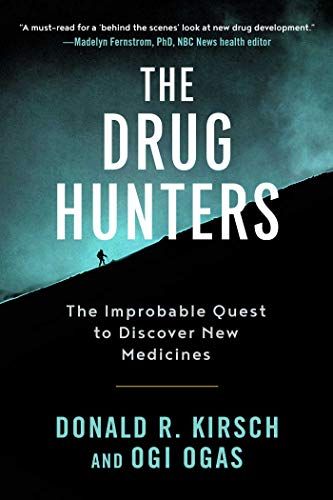
The Drug Hunters
The Improbable Quest to Discover New Medicines
Introduction
Nova: Welcome to Aibrary. I'm Nova, and today we're diving into a book that completely reframes how you think about every pill in your medicine cabinet. It's called The Drug Hunters by Donald R. Kirsch and Ogi Ogas. And here's the opening fact that stopped me cold: if you're a scientist working in drug discovery, your chance of actually producing an FDA-approved medicine in your entire career is about one tenth of one percent.
Nova: : Wait, hold on. One tenth of one percent? That can't be right. We have thousands of drugs on the market. Someone must be succeeding.
Nova: That's exactly the paradox. We have aspirin, penicillin, insulin, Prozac, the birth control pill. But here's what Kirsch reveals: only about five percent of a scientist's ideas for a drug project ever get funded. And of those funded projects, only two percent end up producing an FDA-approved medicine. Multiply those together and you get that brutal one-tenth-of-one-percent success rate.
Nova: : So you're telling me that for every thousand drug ideas a scientist has, maybe one becomes an actual medicine? That's worse odds than getting into Harvard.
Nova: Much worse. And Kirsch would know. He spent thirty-five years as a drug hunter at companies like Bristol-Myers Squibb, Wyeth, and Cambria Pharmaceuticals. He holds two dozen drug-related patents. He's lived this reality. And he wrote this book to answer three questions he kept getting at cocktail parties: why are drugs so expensive, why do they have side effects, and why isn't there a drug for every disease?
Nova: : Those are the questions everyone asks. So what's the short answer?
Nova: The short answer is that drugs are discovered, not engineered. Unlike building a bridge or sending a rocket to the moon, there are no equations, no formulas, no scientific laws that can guide you from an idea to a working medicine. Kirsch says it's more like making a Hollywood movie than designing a car. You can assemble the best talent, spend hundreds of millions of dollars, and still produce a flop.
Nova: : That's both humbling and kind of terrifying. Let's get into this.
How Our Ancestors Stumbled Into Pharmacy
The Iceman's Medicine Kit
Nova: The book opens with an incredible story. In 1991, hikers in the Ötztal Alps between Italy and Austria found a frozen corpse. This was Ötzi the Iceman, a man who died around 3300 BC, more than five thousand years ago. When scientists thawed him out, they found his intestines were infested with whipworms, a painful parasite. But attached to his bearskin leggings were two hide strips, each knotted around a rubbery white lump.
Nova: : Let me guess, those lumps turned out to be something medicinal?
Nova: Exactly. They were fruiting bodies of the birch polypore fungus, which contains oils toxic to whipworms, along with antibiotic and anti-hemorrhaging properties. Kirsch calls this the oldest medicine kit ever found. And here's the key point: Ötzi didn't engineer this remedy. No Stone Age genius designed it. It was discovered through sheer trial and error, probably over generations of people chewing on things and sometimes dying, sometimes getting better.
Nova: : So the very first drug hunters were just brave or desperate people sampling the natural world?
Nova: That's right. Kirsch writes that in the deep mists of prehistory, everybody was a drug hunter. Our parasite-infested, malady-ridden ancestors chewed every new root and leaf they chanced upon, hoping for some benefit and praying they didn't perish. Through sheer serendipity, some stumbled upon opium, alcohol, juniper, frankincense, cumin, and snakeroot.
Nova: : And opium is where the book really digs in, right?
Nova: Yes. The Sumerians were cultivating opium poppies by 3400 BC. They called it the joy plant. The extraction method was dead simple: you score the poppy pod, let the milky sap ooze out and dry, then scrape it off. That simplicity is why opium spread across civilizations for millennia. Then in 1806, a German pharmacist named Friedrich Serturner isolated morphine from opium, the first time anyone had purified a single active compound from a plant.
Nova: : That must have been revolutionary.
Nova: It was, but it also set up one of the great ironies in drug history. Morphine was more potent and more addictive than raw opium. Then in the late 1890s, Bayer Pharmaceuticals, trying to create a non-addictive version of morphine, synthesized diacetylmorphine. They branded it Heroin because it made patients feel heroic. They marketed it as a cough suppressant for children.
Nova: : Oh no. That did not age well.
Nova: It gets even more ironic. At the exact same time, Bayer's head of pharmacological research, Heinrich Dreser, had to choose between funding two new compounds. He picked heroin. The rejected compound was acetylsalicylic acid. The head chemist, Arthur Eichengrün, believed in it so strongly that he secretly arranged human clinical trials behind Dreser's back. That rejected compound became Aspirin.
Nova: : So Bayer bet on heroin and almost killed aspirin before it was born? That's an incredible story.
Nova: And it perfectly illustrates Kirsch's central argument: drug discovery is not a rational, predictable process. It's a messy human endeavor full of misjudgments, lucky breaks, and sheer persistence.
Why Luck Matters More Than You Think
The Four G's of Drug Hunting
Nova: One of the most memorable frameworks in the book comes from Paul Ehrlich, the German immunologist who won the Nobel Prize in 1908. Ehrlich discovered Salvarsan, the first synthetic drug ever created from scratch and the first effective cure for syphilis. He said that to succeed in drug discovery, you need four G's.
Nova: : Four G's. Let me guess, one of them is genius?
Nova: Close. Geschick, which means smarts or ingenuity. Geduld, patience. Geld, money. And the fourth one is the kicker: Glück. Luck.
Nova: : Luck is officially one of the four pillars of drug discovery?
Nova: According to one of the greatest drug hunters in history, yes. And Kirsch says that a hundred and ten years later, nothing has changed. You still need all four. Ehrlich himself embodied this. He was studying synthetic dyes and noticed that certain dyes would stain specific types of cells but not others. That gave him the idea of a magic bullet, a chemical that would selectively target a pathogen without harming the patient.
Nova: : So he basically invented the concept of targeted therapy?
Nova: Exactly. He screened hundreds of dye derivatives, systematically modifying arsenic compounds to find one that would bind to the syphilis-causing bacterium but not to human cells. Compound number 606 finally worked. Salvarsan. It was the first time anyone had rationally designed a drug rather than just stumbling upon it. But even Ehrlich's rational approach required screening hundreds of compounds, one by one, hoping to get lucky.
Nova: : And that screening approach is still the backbone of drug discovery today?
Nova: It is. Kirsch describes modern drug hunters as being like the librarians in Jorge Luis Borges's short story The Library of Babel. In that story, the universe is an infinite library filled with books containing random letters. Once in a while, purely by chance, a book contains a readable sentence. The librarians wander endlessly hoping to find these vindications. Kirsch says the chemical universe contains roughly three times ten to the sixty-second power possible drug compounds. That's a three followed by sixty-two zeros.
Nova: : I can't even visualize that number.
Nova: Nobody can. Kirsch puts it this way: if you tested a thousand compounds every second for a cure for breast cancer, by the time our sun burned out you still wouldn't have made a measurable dent. The vast majority of drug hunters spend their entire careers groping through this labyrinth without ever finding a compound that safely and effectively improves human health.
Nova: : That's existentially bleak.
Nova: It is, but it also explains why drugs cost an average of one and a half billion dollars and fourteen years to develop. You're paying not just for the one success but for all the failures. And Kirsch reveals that executives at Pfizer have told him they're thinking about getting out of drug discovery entirely. They'd rather just buy drugs that other people have already invented.
Nova: : The largest drug company in the world wants to quit the actual discovery business? That says everything.
The Golden Age of Antibiotics and Its Collapse
From Dirt to Blockbusters
Nova: Let's talk about one of the most dramatic chapters in the book: the rise and fall of antibiotic discovery. It starts, of course, with Alexander Fleming in 1928, who noticed that a mold contaminating one of his petri dishes was killing the bacteria around it. That mold produced penicillin.
Nova: : The classic accidental discovery story.
Nova: Right, but Kirsch emphasizes that Fleming's discovery sat on a shelf for over a decade. It wasn't until World War II that a team at Oxford, led by Howard Florey and Ernst Chain, figured out how to mass-produce penicillin. By D-Day in 1944, Allied forces had enough penicillin to treat every wounded soldier. Before penicillin, more soldiers died from infected wounds than from bullets.
Nova: : That's a staggering fact.
Nova: Then in 1943, Selman Waksman and his graduate student Albert Schatz discovered streptomycin from soil bacteria, the first drug that could cure tuberculosis. This opened the floodgates. Pharmaceutical companies started what Kirsch calls the golden era of antibiotic research. They screened soil samples from all over the world. Companies even instituted soil days: employees who brought back soil samples from exotic vacation spots got an extra day off.
Nova: : Wait, soil days? That was an actual corporate policy?
Nova: Kirsch did it himself. He describes hiking along an alpine lake in Switzerland, scooping up what looked like interesting powdery white sand. He brought it through customs with a special permit, hoping it might yield a novel treatment for AIDS-related infections. He got through customs, rushed to the lab, and the samples produced absolutely nothing. Zero.
Nova: : But sometimes it worked, right?
Nova: Sometimes spectacularly. In the mid-1980s, a Lederle Labs scientist took a chalky soil sample from the calichi pits near Kerrville, Texas. From that dirt, researchers isolated a bacterium that produced calicheamicin, one of the most potent antitumor compounds ever discovered. Just a couple of molecules could kill a cancer cell. The problem was, a couple of molecules could also kill a normal cell. It took another decade to figure out how to attach it to a monoclonal antibody that would deliver it selectively to cancer cells.
Nova: : So they turned it into a guided missile.
Nova: Exactly, fulfilling Ehrlich's magic bullet vision a century later. The resulting drug, Mylotarg, was approved for acute myeloid leukemia. But here's the sobering part Kirsch emphasizes: by the 1980s, new antibiotics were getting harder and harder to find. Most pharmaceutical companies abandoned antibiotic research entirely. Kirsch shares a factoid he finds astonishing: in recent years, more Americans have died from bacterial infections that were previously easily treated than died from AIDS.
Nova: : That's terrifying. Why would companies abandon antibiotics if we need them so badly?
Nova: Economics. Antibiotics are taken for a short course, maybe ten days, and then you stop. Compare that to a cholesterol drug like Lipitor that patients take every day for decades. The financial incentive just isn't there. Kirsch says he's one of the youngest people ever to have participated in a full-blown antibiotic discovery program, and he's in his late sixties. We are running out of antibiotics not because scientists are too stupid to discover them, but because the economic model is broken.
How Accidents Changed Modern Medicine
The Serendipity Era
Nova: One of the most entertaining sections of the book covers what you might call the golden age of pharmaceutical accidents. Kirsch devotes an entire chapter to mystery cures, drugs discovered while scientists were looking for something completely different.
Nova: : Like Viagra, I'm guessing?
Nova: That's the most famous example, but the book goes deeper. Take chlorpromazine, the first effective antipsychotic. In the 1950s, a French naval surgeon named Henri Laborit was searching for a better surgical anesthetic. He tried a compound called chlorpromazine and noticed it made patients strangely indifferent to their surroundings without putting them to sleep. He suggested psychiatrists try it on their patients. It revolutionized the treatment of schizophrenia.
Nova: : So an anesthesiologist accidentally discovered the first antipsychotic?
Nova: Exactly. Then there's imipramine, the forerunner to drugs like Prozac. It was being tested on schizophrenic patients and failed completely. It didn't help their psychosis at all. But a Swiss psychiatrist named Roland Kuhn noticed something odd: the patients who were also depressed seemed to cheer up. On a whim, he decided to test it specifically on depressed patients. It became the first tricyclic antidepressant.
Nova: : Both of those discoveries were basically wrong turns that happened to lead somewhere useful.
Nova: And Kirsch argues this isn't the exception, it's the rule. He writes that the vast majority of his colleagues, all educated at top research universities and working at posh laboratories with high-tech gear, have spent their entire careers without ever finding a new compound that safely and effectively improves human health. The only sure thing in drug hunting is that you almost never end up with the exact drug you started stalking.
Nova: : That must be incredibly frustrating for the scientists.
Nova: It is. But it also produced some of our most important medicines. The birth control pill, which Kirsch devotes a full chapter to, came from wild Mexican yams. A chemist named Russell Marker figured out how to extract diosgenin from these yams and convert it into progesterone. He literally went to Mexico, dug up yams himself, and set up a makeshift lab. The pharmaceutical establishment thought he was crazy.
Nova: : But he wasn't.
Nova: He wasn't. His work led directly to the development of the oral contraceptive. And here's the thing Kirsch keeps coming back to: despite all our advances in genomics, molecular biology, and computational chemistry, the fundamental process of drug discovery hasn't changed that much. It's still screening enormous numbers of compounds, hoping for a hit. It's still trial and error. It's still, as Ehrlich said, the four G's.
Nova: : So we've sequenced the human genome, we have artificial intelligence, we have CRISPR, and we're still basically doing what Ötzi the Iceman did?
Nova: In a fundamental sense, yes. Kirsch acknowledges that the tools are vastly more sophisticated. When he started in pharmacology in 1978, for most drugs on the market, nobody knew the molecular definition of the receptor they acted on. Today, every receptor has been cloned, there's an assay for it, and you can profile drugs with incredible precision. But the core challenge remains: you still can't predict how a given chemical compound will interact with a living human body. The human body is not a closed, well-defined system like a rocket. It's an open, unfathomably arcane molecular system, and each person's body operates slightly differently.
Nova: : That's both awe-inspiring and humbling.
Conclusion
Nova: So let's pull this together. The Drug Hunters takes us on a journey from Ötzi's birch fungus to the high-tech labs of modern pharmaceutical giants, and the message is remarkably consistent: drug discovery is an art, not a science. It requires ingenuity, patience, money, and a tremendous dose of luck.
Nova: : And the book really drives home why that matters for all of us. It explains why drugs are so expensive: you're paying for the ninety-nine point nine percent of projects that fail. It explains why drugs have side effects: they're discovered compounds, not perfectly engineered solutions. And it explains why we don't have a drug for every disease: the chemical universe is so vast that finding the right molecule is like finding a specific grain of sand on every beach on Earth.
Nova: Exactly. Kirsch ends the book with a simple line that summarizes the entire history of drug hunting: it's better to be lucky than smart. But he also leaves us with a note of hope. Despite the daunting odds, drug hunters keep searching. Some, through unwavering resolution or outrageous fortune, through individual genius or far-flung collaborations, do stumble upon their vindications.
Nova: : And when they do, it changes the world. Penicillin, insulin, the birth control pill, antiretrovirals for HIV. These aren't just medicines. They're civilization-altering discoveries.
Nova: The next time you take an aspirin for a headache or an antibiotic for an infection, remember the story behind it. Remember the centuries of trial and error, the careers spent in frustration, the lucky accidents, the soil samples from alpine lakes and Texas dirt pits, the rejected compounds that someone believed in anyway. Behind every pill is an improbable quest.
Nova: : That's a beautiful way to think about it. The Drug Hunters by Donald R. Kirsch and Ogi Ogas. It's a colorful, fact-filled narrative that will forever change how you look at your medicine cabinet.
Nova: This is Aibrary. Congratulations on your growth!